Why Choose an Automotive Thermal Car Camera for Safer Driving?
An automotive thermal car camera is one of the most consequential safety investments a fleet operator or vehicle integrator can make today. Unlike conventional dash cams or infrared cameras that depend on visible or near-infrared light, a thermal car camera detects heat signatures emitted by people, animals, and vehicles — operating effectively in complete darkness, dense fog, heavy rain, and blinding glare. For B2B procurement professionals evaluating next-generation driver assistance technology, understanding why this sensor category outperforms legacy options is the critical starting point.
What Is an Automotive Thermal Car Camera and Why Does It Matter?
The Core Technology Behind Thermal Imaging for Vehicles
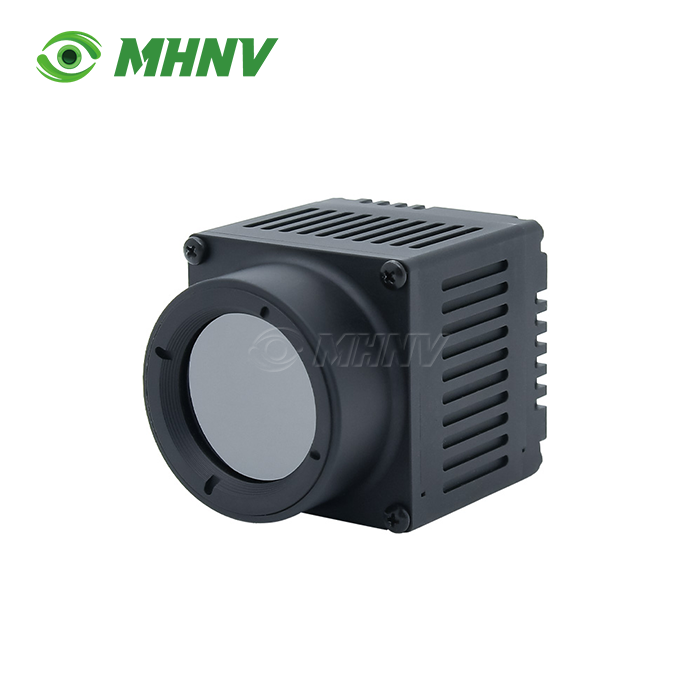
The MHNV® Automotive Thermal Car Camera has a Vanadium Oxide (VOx) microbolometer that works in the 8–14 μm long-wave infrared (LWIR) spectrum and is not cooled. Since this inactive sensor only picks up radiated heat and not reflected light, its output is never affected by light or darkness. With a thermal sensitivity (NETD) of ≤40 mK at f/1.0, the camera can tell the difference between small temperature changes. At distances of more than 150 meters, it can tell the difference between a person wearing dark clothes and a scene that is also dark.
This Automotive Thermal Car Camera is made for cars and comes in two sizes: 384x288 pixels and 640x512 pixels. It has a spatial resolution of 1.32 mrad and a frame rate of 25 Hz or 50 Hz, which are very important when things are moving at highway speeds. The effective focal length of 9.1 mm F#1.0 gives you a field of view of either 28°×21° or 45°×37°, which means you can use it for both narrow highway scanning and wide coverage of urban intersections.
Why Heat-Based Detection Changes the Safety Equation
The National Highway Traffic Safety Administration (NHTSA) says that about 49% of fatal pedestrian accidents happen at night. Standard headlights only shine on the road ahead for 50 to 75 meters, which means that a driver going 100 km/h has less than three seconds to respond. The MHNV® Automotive Thermal Car Camera can see people and cars 80 to 150 meters away and 100 to 200 meters away. It gives 5 to 8 seconds of early warning, which can make the difference between a close call and a death.
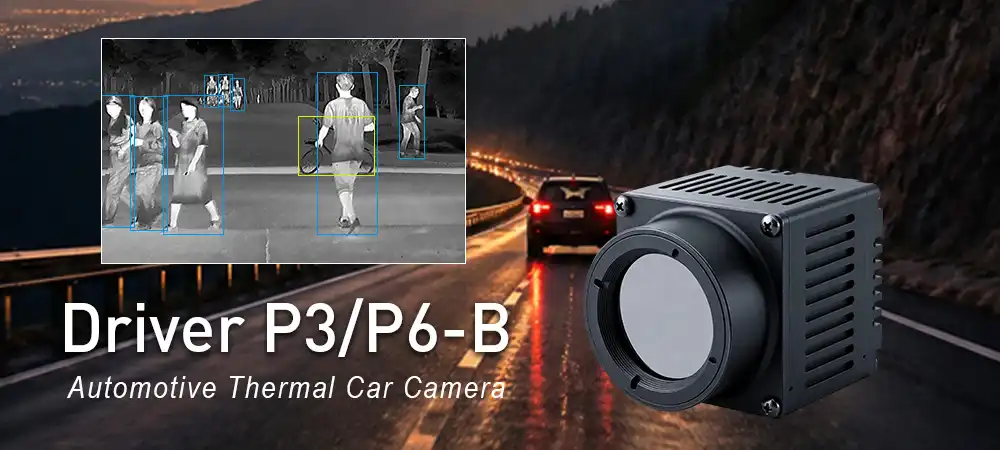
Thermal Cameras vs. Traditional Vehicle Cameras: A Technical Comparison
Why Conventional Cameras Fall Short at Night
CMOS backup thermal night driving cameras and standard RGB dash cams only use visible light. A low signal-to-noise ratio makes it hard for even AI-powered picture processing to work when there isn't enough light in the room. Near-infrared cameras work better in low light, but they can still be damaged by the "dazzle effect," which is when high-beam headlights hit the sensor too much and temporarily blind it.
Both of these problems can't happen with an Automotive Thermal Car Camera. It reads radiation that is sent out, not photons that are reflected, so headlight glare or complete darkness doesn't change the quality of the picture.
Resolution, Accuracy, and ADAS Integration
A higher sensor resolution directly leads to more reliable detection. The 640x512 version has a lot more pixels on a pedestrian target at 150 m than the base 160x120 sensor. This lets AI classification algorithms get the >95% accuracy needed for reliable Forward Collision Warning (FCW) and Autonomous Emergency Braking (AEB) integration.
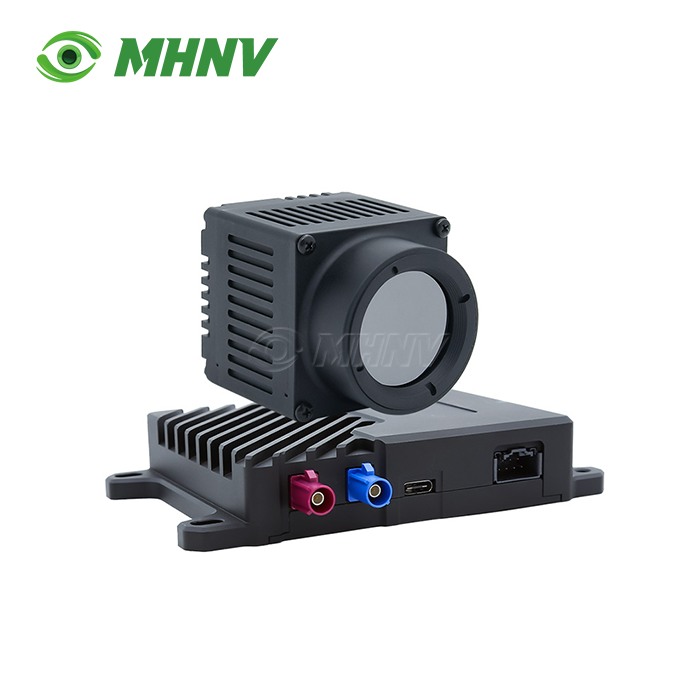
The MHNV® Automotive Thermal Car Camera sends out analog CVBS video through RCA and communicates via USB Type-C. This makes it easy to add to current car safety architectures along with radar and LiDAR without causing electromagnetic interference.
Selecting the Right Automotive Thermal Car Camera for Your Fleet
To choose an Automotive Thermal Car Camera option for fleet rollout, you need to make sure that the technology requirements match the needs of the operation. Here are the main requirements that experienced procurement engineers put most weight on:
- Detector & Sensitivity: A VOx microbolometer that isn't cooled and has a NETD of ≤40 mK makes sure that targets can be reliably distinguished even in tough environmental conditions. This is especially important on country roads where temperature differences aren't very big.
- Resolution Options: 384x288 is good for low-cost passenger vehicle deployments; 640x512 is best for industrial trucks and supply vehicles that need to be able to identify pedestrians at 150–200 m.
- Frame Rate: A 50 Hz output keeps motion blur to a minimum for subjects that are moving quickly, allowing real-time AEB decision loops with little processing latency.
- Detection Range: Action distances of 80 m for pedestrians and 100 m for vehicles at 384×288 pixels, increasing to 150 m and 200 m, respectively, at 640×512 pixels, allow for measurement of fleet risk reduction metrics for safety reports.
- Durability & Compliance: Offering IP67 protection against water and dust, a storage temperature range of -40°C to +85°C, AEC-Q100 approval, and ISO 26262 (ASIL-B) functional safety compliance, this product is reliable enough for 24/7 use in vehicle settings.
These factors show if an Thermal Night Driving Camera seller meets both the technical and liability standards that fleet safety managers and OEM installers need.
Installation, Maintenance, and Long-Term Reliability
The MHNV® Automotive Thermal Car Camera sends out either PAL (720x576) or NTSC (720x480) analog video through standard CVBS. This means that it can be easily connected to existing in-cab monitors or DVR systems without the need for any extra hardware. The USB Type-C port lets you change the system and read diagnostic data without using special software.
For business-to-business buyers in charge of large-scale deployments, MHNV® offers full export paperwork, including a commercial invoice, a packing list, and CE/RoHS certificates. It also helps with shipping through DHL, FedEx, and UPS, and offers worldwide delivery in 5–8 days on average. Through Shanghai and Shenzhen ports, MHNV®'s sea and air freight partnerships can help OEMs with large orders.
Each unit goes through a strict quality control process that includes thermal cycling (from -40°C to +85°C) according to ISO 16750-4, mechanical vibration and shock testing according to ISO 16750-3, high-pressure water jet testing to IP69K, NETD and gain uniformity calibration, and EMC testing according to CISPR 25. This means that every Automotive Thermal Car Camera that is shipped works the same and meets the interference levels that current car ECU environments need.
Real-World Safety Impact: What the Data Shows
In controlled tests, the Traffic21 Institute at Carnegie Mellon University found that thermal imaging sensors find pedestrian hazards at night at rates two to three times higher than visible-light camera systems. Commercial trucking has a lot of insurance claims related to animal strikes and pedestrian accidents at night. Using an Automotive Thermal Car Camera safety system can help reduce the number of accidents and the amount of risk that the company is exposed to.
The MHNV® Automotive Thermal Car Camera supports ADAS pedestrian detection (PD) and FCW functions with over 95% classification accuracy, which lets you send out alerts before a collision happens instead of after the fact. Since passive sensing means that the camera doesn't send any signals, it can work well with radar and LiDAR in multi-sensor fusion designs without interfering with other safety systems.
Conclusion
Automotive thermal car cameras are useful for fleet and OEM use because they use science that can be measured and safety data that has been proven to be accurate. Heat-based recognition closes the gaps in vision that kill people while driving at night, in bad weather, or when there is glare. The MHNV® Automotive Thermal Car Camera has a ≤40 mK NETD, a 640x512 resolution, a 50 Hz frame rate, IP67 protection, and ISO 26262 compliance. It is a technically sound solution that is ready to be bought. Distributors, system developers, and fleet operators looking for a trusted Automotive Thermal Car Camera supplier can count on MHNV®. They have been making OEM and ODM products for over ten years and can handle any order.
FAQ
1. Can a thermal car camera see through automotive glass?
Normal auto glass doesn't let LWIR radiation through. To keep the full spectral response, the Automotive Thermal Car Camera needs to be placed on the outside or behind a special germanium window.
2. How does resolution affect pedestrian detection range?
The 640x512 Automotive Thermal Car Camera puts more pixels on an object that is far away, which lets AI classify things up to 150–200 m away. The 384x288 version reliably finds objects at 80 to 150 m, making it good for lighter-duty or low-cost operations.
3. Does the MHNV® thermal vehicle camera require manual calibration?
During production, internal gain consistency testing is done. Under normal conditions of use, routine field recalibration is not needed.
4. What protection rating does this camera carry?
The unit has an IP67 grade and was tested to IP69K standards, which means it can withstand being submerged in water and high-pressure water jets.
5. What warranty does MHNV® provide?
Complete devices sold by MHNV® come with a standard 1-year manufacturer guarantee, and pre-sales expert help is available 24 hours a day, 7 days a week, no matter what time zone you're in.
Partner with MHNV® for Your Thermal Imaging Procurement
Since 2013, MHNV® has been a dependable Automotive Thermal Car Camera maker, serving distributors and OEM installers in more than 60 countries. Our automotive thermal car cameras are approved by ISO 9001:2015, CE/RoHS, and are built to meet ISO 26262 (ASIL-B) safety standards. Pilot orders start at one unit. If you want to know more about volume pricing and OEM customization, please let us know. You can email our team at sarah@mh-elec.com to get details, samples, or a group quote.
References
1. National Highway Traffic Safety Administration (NHTSA). Traffic Safety Facts: Pedestrians. U.S. Department of Transportation, 2022.
2. Carnegie Mellon University Traffic21 Institute. Sensor Fusion for Autonomous Vehicle Perception in Low-Visibility Conditions. 2021.
3. ISO. ISO 16750-3: Road Vehicles — Environmental Conditions and Testing for Electrical and Electronic Equipment — Part 3: Mechanical Loads. International Organization for Standardization, 2023.
4. ISO. ISO 26262: Road Vehicles — Functional Safety. International Organization for Standardization, 2018.
5. Society of Automotive Engineers (SAE). Thermal Imaging for Advanced Driver Assistance Systems: Performance Benchmarking. SAE International Journal of Advances and Current Practices in Mobility, 2020.
6. FLIR Systems. The Role of Thermal Imaging in Automotive Safety and ADAS Integration. FLIR White Paper Series, 2021.
YOU MAY LIKE