Gen 2 Image Intensifier OEM: Custom Options for Buyers
If you're sourcing night vision components for your product line, understanding what a qualified Gen 2 image intensifier OEM can actually deliver matters more than any sales pitch. A Gen 2 image intensifier uses a microchannel plate (MCP) to multiply electrons and amplify ambient light up to 30,000×, producing clear imagery in near-total darkness. Compared to Gen 1 devices, the Gen 2 image intensifier offers dramatically better resolution, lower distortion, and a longer operational lifespan—making it the preferred choice for distributors, system integrators, and OEM buyers across defense, security, and industrial sectors globally.
Customization Options Offered by Gen 2 Image Intensifier OEMs
When you choose a good OEM provider, you get real technical freedom, not just the ability to swap out catalog items. Reliable Gen 2 Image Intensifier makers let you customize the tubes in a way that has a direct effect on how well the final product works and how well it fits in.
Here are the main technical specs that can be changed by an image intensifier tubes seller with the right tools:
- Photocathode material and sensitivity grade: Na₂KSb(Cs) multialkali photocathode with luminous sensitivity adjustable at 550, 650, or 750 μA/lm (Grade A rating), allowing light-gathering to be optimized for each application.
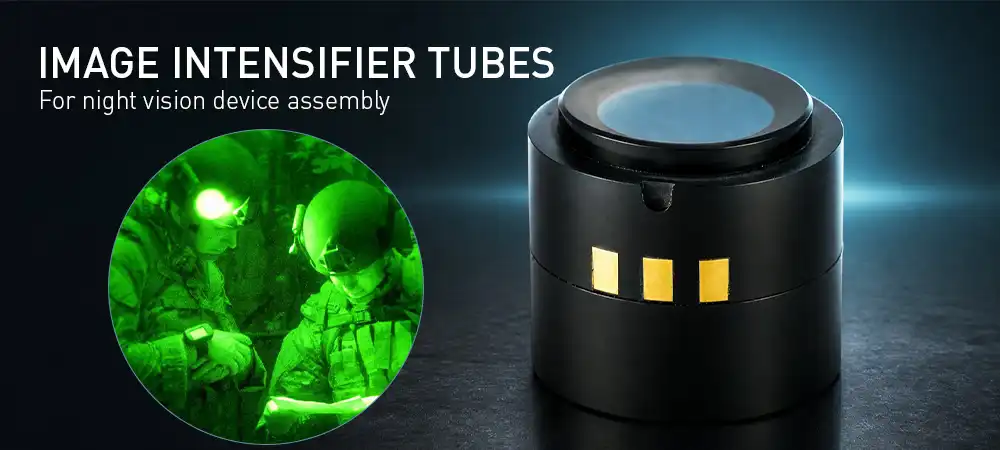
- Output window configuration: Buyers can choose from inverting spherical (SR40), inverting flat, non-inverting spherical (SR40), or non-inverting flat fiber-optic output windows. This is important for mechanical fitting into special housings.
- Phosphor selection: P43 (green) or P45 (white/black) phosphor powder choices meet the needs of different markets, such as the white-phosphor setups that are popular in tactical markets in the US and EU.
- Resolution and SNR tier: With resolution grades of 60 or 64 lp/mm and SNR levels of 20, 22, or 25, buying teams can find the best deal without going over budget.
- Environmental tolerance: Operating temperatures between -45°C and +55°C and storage stability between -55°C and +70°C cover activities in the arctic and the desert.
- Weight envelope: A 75-gram tube mass supports both helmet-mount and weapon-mount form factors without making it harder for the operator to move around.
These factors directly affect how different a product is from others in the same market. For example, a US distributor that sells to law enforcement might ask for white phosphor with 64 lp/mm resolution, SNR 25, and a flat output that doesn't flip. In the Middle East, a surveillance OEM might ask for green phosphor with a spherical output and 650 μA/lm photocathode sensitivity. Working with an experienced Gen 2 Image Intensifier OEM instead of a regular reseller is the best way to get this level of control.
The auto-gating power supply module, which is built right into the tube assembly and works on a 2.2–3.4 V input, keeps the resolution constant without any help from the user as the light level changes from deep dark to bright ambient light. That one feature keeps the photocathode from breaking down a lot over the tube's useful life.
How to Choose the Right Gen 2 Image Intensifier OEM Supplier
Not every company that sells a Gen 2 Image Intensifier tube has the production facilities to back up the information on their datasheets. If you want to find a reliable OEM partner, you should look at their qualifications instead of their marketing words.
Certifications and Quality Traceability
An honest company that makes Image Intensifier Tubes follows ISO 9001:2015 quality management and includes a serialized QC data sheet with each tube that confirms the SNR, Figure of Merit (FOM), resolution, halo diameter, and EBI. Products meant for sale in the US or EU should have paperwork showing that they comply with CE and RoHS rules. The standard for defense and law enforcement processors is ArcticD-810 environmental grading, which includes shock, vibration, humidity, and pressure.
Manufacturing Depth and Customization Flexibility
Suppliers who do their own photocathode casting, MCP integration, and vacuum closing have better control over specs than those who use tubes from outside sources. Directly ask possible providers about how to classify a cleanroom, how to use vacuum processing tools, and how to test photocathode uniformity. It's also a good idea to check the MOQ flexibility early on. A supplier that can handle test orders starting at 10 pieces for IIT and ramping up to mass production within 30 to 45 days shows real manufacturing speed.
Procurement Strategies for Buying Gen 2 Image Intensifiers
Getting a Gen 2 Image Intensifier quickly and easily starts with having clear specifications. Before you ask for quotes, you should send a detailed technical brief that includes the resolution level, photocathode sensitivity grade, output window type, phosphor preference, and environmental requirements. This cuts down on emailing back and forth and speeds up the sample approval process.
When buyers combine several SKUs into a single framework deal, they have more power in talks for bulk purchases. Logistics lead times can be cut down by a lot if the supplier has warehouses in both Asia and close to North American or European distribution hubs. Door-to-door delivery in 5–8 business days is possible for verified exporters who work with DHL, FedEx, and UPS on framework rates. This is important for distributors who are trying to keep their inventory levels low. Regulatory compliance paperwork, like Commercial Invoices, CO certificates, CE/RoHS certificates, and End-User Statements, should be taken care of by the seller as normal export practice, not as an extra service.
Maintenance and Long-Term Performance Optimization
Under normal conditions, a Gen 2 Image Intensifier tube that was made by a professional will work for 10,000 to 15,000 hours. To get to that ceiling, system integrators need to be good at maintaining their systems.
Dry nitrogen or approved optical tissue is the only thing that should be used to clean the lens surfaces. Seals don't break down when they are stored in humidity-controlled areas below 60% RH. Quality tubes have an auto-gating circuit that handles sudden changes in brightness automatically. However, leaving them in direct sunlight for a long time without any protective caps on is still the main reason why the photocathode dies too soon. When SNR readings fall more than 15% below the original certified value, the most cost-effective way to figure out what's wrong is to compare them to a reference tube.
Upgrading from a standard Gen 2 architecture to a Gen 2+ architecture, which has a higher-efficiency MCP and better Na₂KSb(Cs) photocathode uniformity, gives buyers a good return on investment (ROI) when their applications need to work faster or in warmer environments where EBI creep becomes a real performance problem.
Conclusion
The Gen 2 Image Intensifier still holds a strategically important place in the night vision market, thanks to its well-proven performance, low cost, and wide range of customization options. For OEM buyers and wholesalers, the real competitive edge is not in the tube itself, but in their relationship with the provider, which determines how flexible the specifications can be, how easy it is to track the quality, and how reliable the supply chain is. If you choose a company that does its own vacuum electronics research and development, safe production, and has proof of international compliance, you can be sure that the Gen 2 Image Intensifier tubes you buy will last and be a solid base for your products, not something you have to worry about.
FAQ
1. What is the operational lifespan of a Gen 2 image intensifier tube?
Under normal conditions, most professional-grade Gen 2 Image Intensifier tubes last between 10,000 and 15,000 hours. How long something actually lasts depends a lot on how much light it is exposed to over time and whether auto-gating protection is turned on.
2. What distinguishes Gen 2 from Gen 2+?
Gen 2+ tubes usually have a better photocathode that is more sensitive to light and has a higher-efficiency MCP. This means that the images are clearer and the signal-to-noise ratio is higher than in standard Gen 2 tubes.
3. Can a Gen 2 image intensifier tube be damaged by bright light?
Yes. Direct exposure to bright light can burn in the photocathode if auto-gating is not used. Good tubes have an auto-gating supply module that lowers the voltage automatically when the light changes, which keeps the tubes in good shape.
4. What phosphor options are available for OEM customization?
You can choose between P43 (green phosphor) and P45 (white phosphor). In military situations in the US and EU, white light is often used because it gives the impression of more contrast and makes eyes less tired.
5. How many image intensifier tubes are typically required for a pilot OEM order?
Reliable OEM providers can take test orders for image intensifier tubes as low as 10 pieces, and can start mass production 30 to 45 days after the sample is approved.
Partner with MHNV® for Your Next Gen 2 Image Intensifier Project
MHNV® has been making full-stack night vision products for over 12 years and is a known Gen 2 Image Intensifier maker. Each tube comes with an ISO 9001:2015 certificate, a MIL-STD-810 grade, and a numbered QC data sheet. To get specs, sample prices, or a custom OEM proposal, go to email our technical sales team at sarah@mh-elec.com. Anywhere in the world, our tech team gets back to you within 24 hours.
References
1. Holst, G. C. Electro-Optical Imaging System Performance. SPIE Press, 2008.
2. Bhattacharya, P. Semiconductor Optoelectronic Devices. Prentice Hall, 1997.
3. Jane's Electro-Optic Systems. IHS Markit, 2019.
4. Studer, R. & Tomkins, S. "Performance Benchmarking of Generation II and Generation III Image Intensifier Tubes." Proceedings of SPIE, Vol. 8706, 2013.
5. U.S. Army Night Vision and Electronic Sensors Directorate. AN/PVS-14 Monocular Night Vision Device Technical Manual. Department of the Army, 2015.
6. International Organization for Standardization. ISO 9001:2015 Quality Management Systems — Requirements. ISO, 2015.
YOU MAY LIKE