How to Choose the Right 6KM Laser Rangefinder Binocular?
Choosing the right 6KM laser rangefinder binocular comes down to five non-negotiable factors: laser wavelength safety classification, measurement accuracy at full range, system integration capability, environmental durability rating, and verified supplier credibility. A professional-grade long-range laser rangefinder binocular must deliver ±1m accuracy at 6,000m, carry IEC 60825-1 Class 1 eye-safe certification, and support serial data output for system integration. Get these five parameters right, and your procurement decision will hold up under real operational pressure.
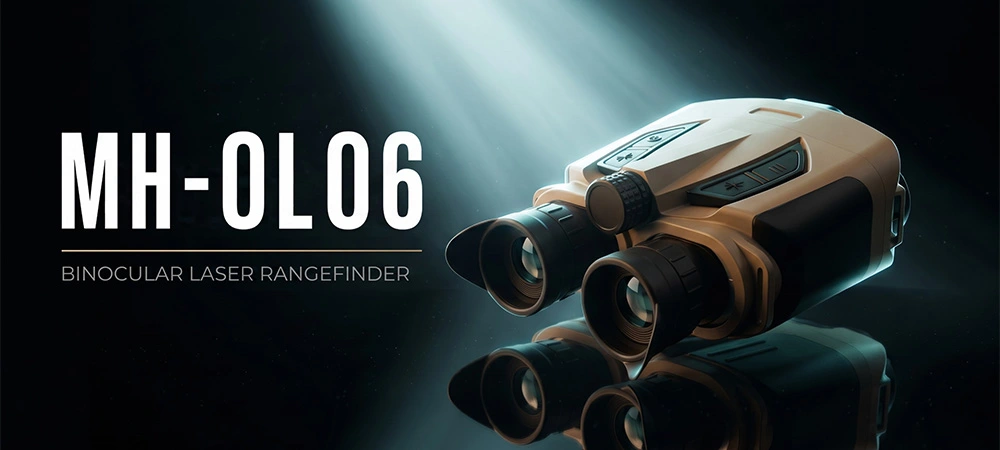
What Is a 6KM Laser Rangefinder Binocular?
A 6KM Laser Rangefinder Binocular is a high-precision optical and electronic device that combines long-distance measuring, twin-eye viewing, and finding your way around in space into a single movable unit. A consumer-grade rangefinder can only work within a few hundred meters. An expert laser ranging scope, on the other hand, uses Pulse Time-of-Flight (ToF) technology to give sub-meter accuracy over very long distances.
Core Technology Behind Long-Range Laser Ranging
The way it works is by measuring the time that has passed between a laser pulse being sent out and its back echo. At a wavelength of 1535nm, which is in the retina-safe band defined by IEC 60825-1 Class 1, the laser has enough power to hit targets the size of vehicles at 6,000m and large structures beyond 10,000m. It also doesn't need any special safety gear for the operator and is legal for civilian and industrial export.
Key Specification Categories That Define Performance
There are three groups of features that set entry-level units apart from professional-grade binocular laser rangefinders:
- Ranging performance: The minimum and maximum ranges for each type of target, as well as the measurement accuracy (±1m is the professional standard) and the scan mode refresh rate are all parts of ranging performance.
- Environmental integrity: The environmental stability includes an IP rating, a working temperature range of at least -20°C to +50°C, and an optical cavity that has been nitrogen-purged to stop condensation from forming inside.
- Integration readiness: It's ready to be integrated if it has a data port type (RS232, TTL, or Type-C), a compass correction method, and a standard tripod mount.
By testing these three groups in a planned way, you can be sure that a device will work well in your unique deployment situation. This lowers the risk of buying something.
Essential Criteria for Selecting the Right Device
When buying a professional laser rangefinder scope, it's not enough to just compare the range numbers on the packaging. Every specification preference is based on the application environment.
Accuracy and Laser Wavelength
Professionals expect accuracy of ±1m at 6,000m. 905nm devices have shorter effective ranges and higher laser safety ratings, which means they can't be used in public places without safety controls. A 1535nm eye-safe Long Range Laser Rangefinder Binoculars resolves both problems at the same time: it lets more light through the atmosphere, and the user can use it freely. The MHNV® MH OL06 works at 1535nm ±5nm and has a consistent accuracy of ±1m from 10m to 6,000m on targets the size of vehicles (2.3×2.3m) and more than 10,000m on big buildings.
Range Gating and Multi-Mode Operation
A specification called "clutter rejection" is often taken for granted. Range gating lets the user set a minimum and maximum measurement window. This blocks out things in the view, like rain, branches, and fences, that would cause false returns otherwise. The MH OL06 has minimum gates (10m to 500m) and maximum gates (1,000m to 20,000m) that can be chosen. This gives users full control over the measurement range. In addition to gating, a good binocular laser rangefinder should have Single, Scan, A-B, Height, and Gate modes all in one device. Each mode should be able to do a different type of measurement without the need for extra tools.
Data Integration and OEM Compatibility
The data interface is an important buying factor for B2B buyers who want to add range data to command systems, PLCs, or field tablets. With a baud rate and frame format that can be set, the RS232 and TTL serial output lets you send data to external systems in real time. A Type-C port is used to send files and change firmware. When looking for a 6 km laser rangefinder binocular for OEM or system integration, buyers should make sure that the seller offers protocol paperwork and software customization. MHNV® does both of these things.
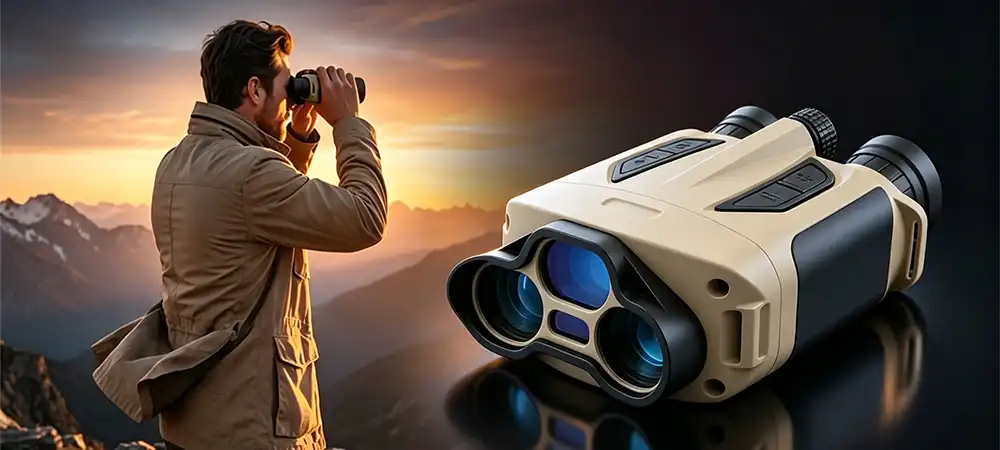
Market Overview — Supplier Credibility and Procurement Strategy
There are both well-known original equipment makers (OEMs) and generic dealers in the long-range laser rangefinder binocular market. Your investment is safe if you can tell them apart.
Suppliers of reliable Long Range Laser Rangefinder Binoculars should have quality management systems that are ISO 9001:2015-certified, follow CE and RoHS rules for entering the EU and US markets, provide test data that can be checked (with consistent results at 1km, 3km, and 6km), and have waterproof certifications of IP67 or higher that are backed up by real immersion tests. Also, they should be clear about the wait times they promise. For example, MHNV® sends stock models within 3–7 days and completes ODM production within 30–45 days of receiving an approved purchase order.
Procurement teams should request serialized QC data sheets and, if possible, set up a live ranging show or video call comparison. This step of validation is common practice for experienced business-to-business buyers who buy precision optical equipment from Chinese manufacturers.
Practical Comparison: Where the MH OL06 Stands
By comparing a certain model to procurement requirements, it becomes clear where compromises are possible and where they are not. Here are the main operating benefits of the MHNV® MH OL06 that directly address common problems in B2B procurement:
- Eye-safe laser compliance: 1535nm, IEC 60825-1 Class 1 approval gets rid of the need for operator safety devices and lets civilian and corporate exports happen without the need for extra licenses in most places.
- Environmental robustness: IP67 protection, a working temperature range of -20°C to +50°C, and a standard ¼" tripod mount make it easy to use for coastal surveillance, mountain surveys, and infrastructure inspection with a 6KM Laser Rangefinder Binocular.
- Orientation data output: An electronic compass with gyro and magnetic dual calibration is built in and gives range readings as well as azimuth and elevation angle data. This means that you don't have to carry around separate instruments in the field.
- Operator ergonomics: For the comfort of the operator, the diopter adjustment for both eyes can be made separately, as can the interpupillary adjustment. The 16-level reticle brightness and four crosshair shape choices allow for a wide range of operator profiles without having to change the hardware.
Finalizing Your Purchase Decision
Go through this organized testing process for any long-range binocular rangefinder before you place an order. First, describe the deployment setting, including the working temperature range, the amount of rain or snow that is predicted, and whether the device will be held in the hand or on a tripod. Check the specifications of the required data output protocol against those of the receiving system. Ask for records of the IP67 immersion test and the ranging accuracy test at set target distances. Talk about sending out a sample unit before committing to a large order. MHNV® can handle trial orders for finished devices starting from one unit. Make sure that the warranty terms work with your distribution cycle and that you can customize the firmware if your OEM has specific branding or language requirements for the menu. A verified 6 km laser rangefinder binocular ensures these standards are met.
Conclusion
To choose the best 6KM Laser Rangefinder Binocular, you need to carefully consider the laser wavelength, measurement accuracy, ability to integrate, longevity, and source confirmation. Professional-level devices like the MHNV® MH OL06 combine these needs—1535nm operation that is safe for the eyes, ±1m accuracy at 6,000m, IP67 security, RS232/TTL serial output, and full OEM customization support—into a platform made for tough B2B deployment. When procurement teams put verified specs ahead of big claims, they always get better operational ROI and lower post-delivery risk across all of their distribution processes.
FAQ
1. How accurate is a 6KM laser rangefinder binocular in real-world conditions?
Professional units like the MH OL06 can hit objects the size of vehicles with an accuracy of ±1m at 6,000m when the weather is clear. Non-reflective targets, like thick vegetation, usually give accurate readings between 3.5 km and 4.5 km away, depending on how reflective the surface is and how well you can see it with a 6KM Laser Rangefinder Binocular.
2. How does weather affect ranging performance?
Heavy rain and thick fog scatter laser waves, making the range less useful. The MH OL06's range gating makes it easier to find things in light rain by blocking out background noise. In haze situations, the 1535nm light also penetrates the atmosphere better than 905nm devices.
3. Can the ranging data connect to external systems?
Yes. The MH OL06 sends out real-time range data over an RS232/TTL tail-wire interface and can be connected via Type-C for software changes. This makes it possible to connect directly to GIS systems, outdoor tablets, PLCs, and data loggers.
4. How should I maintain the optical lenses?
When you clean the microfiber cloths, only use high-purity anhydrous alcohol. The outside lenses have anti-scratch and water-repellent coatings that reduce how often they need to be cleaned. Stay away from rough materials that could damage the covering layer.
Ready to Source a Verified 6KM Laser Rangefinder Binocular? Contact MHNV®
Since 2013, MHNV® has been a trusted maker of 6KM Laser Rangefinder Binoculars for business-to-business buyers, OEM integrators, and distributors in more than 60 countries. There is full compliance documentation, serialized QC data, and a range of flexible ODM options that come with the MH OL06. Our technical sales team can be reached at sarah@mh-elec.com to get a sample, a live demonstration, or a bulk price.
References
1. Laser & Photonics Reviews — Atmospheric Propagation of Eye-Safe Lasers at 1535nm, Wiley-VCH, 2019.
2. Optical Engineering — Pulse Time-of-Flight Ranging: Accuracy Limits and System Design, SPIE, 2021.
3. IEC 60825-1:2014 — Safety of Laser Products, Part 1: Equipment Classification and Requirements, International Electrotechnical Commission, 2014.
4. Journal of Applied Remote Sensing — Performance Evaluation of Long-Range Electro-Optical Rangefinders Under Variable Atmospheric Conditions, SPIE, 2020.
5. Defense & Security Analysis — Procurement Standards for Electro-Optical Targeting and Observation Systems, Taylor & Francis, 2022.
6. Photonics Spectra — Advances in Eye-Safe Laser Rangefinder Technology for Industrial and Defense Applications, Laurin Publishing, 2023.
YOU MAY LIKE