What Is a Cooled MWIR Thermal Camera Core?
A cooled MWIR thermal camera core is a precision mid-wave infrared imaging engine operating in the 3–5 μm spectral band. Unlike uncooled sensors, it integrates a cryogenically cooled focal plane array — typically using a Stirling-cycle or HOT cooler — to suppress detector noise and achieve thermal sensitivity below 25 mK. This architecture enables detection of minute temperature gradients invisible to uncooled LWIR modules, making the cooled MWIR thermal camera core the preferred choice for long-range surveillance, gas leak detection, UAV EO payloads, and defense target acquisition where image fidelity cannot be compromised.
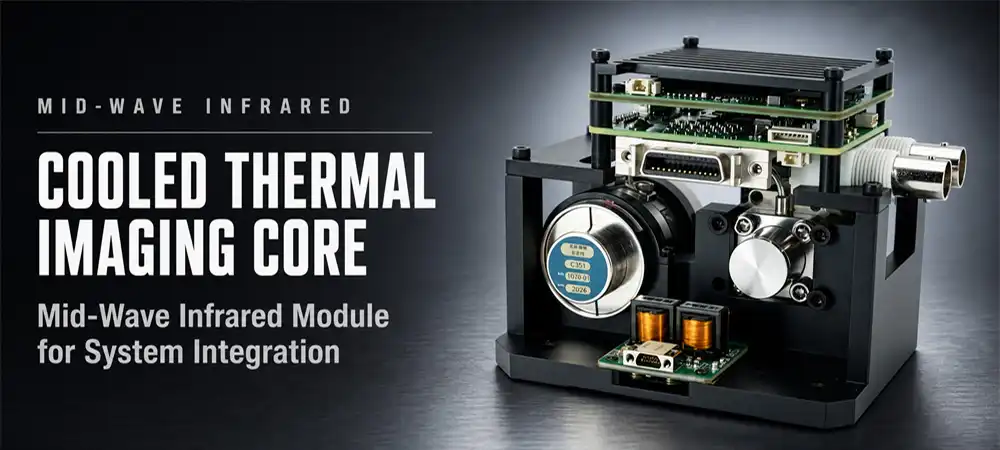
Technical Specifications and Performance Metrics
To choose a mid-wave infrared image core, you need to look at a number of factors that affect each other rather than just one big number. It's important that the sensitivity, resolution, pixel geometry, spectral response, and interface compatibility all work with the limitations of the target platform.
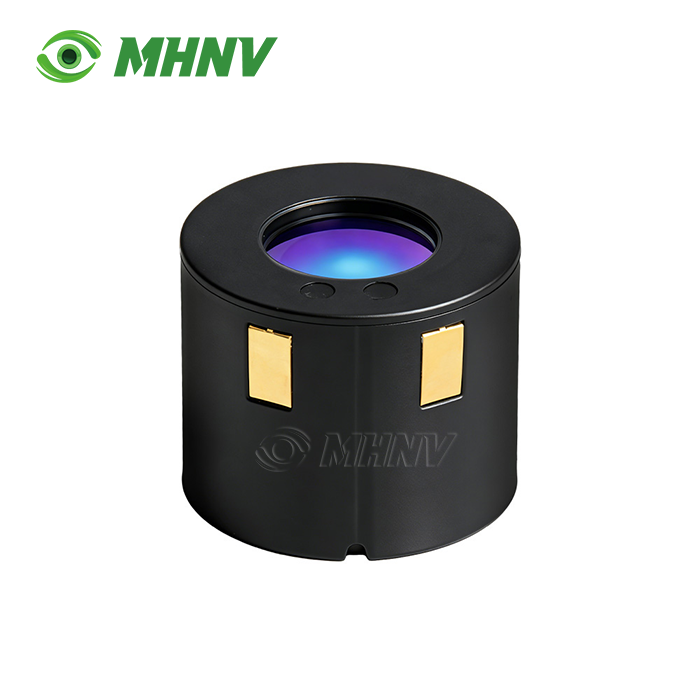
The MHNV HOT-series Cooled MWIR Thermal Camera Core shows what a mature HOT design can do in a small OEM package. These are the most important technical specs of this device:
- Detector resolution and pixel pitch: 640 by 512 pixels with a 15-µm pitch make up the detector's resolution and pixel pitch. This gives the module the right balance of angular resolution and small optic diameter for high-magnification long-range observation.
- Thermal Imaging Components sensitivity (NETD): ≤22 mK at 23 °C ambient; able to resolve temperature differences of less than 100 mK, which can show gas plumes, thermal imaging component leaks, and hidden hot electrical problems over a large standoff range.
- Spectral response: 3.7–4.8 µm MWIR—the window of air transmission that works better than 8–14 µm LWIR in humid tropical, marine, and industrial-plume settings by keeping the signal strong where longer wavelengths lose contrast.
- Cooldown time: ≤3 Minutes and 30 seconds at 23 °C—the system starts taking stable pictures within four minutes of being turned on, which is an important factor for quickly setting up UAVs and field surveillance systems.
- Frame rate and zoom: 50 Hz output with 2×, 4×, and 8× digital zoom, which lets overhead gimbal packages take smooth pictures of moving objects and track changing scenes without motion blur.
- Power envelope: The power range is ≤6.5 W steady-state and ≤12 W peak. This allows for long-lasting battery-powered platforms that older cooled MWIR cores, which usually draw 20–40 W, can't physically handle.
- Physical footprint: It has a size of ≦100 x 100 x 81 mm and weighs 580 g. It has a 4× M4 threaded mounting interface for straight fitting into OEM housings.
These benefits directly address the SWaP issues that have kept cooled MWIR technology out of mobile, UAV-payload, and unsupervised field-installation uses in the past. Without any extra signal processing hardware, the RS422 full-duplex control interface lets installers use command sets to fix non-uniformity, replace bad pixels, reduce adaptive dynamic range, switch between seven color palettes, flip images, and change polarity.
Applications Across Industries

The 3.7–4.8 µm band isn't just an alternative to LWIR; it has its own physical benefits that make cooled mid-wave infrared imaging necessary in some situations where uncooled LWIR doesn't work well enough.
Defense and Long-Range Surveillance
When paired with the right optics, the Cooled MWIR Thermal Camera Core is great at finding car heat signals and people against complex backgrounds at ranges of more than 10 km in defense and border security situations. The way it shows hot exhaust and engine marks against a cool sky background gives operators a clear edge when it comes to recognition.
Optical Gas Imaging and Industrial Inspection
Hydrocarbons, methane, and many volatile organic substances can all be absorbed in the 3–5 µm band. An MWIR core with a NETD of less than 25 mK can see escape gas plumes that uncooled LWIR sensors can't see at all. This makes it the standard technology for checking the integrity of pipelines, checking the safety of refineries, and making sure that industrial leak-detection rules are followed.
UAV Payloads and Airborne Platforms
In steady state, HOT-architecture cores use less than 7 W of power and weigh less than 600 g. These specs make it possible for them to be used in multi-rotor UAV EO gimbals where older cooling cores were too heavy and power-hungry to be used. The 50 Hz frame rate gets rid of motion blur during fast platform movements, and the small 100 × 100 × 81 mm size fits standard two-axis gimbal bays without the need for custom housing changes.
Choosing the Right Cooled MWIR Thermal Camera Core: A Decision-Making Guide
When looking at mid-wave infrared camera parts for OEM integration, procurement teams should think about the sensitivity needs, platform SWaP budget, interface compatibility, and provider customization depth all at the same time. For real long-range or gas imaging tasks, the current performance floor is a Cooled MWIR thermal imaging component with an average NETD below 25 mK, a resolution of 640 × 512, and a cooldown time of less than 4 minutes.
FLIR Systems (now Teledyne FLIR), Leonardo DRS, and Teledyne Judson are some of the biggest companies in this field. They all offer high-performance cores at prices that are geared toward defense-scale purchases. Technology developers and wholesalers are asking for more and more OEM-grade cooled MWIR performance with flexible customization, a low MOQ, and direct engineering support. These are all things that big defense-tier suppliers rarely offer to mid-volume B2B buyers.
Some important things to look for in a supplier are NETD verification through blackbody calibration, the quality of the NUC algorithm, the MTTF ratings for the cryocooler (usually 10,000–20,000 hours for Stirling coolers), the flexibility of the interface, and the supplier's ability to support custom optical configurations and firmware changes.
Procurement and Practical Considerations
When you buy a Cooled MWIR Thermal Camera Core on an OEM scale, you have to think about wait time, customization, and compliance in ways that raw spec sheets don't. MHNV® has a quality management system that is ISO 9001:2015 approved, and all of their goods are made to meet CE and RoHS standards so they can be sold in the US and EU. Each unit comes with QC data that has been serialized.
There will be a 15–25-day lead time for samples and a 30–45-day lead time for full production. MHNV® allows full customization of optical setup, firmware settings, housing design, IP rating, and packaging. It has been manufactured for 12 years and is regularly seen at foreign defense shows like IDEX UAE and Enforce Tac Germany. Logistics are taken care of through relationships with DHL, FedEx, and UPS Express. For returning wholesale buyers, there is a US transit warehouse in Los Angeles.
Conclusion
A cooled MWIR thermal camera core fills a small but important gap in the thermal imaging market. It offers better sensitivity, air penetration, and contrast performance than uncooled LWIR technology in long-range, gas-imaging, and high-speed overhead uses. There are no longer any traditional SWaP barriers in HOT detector architecture. This means that cooled mid-wave infrared performance can be found in an OEM module that weighs less than 600 g and uses less than 7 W. For acquisition teams making next-generation surveillance platforms, UAV payloads, or industrial inspection tools, the MHNV HOT-series Cooled MWIR Thermal Camera Core is a fully adjustable, technically mature, and commercially viable option.
FAQ
1. What distinguishes a cooled MWIR thermal camera core from an uncooled LWIR module?
A cooled MWIR Thermal Camera Core has a focal plane array that is steadied by cryogens. This stops the detector from self-noise and gets NETD values below 25 mK, which is usually five to ten times more sensitive than LWIR modules that are not cooled. In wet and hazy places where LWIR signals weaken, it also works in the 3–5 µm band, which has better air transmission.
2. How often does a cooled MWIR core require calibration?
Non-uniformity correction (NUC) is usually done automatically by the core's software at set times or when the temperature changes. Every 6 to 12 months, based on the working job cycle and environmental exposure, a two-point blackbody calibration should be done to make sure the accuracy is perfect.
3. Which industries benefit most from cooled mid-wave infrared imaging?
The main areas are defense and border surveillance, optical gas imaging for inspecting petrochemicals and pipelines, scientific spectroscopy, UAV EO payload integration, and environmental monitoring from the air. This technology is useful for any task that needs sub-50 mK thermal resolution or better contrast between a hot target and a cool background.
4. What does HOT detector architecture mean in practice?
HOT (high operating temperature) detectors keep the cryocooler at a higher stage temperature than traditional cooled MWIR designs. This cuts the size, weight, power use, and cooling time of the cryocooler to about a third of what they used to be, all without affecting the NETD or spectral performance.
Request a Cooled MWIR Thermal Camera Core Quote from MHNV®
MHNV® has been making cooled MWIR thermal camera cores for over 12 years and is an experienced full-stack infrared engineer. The HOT-series has a ≦22 mK NETD, a resolution of 640 × 512, and a cooldown time of less than 4 minutes in a 580 g OEM module. It is certified to ISO 9001:2015, complies with CE/RoHS rules, and comes with direct engineering support. You can email our team at sarah@mh-elec.com to get more information, OEM prices, or to see a live display.
References
1. Rogalski, A. Infrared Detectors. CRC Press, 2011.
2. Vollmerhausen, R. H., & Driggers, R. G. "Analysis of Sampled Imaging Systems." SPIE Press, 2000.
3. Holst, G. C. Common Sense Approach to Thermal Imaging. SPIE Optical Engineering Press, 2000.
4. Kinch, M. A. "State-of-the-Art Infrared Detector Technology." SPIE Press Monograph, 2014.
5. Tidrow, M. Z., et al. "High Operating Temperature Infrared Detectors: Progress and Challenges." Journal of Electronic Materials, 2019.
6. Piotrowski, J., & Rogalski, A. "High-Operating-Temperature Infrared Photodetectors." SPIE Press, 2007.
YOU MAY LIKE
.webp "Laser Target Locator Module (LTLM)")