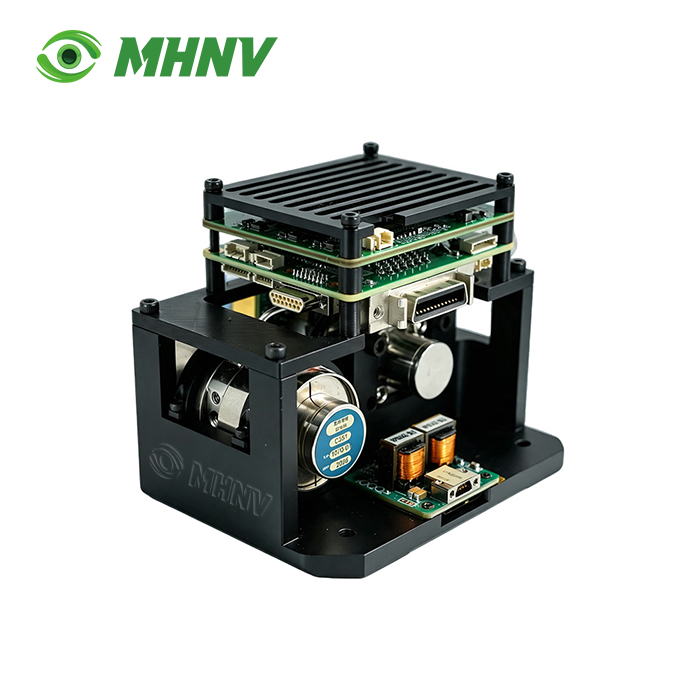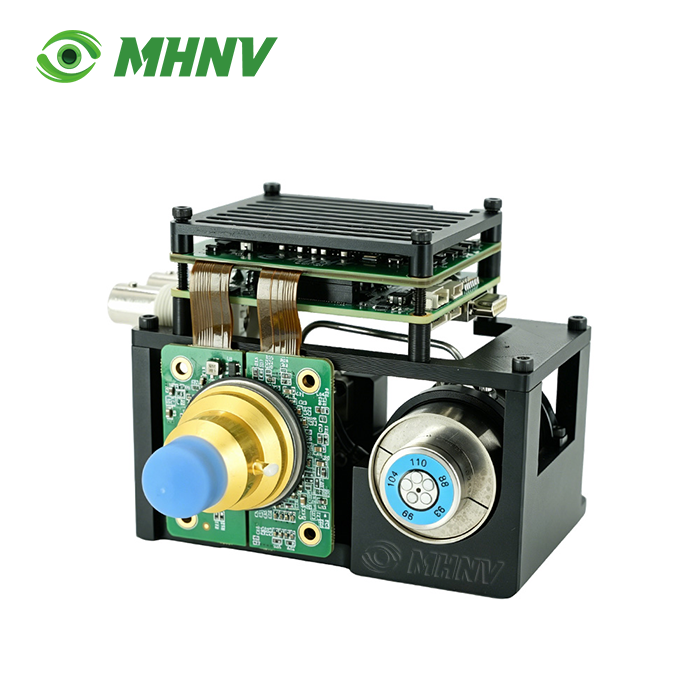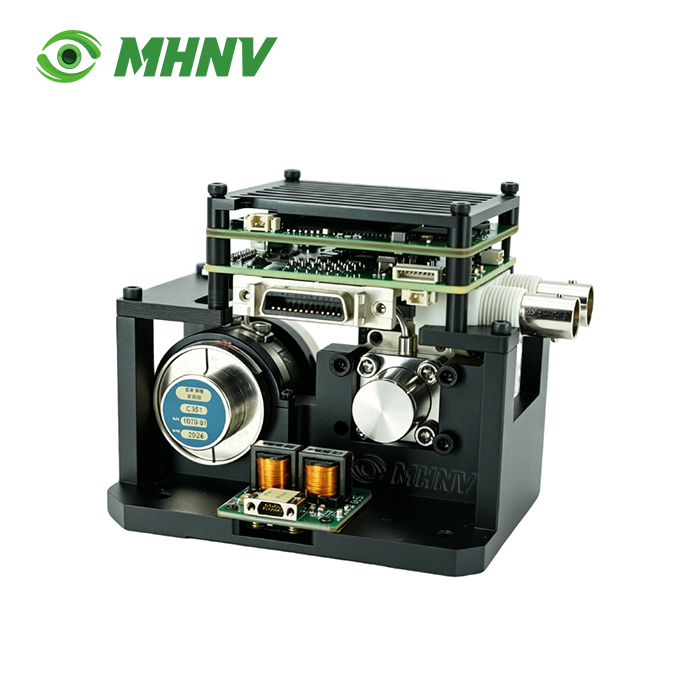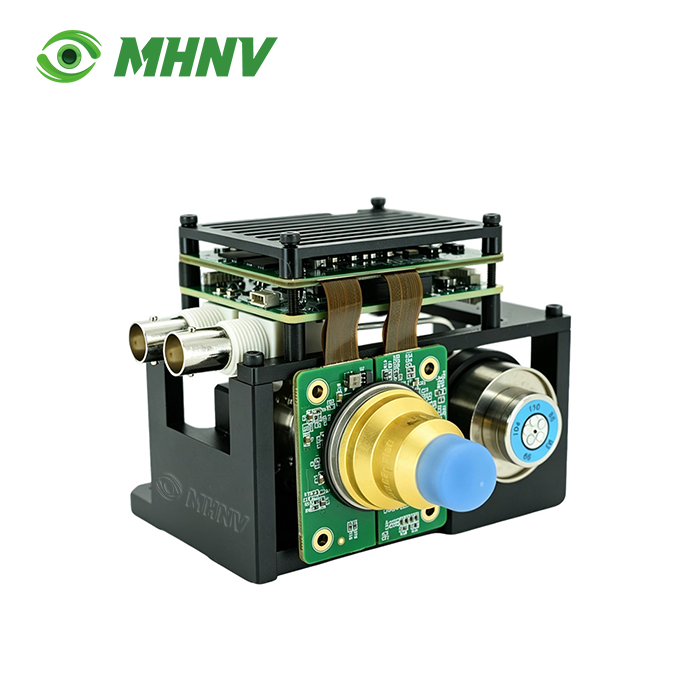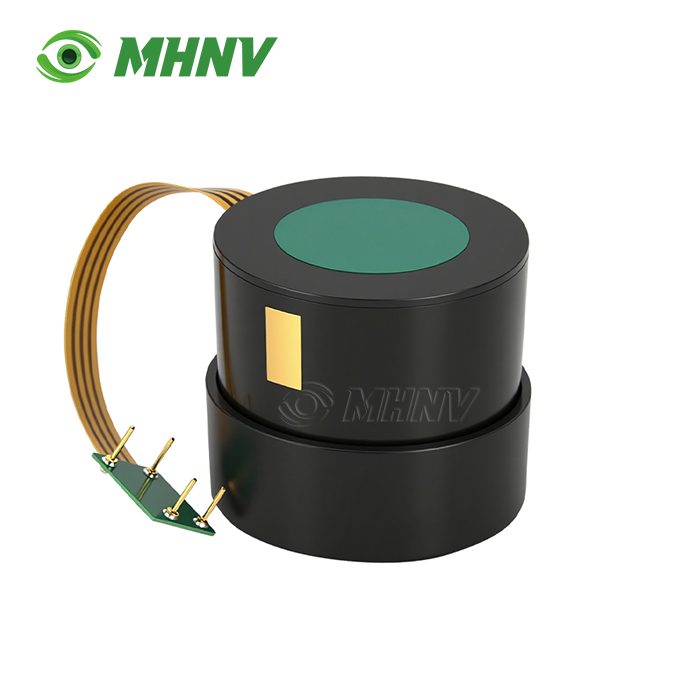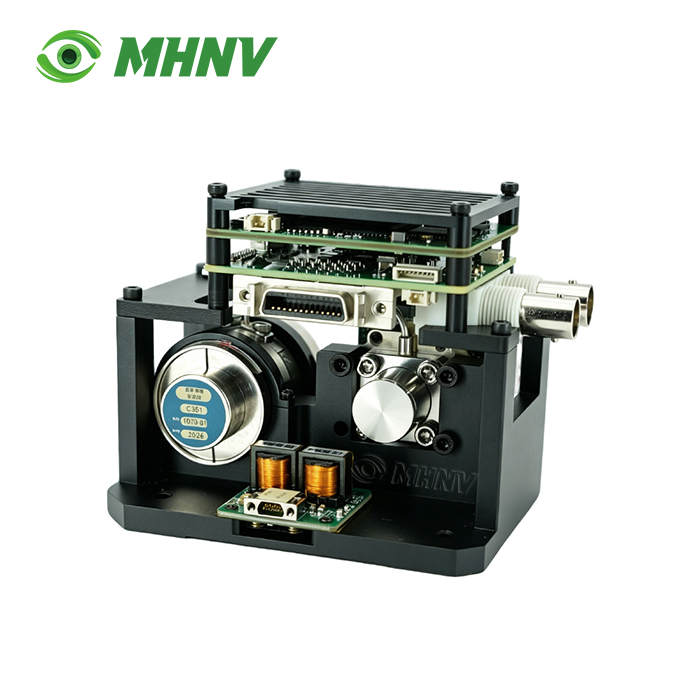
Cooled MWIR Camera Core
Cooled MWIR Camera Core | HOT Detector Technology | Compact OEM Integration Platform for UAV, Surveillance & Industrial Vision
MHNV® HOT-series Cooled MWIR Camera Core delivers cryogenically stabilized mid-wave infrared imaging in an OEM-ready package engineered for UAV gimbals, long-range surveillance platforms, optical gas detection systems and industrial monitoring applications. Built around a 640×512 high operating temperature detector with 15 μm pixel pitch, this core achieves ≤22 mK thermal sensitivity across the 3.7–4.8 μm MWIR spectral band while maintaining a compact 100×100×81 mm envelope and ≤580 g weight. With ≤3 min 30 sec cooldown at 23°C, full-duplex RS422 command interface, CameraLink digital output plus DVP and PAL analog streams, the core provides immediate integration capability for your next-generation thermal product.
Why HOT Detector Architecture Redefines OEM Thermal Integration?
High operating temperature detector technology reduces cryocooler stage temperature requirements compared to legacy cooled cores, cutting size, weight and power consumption by approximately two-thirds. You gain cooled MWIR performance—sub-25 mK NETD, true photon detection and superior atmospheric penetration—inside a form factor previously reserved for uncooled modules.
The 3.7–4.8 μm MWIR band penetrates humid coastal fog, industrial plume environments and tropical moisture layers far more effectively than 8–14 μm LWIR sensors. Hot targets—combustion engines, exhaust plumes, gas leaks, electrical faults—exhibit 3× to 5× higher radiant contrast in MWIR, enabling your system to detect thermal anomalies that uncooled sensors miss entirely.


Technical Specifications at a Glance
| Parameter | Specification |
|---|---|
| Model | MHNV HOT-series Cooled MWIR Camera Core |
| Detector Type | High Operating Temperature Cooled MWIR |
| Resolution | 640×512 pixel |
| Pixel Pitch | 15 μm |
| Spectral Range | 3.7–4.8 μm (MWIR) |
| Thermal Sensitivity (NETD) | ≤22 mK @ 23°C |
| Cooldown Time | ≤3 min 30 sec @ 23°C |
| Frame Rate | 50 Hz |
| Digital Zoom | 2×, 4×, 8× |
| Power Supply | 12–18 VDC |
| Steady-State Power | ≤6.5 W @ 23°C |
| Peak Power | ≤12 W @ 23°C |
| Dimensions (L×W×H) | ≤100×100×81 mm |
| Weight | ≤580 g |
| Mounting Interface | 4×M4 threaded holes |
| Digital Output | CameraLink, DVP 8-bit (BT.656, 1.8V logic) |
| Analog Output | PAL composite (BNC) |
| Control Interface | RS422 full-duplex serial |
| Operating Temperature | −40°C to +60°C |
| Storage Temperature | −45°C to +65°C |
Complete Image Processing Pipeline Inside the FPGA
Every core ships with a fully implemented infrared image signal processor built into the onboard FPGA. Single-point and two-point non-uniformity correction algorithms automatically compensate for FPA responsivity variation. Adaptive dynamic range compression expands scene detail in high-contrast environments. Bad-pixel detection and correction run continuously in firmware.
You select from seven color palettes—iron red, green-red, yellow hot, rainbow, warm, blue-green-red, blue-red—via a single RS422 command. Black-hot and white-hot polarity switch, brightness and contrast adjustment, horizontal mirror and vertical flip are all accessible through the full-duplex serial interface. This removes the 6–18 month ISP development cycle from your project timeline and ships premium image quality immediately.
Sub-Four-Minute Cooldown for Rapid Deployment Scenarios
The ≤3 min 30 sec cooldown specification at 23°C places this Cooled MWIR Camera Core at the top of the compact cooled MWIR class for mission-critical responsiveness. Legacy 6–10 minute cooldown cores miss observation windows in surge-scenario surveillance, battery-constrained UAV sorties and quick-response platform deployments. This core reaches imaging-ready state within four minutes of power-on, meeting modern operational tempo requirements that uncooled sensors cannot match in sensitivity and cooled legacy systems cannot match in startup speed.
Universal OEM Interface Stack for Accelerated Integration
Three simultaneous video outputs ensure compatibility with any system architecture. CameraLink digital stream connects directly to high-speed FPGA processing boards for AI target detection and multi-sensor fusion. DVP 8-bit parallel output with BT.656 timing at 1.8 V logic level integrates seamlessly into ARM-based SoC platforms. PAL analog composite output (BNC connector) supports legacy analog video recorders and operator displays.
RS422 serial control provides full command access to NUC modes, polarity, brightness, contrast, bad-pixel correction, dynamic range compression, zoom levels, palette selection and image flip. Reference integration schematics and command-set documentation ship under NDA, reducing your engineering team's integration timeline from 6–12 months to 4–12 weeks of firmware and mechanical adaptation work.
Superior Atmospheric Performance in Humid and Industrial Environments
MWIR atmospheric transmission windows outperform LWIR in maritime fog, coastal salt spray, industrial chemical plumes and tropical humidity. The 3.7–4.8 μm spectral band experiences 40–60% lower atmospheric attenuation than 8–14 μm LWIR under high water-vapor conditions, extending your effective detection range by 30–50% in real-world humid environments.
For optical gas imaging applications—methane leak detection at refineries, VOC monitoring at chemical plants, SF₆ inspection at electrical substations—MWIR spectral response aligns directly with hydrocarbon absorption bands that LWIR sensors cannot resolve. This product enables gas-plume visualization that saves facility operators millions in regulatory compliance costs and prevents catastrophic safety incidents.
Compact, Lightweight Package for UAV and Handheld Platforms
At ≤580 g and 100×100×81 mm, the core fits into UAV gimbal payloads, handheld inspection tools and vehicle-mounted turrets previously restricted to uncooled sensors. The 6.5 W steady-state power budget allows battery-powered operation for extended missions without thermal management challenges. Four M4 threaded mounting holes and standardized J30JZ/XLN15TJWA000 15-pin electrical connector simplify mechanical integration into your existing platform architecture.
The −40°C to +60°C operating temperature range covers Arctic to desert deployment zones without external environmental conditioning. Altitude, shock and vibration performance align with MIL-STD-810 durability expectations, ensuring reliability in demanding field conditions.

FAQ
Q: What is a product and how does it differ from uncooled thermal sensors?
A: A product is a mid-wave infrared imaging engine operating in the 3.7–4.8 μm spectral range, integrated with a cryogenic cooler (typically Stirling cycle architecture) that reduces the detector focal plane array to approximately 77 Kelvin (−196°C). This cryogenic stabilization suppresses thermally induced electron noise within the sensor material itself, enabling true photon detection rather than bolometric resistance-change measurement. The result is 5× to 10× higher thermal sensitivity (sub-25 mK NETD versus 50–80 mK for uncooled), 3× to 5× longer detection range in atmospheric conditions, and the ability to resolve minute temperature differences across vast distances that uncooled LWIR sensors cannot achieve.
Q: How long does the product take to reach operational imaging temperature?
A: The MHNV HOT-series core achieves full operational imaging capability in ≤3 minutes 30 seconds at 23°C ambient temperature. This rapid cooldown specification reflects the efficiency of high operating temperature detector architecture, which allows the cryocooler to stabilize at a warmer stage temperature than legacy cooled MWIR cores requiring 6–10 minutes. In field deployment scenarios—battery-powered UAV missions, rapid-response surveillance and time-critical inspection tasks—this sub-four-minute cooldown window determines whether your platform meets the mission timeline or misses the observation opportunity entirely.
Q: What video output interfaces are provided for OEM system integration?
A: The core provides three simultaneous video streams to accommodate diverse system architectures: CameraLink digital output delivers high-bandwidth pixel data to FPGA-based processing boards for real-time AI target detection and sensor fusion; DVP 8-bit parallel interface with BT.656 timing at 1.8 V logic level connects directly to ARM SoC platforms; PAL analog composite output (BNC connector) supports legacy video recorders and analog displays. Full-duplex RS422 serial control enables your host system to command NUC modes, polarity, brightness, contrast, zoom, palette selection and image flip through a documented command protocol supplied at NDA signature.
Q: Why is MWIR spectral range preferred over LWIR for long-range surveillance in humid environments?
A: The 3.7–4.8 μm MWIR atmospheric transmission window experiences significantly lower water-vapor absorption than the 8–14 μm LWIR band. In coastal fog, maritime conditions, tropical humidity and industrial plume environments, MWIR sensors maintain 40–60% higher transmission efficiency, directly translating to 30–50% extended detection range. Additionally, hot targets—combustion engines, exhaust plumes, gas leaks—emit 3× to 5× higher radiant intensity in MWIR compared to LWIR due to Planck's law spectral peak shift, providing superior target contrast for surveillance, gas imaging and hot-spot detection applications that LWIR sensors cannot match.
Q: What image processing functions are built into the core firmware?
A: The onboard FPGA runs a complete infrared image signal processor, eliminating the need for your engineering team to develop ISP algorithms from scratch. Implemented functions include single-point and two-point non-uniformity correction (NUC) to compensate for FPA responsivity variation; automatic bad-pixel detection and correction to remove sensor defects; adaptive dynamic range compression (DRC) to enhance scene detail in high-contrast environments; seven selectable color palettes (iron red, green-red, yellow hot, rainbow, warm, blue-green-red, blue-red); black-hot and white-hot polarity switching; brightness and contrast adjustment; digital zoom (2×, 4×, 8×); and horizontal mirror plus vertical flip. All parameters are accessible via RS422 serial commands, delivering premium image quality immediately without 6–18 months of in-house ISP development.
Contact MHNV® for Integration Support and Custom OEM Solutions
Ready to integrate premium Cooled MWIR Camera Core performance into your next surveillance platform? Contact us today at sarah@mh-elec.com for specifications, integration guides and OEM pricing.
YOU MAY LIKE
.webp "Laser Target Locator Module (LTLM)")