MWIR Cooled Cameras & Cores
High-Performance MWIR Cooled Cameras & Cores | HOT Detector Technology for Long-Range Surveillance & Industrial Monitoring
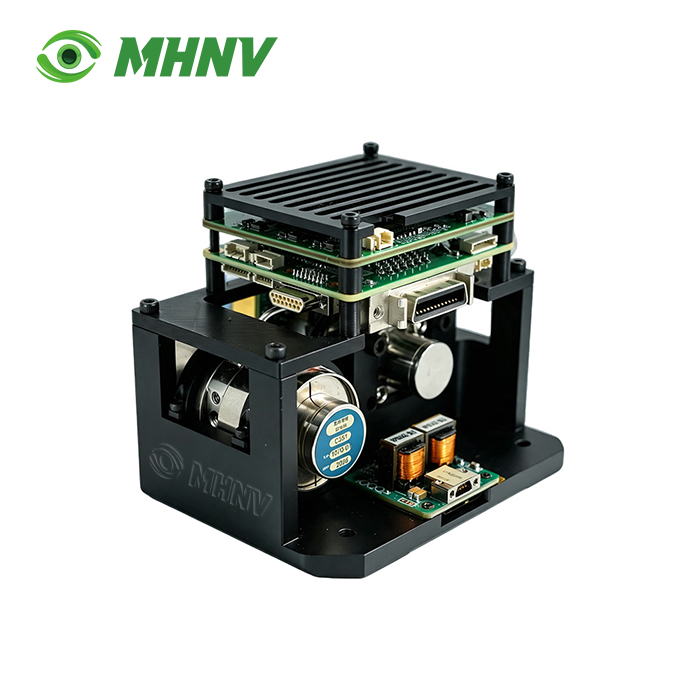
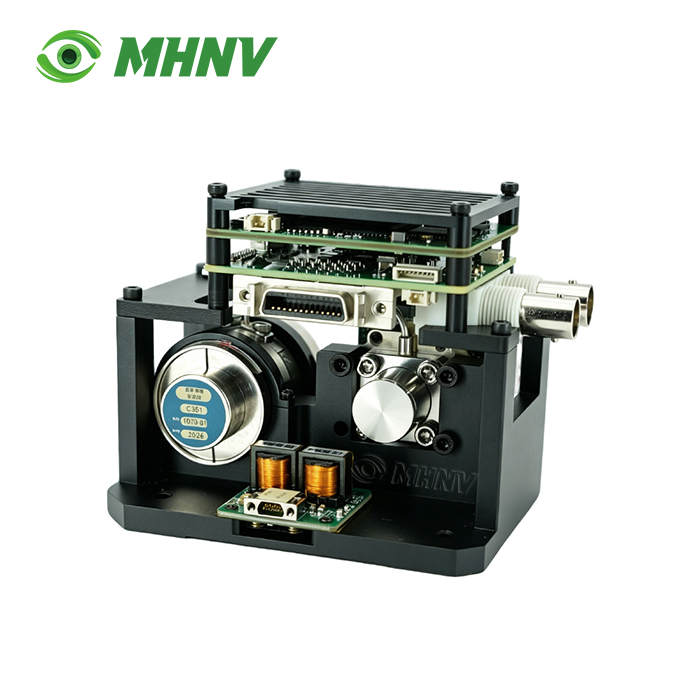
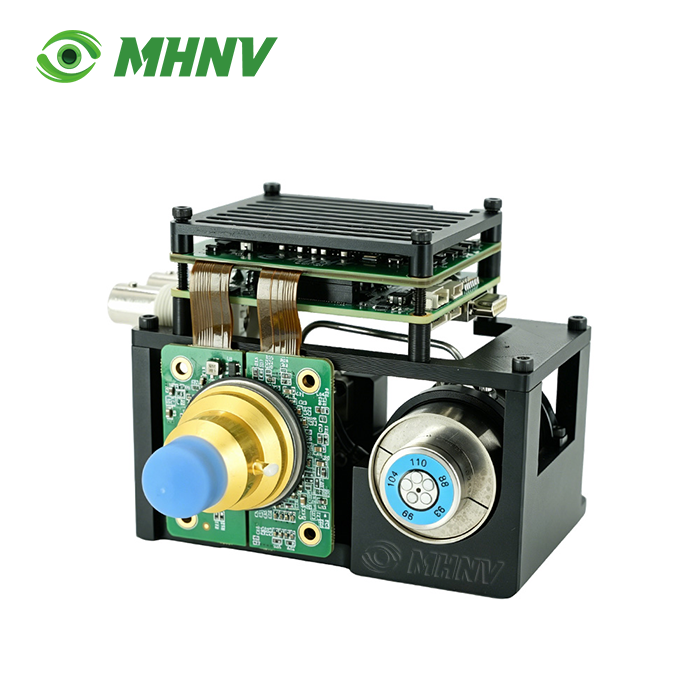
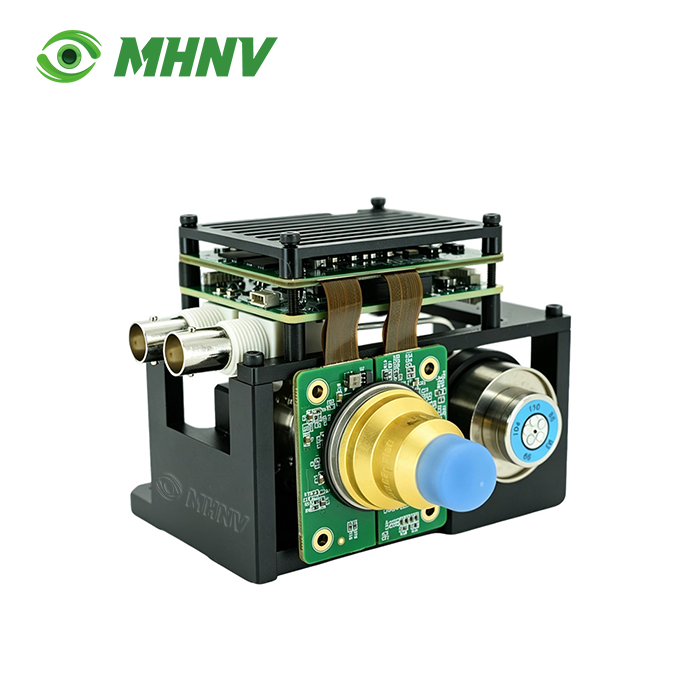
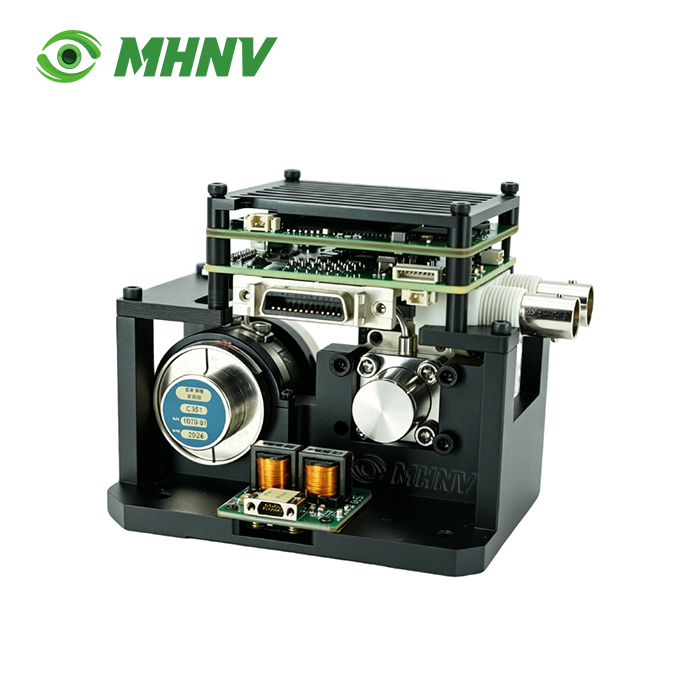
MWIR Cooled Cameras & Cores from MHNV® deliver enterprise-grade thermal imaging for demanding OEM integration projects. The HOT-series cooled MWIR camera core combines high operating temperature detector architecture with 640×512 resolution and 15μm pixel pitch, achieving ≤22mK thermal sensitivity across the 3.7–4.8μm spectral band. Designed for long-range surveillance systems, UAV electro-optical payloads, industrial monitoring platforms and gas detection solutions, this core reaches operational temperature in ≤3 minutes 30 seconds and consumes only ≤6.5W steady-state power at 23°C. Compact dimensions of ≤100×100×81mm and ≤580g weight enable direct integration into battery-powered and unattended platforms, while CameraLink, DVP 8-bit and PAL analog outputs support legacy through modern OEM architectures.
Compact Cooled MWIR Performance in Uncooled-Class Footprint
The HOT detector architecture transforms traditional cooled MWIR design constraints. High operating temperature technology allows the cryocooler to maintain detector performance at warmer stage temperatures than conventional systems. This advancement reduces cryocooler size, weight and power consumption to approximately one-third of legacy cooled MWIR envelopes.
Your OEM platform gains genuine cooled MWIR atmospheric penetration and low-noise imaging within a form factor previously limited to uncooled LWIR modules. Handheld instruments, tactical UAV gimbals and battery-critical platforms that physically excluded traditional cooled cores can now leverage superior 3.7–4.8μm spectral performance. The compact 100×100×81mm housing and 4×M4 threaded mount pattern simplify mechanical integration into custom enclosures.
Rapid Deployment Performance: Sub-4-Minute Cooldown
Modern quick-response mission profiles demand immediate imaging capability. The MHNV HOT-series core achieves full operational status within 3 minutes 30 seconds at room temperature—cutting traditional 6-to-10-minute cooldown timelines by more than half.
Surge-scenario surveillance, rapid-deployment platforms and battery-conscious UAV missions depend on fast cooldown performance. When your observation window opens, this core delivers imaging-ready thermal data before legacy systems complete their initialization cycle. Operating temperature range from –40°C to +60°C ensures reliability across extreme deployment environments.
Technical Specifications
| Parameter | Specification |
|---|---|
| Model | MHNV HOT-series cooled MWIR camera core |
| Detector Type | High operating temperature (HOT) cooled digital MWIR detector |
| Resolution | 640 × 512 pixels |
| Pixel Pitch | 15 μm |
| Spectral Range | 3.7–4.8 μm (MWIR) |
| NETD Thermal Sensitivity | ≤22 mK at 23°C |
| Cooldown Time | ≤3 min 30 sec at 23°C ambient |
| Frame Rate | 50 Hz |
| Digital Zoom | 2×, 4×, 8× |
| Supply Voltage | DC 12–18 V (FPGA and cryocooler) |
| Steady-State Power | ≤6.5 W at 23°C |
| Peak Power | ≤12 W at 23°C |
| Dimensions (L×W×H) | ≤100 mm × 100 mm × 81 mm |
| Weight | ≤580 g |
| Mounting Interface | 4 × M4 threaded holes |
| Digital Video Output | CameraLink |
| DVP Interface | 8-bit parallel, BT.656 compatible, 1.8 V logic |
| Analog Video Output | PAL composite (BNC) |
| System Control | RS422 serial (full duplex) |
| NUC | Single-point and two-point |
| Polarity | Black hot / white hot |
| Color Palettes | 7 modes (iron red, green-red, yellow hot, rainbow, warm, blue-green-red, blue-red) |
| Image Flip | Horizontal mirror and vertical flip |
| Operating Temperature | –40°C to +60°C |
| Storage Temperature | –45°C to +65°C |
| Electrical Connector | J30JZ/XLN15TJWA000 series (15-pin) |
Superior Atmospheric Transmission & Hot-Target Contrast
The 3.7–4.8μm MWIR spectral band provides measurable performance advantages over 8–14μm LWIR systems in specific operational conditions. MWIR wavelengths penetrate humid tropical atmospheres, coastal salt-spray environments and industrial plume conditions substantially better than longwave infrared.
Applications focused on hot-target detection—engine signatures, exhaust plumes, gas leaks and thermal faults—benefit from enhanced contrast that only MWIR Cooled Cameras & Cores deliver. The ≤22mK NETD specification resolves sub-100mK temperature differences essential for leak detection, fault monitoring and plume visualization. When atmospheric humidity or aerosol content degrades LWIR performance, MWIR maintains detection range and image quality.
Complete OEM Integration Interface Stack
MHNV® engineered the HOT-series core with comprehensive digital, parallel and analog video outputs to accelerate your integration timeline. CameraLink digital output supports high-speed FPGA-based processing chains. DVP 8-bit parallel interface with BT.656 compatibility at 1.8V logic enables direct SoC integration. PAL analog composite via BNC preserves compatibility with legacy analog video pipelines.
RS422 full-duplex serial control provides command access to non-uniformity correction (single-point and two-point), polarity switching, brightness/contrast adjustment, bad-pixel correction, adaptive dynamic range compression, digital zoom (2×, 4×, 8×), seven color palettes and image flip functions. Reference schematics and complete command-set documentation ship at NDA signature, reducing your integration cycle to 4–12 weeks instead of the 6–12 months typical for ground-up cooled MWIR development.
Built-In Image Processing Pipeline Accelerates Time-to-Market
Developing infrared image signal processors internally consumes 6–18 months of algorithm engineering effort. The HOT-series core eliminates this development burden with a complete FPGA-based processing pipeline integrated inside the camera.
Single-point and two-point NUC, automatic bad-pixel detection and correction, adaptive DRC, polarity switching (black-hot/white-hot), manual brightness and contrast control, seven professional color palettes (iron red, green-red, yellow hot, rainbow, warm, blue-green-red, blue-red) and digital zoom all execute within the core. Your OEM product receives fully processed, broadcast-ready video without investing in proprietary ISP development. The core outputs premium image quality at 50Hz frame rate for smooth motion imaging in gimbal, vehicle and dynamic tracking applications.
OEM Customization & Engineering Support
Xi'an MH Electronics And Technology Co., Ltd. operates a complete multidisciplinary engineering team covering optical design, FPGA processing, embedded firmware, hardware engineering, mechanical design and quality testing. This in-house capability enables full-spectrum OEM and ODM customization tailored to your product requirements.
Optical customization includes magnification adjustment, field-of-view optimization and anti-reflective coating selection. Firmware customization supports user interface language, gain curve tuning, video overlay integration and wireless streaming functions. Mechanical customization spans logo placement, housing redesign, material selection (aluminum alloy, magnesium alloy, polymer) and IP protection rating.
Production timelines support rapid prototyping: ready-stock products ship within 3–7 days, ODM samples deliver in 15–25 days, and mass production completes in 30–45 days. MHNV® provides ISO 9001:2015 certified quality management, CE/RoHS/FCC compliance documentation and individual serialized QC data sheets for every shipped core.

FAQ
Q: How long does the cryocooler built into the products last? A: It will last a lifetime.
A: Modern linear Stirling coolers used in commercial goods have MTTF ratings between 10,000 and 22,000 hours for regular duty cycles and environmental conditions. Real-world operating lifetime depends on high ambient temperatures, duty cycle patterns (continuous operation vs. intermittent operation), and levels of exposure to vibration. In the case of high-uptime deployments, purchasers should develop cooler health monitoring systems and budget for possible Stirling engine refurbishment as the core approaches its rated service hours to maintain sensitivity standards.
Q: What is the cooldown time of this core versus legacy cooled MWIR systems?
A: Under normal ambient circumstances, most professional vintage MWIR systems need 6-10 minutes to reach operational cryogenic temperatures. The MHNV HOT-series core is imaging-ready in 3 minutes 30 seconds or less. This rapid cooldown performance directly answers the needs of quick-response mission profiles, surge-scenario surveillance deployments and battery-constrained UAV platforms where long initialisation delays lead to missed observation windows or over-consumption of power prior to image.
Q: Why do humid maritime and coastal surveillance applications favor MWIR over LWIR technology?
A: The 3.7–4.8μm MWIR spectral band has far less atmospheric absorption by water vapour than the 8–14μm LWIR band, which provides significantly greater contrast, detection range and image quality in humid tropics, coastal salt-spray and fog-prone settings. But water molecules are quite good at absorbing longwave infrared energy, therefore LWIR systems tend to work poorly. The MWIR window is less affected by water molecules, so contrast with the target is maintained and the effective range of the system is extended over the operational areas of interest (ocean and high humidity areas).
Q: Can the items be made tiny enough to fit into small tactical UAV gimbals?
A: Yes—advancements in high operating temperature (HOT) detector architecture have produced cooled MWIR cores with drastically reduced size, weight and power (SWaP) profiles compared to legacy systems. The MHNV HOT-series core, weighing ≤580 g, measuring ≤100×100×81 mm and consuming ≤6.5 W steady-state power, allows for direct integration into tactical UAV electro-optical payloads, handheld reconnaissance instruments and battery-powered platforms that could only accommodate uncooled LWIR sensors, while gaining superior MWIR atmospheric penetration and hot-target contrast performance.
Q: What are the typical maintenance requirements for cooled MWIR camera cores?
A: Maintenance is centred on monitoring the health indicators of the cryocooler via RS422 telemetry including temperature stability, trends in cooldown time and vibration signatures. This is to detect any early signals of Stirling engine deterioration before sensitivity loss occurs. "Operational platforms shall record power-on cycles and total run hours against the rated MTTF criteria. After the core has reached its rated service hours, arrange for the Stirling engine refurbishment or cooler assembly replacement with the OEM manufacturer to return performance to original specifications and prolong operational lifespan.

Partner With MHNV® for Your Next Thermal Imaging Project
Contact our OEM integration team at sarah@mh-elec.com to discuss your MWIR Cooled Cameras & Cores project requirements and request technical documentation.
YOU MAY LIKE
.webp "Laser Target Locator Module (LTLM)")