What Features Define the Best Automotive Thermal Car Camera?
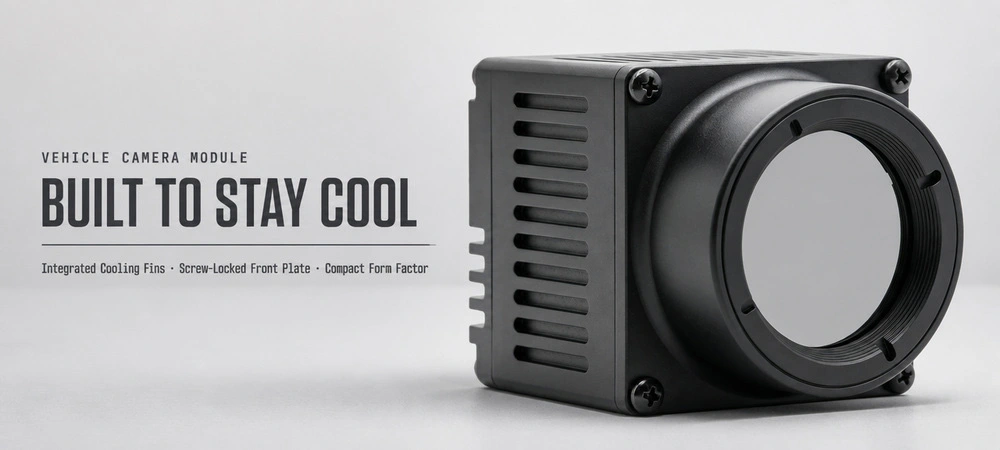
The best automotive thermal car camera delivers reliable heat-signature imaging across all driving conditions — darkness, fog, rain, or glare. Unlike standard dash cams or RGB-based ADAS sensors, a high-performance thermal car camera uses an uncooled VOx microbolometer operating in the 8–14μm LWIR spectrum to detect pedestrians, animals, and vehicles well beyond the reach of headlights. Key defining features include NETD sensitivity < 40 mK, resolution up to 640×512, AI-powered detection, IP67 protection, and ISO 26262 functional safety compliance — making it a mission-critical component for modern vehicle safety architectures.
Why Automotive Thermal Cameras Are Redefining Vehicle Safety
The NHTSA says that night driving is responsible for about 49% of fatal crashes, even though it only makes up a small part of all vehicle miles traveled. That difference shows a real difference in how people see things that regular lights and visible-light cameras cannot fix. The Automotive Thermal Car Camera fills that gap by picking up radiated heat energy instead of reflected light. This means that people walking, bikers, and big animals can be seen even when it is completely dark outside or there is a lot of atmospheric interference.
Understanding the difference between a good thermal imager and a truly field-ready one is important for B2B buying professionals, OEM engineers, and fleet technology managers. It can affect product liability, insurance costs, and customer happiness on a large scale.
Understanding Automotive Thermal Imaging: Technology and Benefits
How Thermal Imaging Differs from Standard IR Cameras
Normal near-infrared (NIR) cameras still need an outside light source and have trouble with headlight glare. Long-wave infrared (LWIR) thermal cameras, on the other hand, do not do anything; they just read the thermal radiation that everything warm gives off. This means that there are no electromagnetic leaks and the object is not vulnerable to high-beam glare. A thermal imager adds a layer of awareness that radar or LiDAR alone cannot do, especially in fog, dust, or smoke, when combined with them in an ADAS sensor-fusion stack.
Practical B2B Benefits Worth Quantifying
When thermal imaging is built into fleet or OEM systems, results can be measured. According to a study in the journal Transportation Research Part C, thermal-enhanced pedestrian recognition systems cut the risk of accidents by up to 35% compared to baselines that only used thermal night driving cameras. Predictive maintenance uses are also very appealing. For example, thermal night driving cameras can find brake systems that are overheating, alternators that are failing, and wire harnesses that are overstressed before they break down on the side of the road. This directly saves logistics operators money on downtime costs.
Core Features That Define the Best Automotive Thermal Car Camera
Picking the best thermal imaging sensor is more than just picking the one with the most pixels. Each specification leads to a real-life result in terms of safety or integration. Here are the most important things that buying teams should look at very carefully.
Here are the main performance factors that buyers always look for in a vehicle-grade LWIR camera:
- Uncooled VOx Microbolometer Detector — The uncooled VOx microbolometer detector uses vanadium oxide (VOx) microbolometer technology, which offers the best balance of sensitivity and long-term stability. Since it does not need cryogenic cooling, it uses less power, has a smaller size, and lasts longer, all of which are important for high-volume OEM deployment.
- High-Definition Resolution (384×288 / 640×512) — Resolution controls how many heat pixels hit an item far away. With a 9.1mm F/1.0 lens and a resolution of 640×512, the field of view is 45°×37°, and it can identify people up to 150m away and cars up to 200m away. The 384×288 version has a smaller field of view (28°×21°) and works well for forward-looking in the middle of a highway lane, with action distances of 80m for pedestrians and 100m for vehicles.
- NETD ≤ 40mK Thermal Sensitivity — NETD is the most important sign of sensor quality. At ≤40mK @f/1.0, this camera's temperature difference is well below the level needed for accurate separation of people and animals, and it performs better than many mid-range thermal modules that can only reach 50mK or less.
- Frame Rate 25Hz / 50Hz — A 50Hz output keeps motion blur to a minimum for objects that are moving quickly and allows real-time AEB (Autonomous Emergency Braking) processing pipelines. The 25Hz mode works well in situations where the bandwidth is low, but safety-critical responsiveness must not be compromised.
- Spatial Resolution 1.32mrad — This number tells the Thermal Night Driving Cameras exactly how small an item they can see at a certain distance. At 1.32mrad, the camera can tell the difference between a person's silhouette at distances that give drivers 5–8 seconds to react at highway speeds, which is more time than standard headlights can give.
All of these qualities work together as a whole. A high-resolution sensor with bad NETD still makes noisy, uncertain images, and a great sensor in a case that does not seal well breaks after a few months of being exposed to road debris. For volume buying, the only way to make sense is to look at all the factors together.
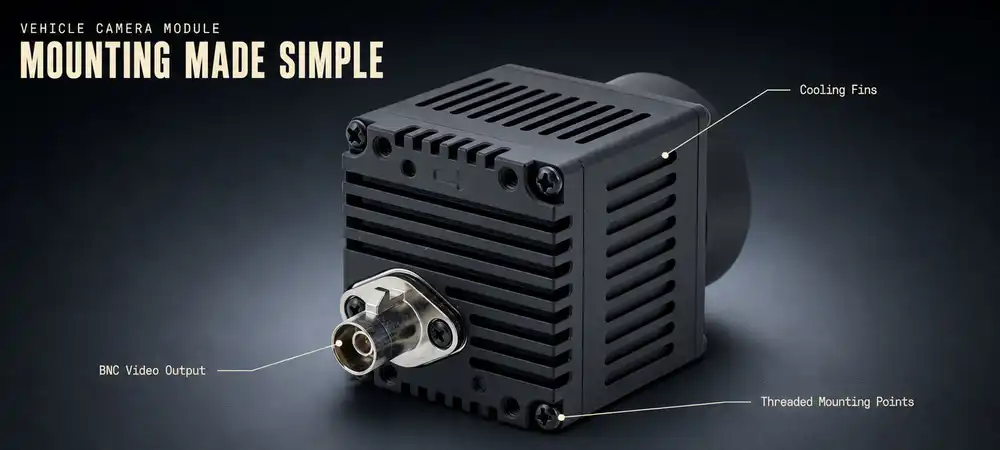
The interface and environmental ratings matter equally for integration readiness. It is easy to use with other in-car video and DVD players thanks to the RCA/CVBS analog video output (PAL 720×576 / NTSC 720×480). With USB Type-C communication, you can update firmware and do diagnostics without having to use special tools. Automotive-grade longevity in all regions is confirmed by IP67 sealing, a storage temperature range of -40°C to +85°C, and AEC-Q100 certification.
How to Choose the Right Thermal Car Camera for Your Business
Aligning Specifications with Operational Requirements
Fleet workers who go on long trips need the 640×512 version because it has a longer detection range and a bigger field of view. OEM integration teams that are making ADAS stacks for passenger cars will make ISO 26262 ASIL-B compliance a must. The diagnostic application, which finds electrical hot spots and brake fade, is usually the main reason why people buy equipment for service centers, and the 384×288 module may be enough for them.
Vendor Reliability and OEM/ODM Capability
Scalable procurement needs more than just specification sheets; it also needs stable suppliers. For a car thermal imager that is ready for production, quality control standards include ISO 16750-4 thermal cycling, ISO 16750-3 mechanical vibration, IP69K high-pressure jet sealing verification, NETD gain uniformity calibration, lens heater de-icing performance, and CISPR 25 EMC testing. Before committing to large orders, buyers should ask for written test results for each of these measures.
Real-World Applications: Where Thermal Imaging Delivers Measurable ROI
Thermal photography for cars is no longer just a proof of concept. Many big European logistics companies say that the number of wildlife strikes has gone down by 20–30% since they put forward-looking LWIR cameras on their long-haul fleets. With over 95% accuracy, AI-powered pedestrian classification supports FCW (Forward Collision Warning) triggers that give drivers a decisive early warning edge, especially on country roads where animals cross without notice.
The thermal camera is used as a backup biological danger detector in multi-modal sensor sets for developing self-driving cars. LiDAR pulses get scattered in thick fog, and RGB cameras lose contrast when it is cloudy at night. But the LWIR channel keeps making clear, usable images. From SAE Level 3 on up, this redundancy is required by architecture and cannot be skipped.
Conclusion
To pick the best automotive thermal car camera, you need to look at the science of the sensors, the intelligence of the software, the sturdiness of the structure, and the trustworthiness of the supply chain as a whole. The current engineering standard for vehicle-grade thermal perception is an uncooled VOx microbolometer with a NETD of < 40 mK, a resolution of 640×512, and compliance with ISO 26262. If procurement teams know about these factors, they can confidently and legally make decisions about where to get products. These choices will lead to safer products, less risk for warranties, and better competitive standing in the OEM and fleet markets.
FAQ
1. Can a thermal car camera see through automotive glass?
No, LWIR rays cannot get through regular glass. To keep its full spectral sensitivity, the camera needs to be mounted on the outside of the car or have a special germanium window built into the body.
2. What protection rating should an automotive thermal camera carry?
IP67 is the bare minimum for use on the road. IP69K adds resistance to high-pressure jets and is recommended for heavy commercial vehicles that will be washed down.
3. Does higher resolution always mean better pedestrian detection?
The higher the resolution, the more pixels are on target at a given range. For example, 640×512 resolution lets you see beyond 150 meters, but the NETD sensitivity and lens quality decide whether those pixels have useful thermal contrast.
4. How does this camera integrate with existing ADAS platforms?
The CVBS analog output can connect directly to most display and recording systems inside the car. The USB Type-C interface, on the other hand, lets you do troubleshooting and control software without any special hardware.
5. Is manual calibration required during operation?
Thermal cameras made for cars that have automated gain uniformity calibration algorithms keep the image quality the same across the whole operating temperature range, without the driver having to do anything.
Partner with MHNV® — Your Trusted Automotive Thermal Car Camera Supplier
From its factory in Xi'an, China, MHNV® designs and makes thermal imaging products for the car industry. Since 2013, the company has served OEM clients and distributors in more than 60 countries. Our line of automotive thermal car cameras is ready for OEM/ODM customization. They are made with VOx microbolometer technology, have a NETD of less than 40 mK, and meet ISO 26262 ASIL-B standards. To get specs, samples, or a bulk price matrix, email Sarah at sarah@mh-elec.com.
References
1. National Highway Traffic Safety Administration (NHTSA). Traffic Safety Facts: Nighttime Driving. U.S. Department of Transportation, 2022.
2. Kruse, J. M., & Berndt, H. "Pedestrian Detection Performance of Far-Infrared Camera Systems in Real Traffic." Transportation Research Part C: Emerging Technologies, 2019.
3. International Organization for Standardization. ISO 26262: Road Vehicles — Functional Safety. ISO, 2018.
4. Society of Automotive Engineers. SAE J3016: Taxonomy and Definitions for Terms Related to Driving Automation Systems. SAE International, 2021.
5. Vollmer, M., & Möllmann, K.-P. Infrared Thermal Imaging: Fundamentals, Research and Applications. Wiley-VCH, 2018.
6. International Electrotechnical Commission. CISPR 25: Vehicles, Boats and Internal Combustion Engines — Radio Disturbance Characteristics. IEC, 2021.
YOU MAY LIKE