Can an Automotive Thermal Car Camera Detect Roadside Hazards?
An automotive thermal car camera can reliably detect roadside hazards that standard cameras and human eyes completely miss. By capturing heat signatures in the 8–14μm long-wave infrared spectrum, this technology identifies pedestrians, animals, and stalled vehicles in total darkness, dense fog, heavy rain, and glare conditions. Unlike conventional dash cams dependent on visible light, a thermal car camera delivers consistent, real-time hazard awareness regardless of ambient lighting. For fleet operators and automotive OEMs, this translates directly into fewer collisions and measurably improved driver response time.
Understanding Automotive Thermal Car Cameras and Their Capabilities
Infrared cameras on modern cars work in a very different way than visual sensors built on silicon. They measure emitted thermal radiation instead of reflected light, which makes things that aren't visible visible.
How the Uncooled VOx Microbolometer Works
The Automotive Thermal Car Camera from MHNV® has a Vanadium Oxide (VOx) microbolometer device that works in the 8–14μm LWIR band and is not cooled. When infrared light hits a pixel, it changes its electrical resistance. The processor then turns this information into a temperature-mapped picture. With NETD ≤ 40mK at f/1.0, the sensor can tell the difference between temperatures that are less than 0.04°C, which is enough to tell the difference between a warm person walking on the sidewalk and the cold asphalt behind them from a distance. The higher-density array has a resolution of 1.32 mrad and comes in two sizes: 384×288 and 640×512. This lets you tell the difference between objects at far distances.
Key Operational Parameters
The gadget has a germanium lens with a focal length of 9.1 mm and an aperture of 1.0. Depending on the setting chosen, it has a field of view of either 28°×21° or 45°×37°. Frame rates of 25Hz or 50Hz make sure that the video output through the RCA/CVBS interface is smooth and free of latency. It works with both PAL (720×576) and NTSC (720×480) display standards. A USB Type-C port for transmission lets you update the software and connect the system to it. The case is protected by IP67 and works successfully in temperatures ranging from -40°C to +85°C, which is real automotive-grade toughness.
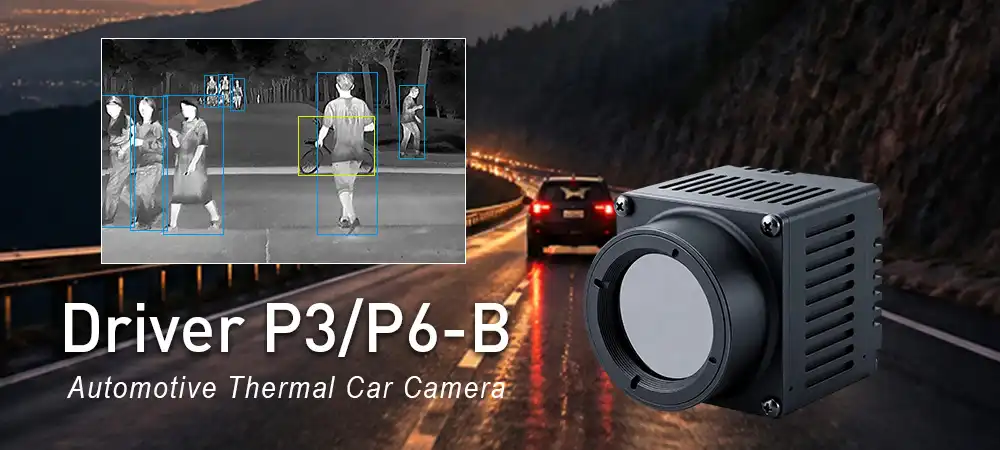
Thermal Car Cameras vs. Traditional Vision Systems: Which Is More Reliable?
Both regular dash cams and near-infrared night vision illuminators have a major flaw: they need light to work. Rain scatters light, fog soaks it up, and oncoming high beams completely blind them. Any sensor that depends on light can't see an animal standing by the side of the road in a rural area that isn't well lit.
An Automotive Thermal Car Camera picks up energy that things give off instead of energy that is reflected off of them. Because of this actual difference, the most common ways that systems fail are no longer possible. Take a look at these confirmed performance numbers from MHNV®'s LWIR camera line:
- All-weather imaging: The Thermal Night Driving Cameras take clear pictures in the dark, in the rain, in the snow, in the fog, and in strong sunlight with no glare.
- Extended detection range: Depending on the resolution level, pedestrians can be found at 80–150m and vehicles at 100–200m. This is about three times the range of a normal high-beam headlight.
- Passive operation: There is no need for an infrared illuminator. The monitor doesn't send out any electromagnetic waves, so it won't mess up radar, LiDAR, or CAN-bus systems on board.
- AI-powered classification: Integrated algorithms correctly identify live things over 95% of the time, helping with features like Forward Collision Warning (FCW) and Autonomous Emergency Braking (AEB).
These benefits deal with the specific types of failures that cause dangerous false negatives in current systems. A transportation team that drives through rural areas at night has an extra 5–8 seconds to respond, which directly decreases the risk of accidents.
How Thermal Car Cameras Detect Roadside Hazards: Technical Insights
More than just sensor sensitivity affects how well a detection works. Calibrated optics, precise image processing, and tested system integration are all parts of the signal chain that goes from photon to driver alert.
ADAS Integration and Signal Processing
The Automotive Thermal Car Camera from MHNV® sends out a standard CVBS analog signal, so it works with all ADAS head units, DVRs, and multi-camera fleet control tools that are already out there. The 50Hz frame rate keeps motion blur to a minimum at fast speeds, and the shutterless design uses automatic internal Non-Uniformity Correction (NUC) to keep picture quality stable as temperatures change, so the driver doesn't have to do anything.
Reliability Under Automotive-Grade Stress
The quality control for this Thermal Night Driving Camera is based on a strict test procedure that is in line with standards in the automobile industry. Thermal cycling according to ISO 16750-4 proves that the device can work from -40°C to +85°C. ISO 16750-3 vibration and mechanical shock testing models how much stress a car will be under on the road over its lifetime. The integrity of the hermetic seal has been confirmed by IP69K high-pressure water jet testing. Crosstalk with other car ECUs is prevented by EMC tests according to CISPR 25. The device also has AEC-Q100 component certification and ISO 26262 ASIL-B functional safety compliance, which is the same standard that Tier 1 automotive suppliers look for.
Procurement Considerations When Choosing an Automotive Thermal Car Camera
When B2B buyers look for an Automotive Thermal Car Camera for a fleet or for OEM integration, they have to make a lot of choices. Not only unit price but also sensor performance, system compatibility, supply chain stability, and assistance after the sale all affect the total cost of ownership.
The resolution level directly controls the range of recognition. The 640×512 configuration increases the range for detecting pedestrians to 150m and vehicles to 200m. The 384×288 configuration, on the other hand, is better for cost-effective uses where an 80m range for pedestrians and a 100m range for vehicles is enough. The two have the same IP67 protection, RCA output, and temperature sensitivity (NETD ≤ 40mK). This makes it easier to integrate them across groups that are made up of different types of devices.
With sample lead times of 15–25 days and mass production processes of 30–45 days, MHNV® can help with both OEM and ODM purchases. Within 3–7 days, stock units are sent out. With framework logistics agreements with DHL, FedEx, and UPS, the company can deliver from door to door in 5–8 days anywhere in the world. It also has ISO 9001:2015 certification and ships all of its products with full CE and RoHS documentation. A third-party logistics (3PL) overseas transit warehouse in Los Angeles serves buyers in North America who need stock from the region.
In this product area, being open with your suppliers is important. MHNV® has been a verified Alibaba Gold Supplier for 11 years in a row and takes part in well-known industry events like SHOT Show USA and Enforce Tac Germany. These are signs of a stable presence in the market and a commitment to being responsible.
Conclusion
A well-designed automotive thermal car camera changes what a driver or an ADAS system can see at night and in bad weather in a big way. LWIR detection gets rid of the main problems with light-based sensors, allowing for accurate detection of dangers at ranges that allow for actionable reaction time. Long-term ROI is based on how well the sensors work, how well the cameras work with other systems, and how reliable the source is for business-to-business buyers looking at car infrared cameras. MHNV®'s LWIR camera line meets standards for car use and gives OEM/ODM freedom to meet a wide range of fleet and integration needs.
FAQ
1. Can a thermal camera detect animals and pedestrians at night?
Yes. No matter how bright it is outside, the LWIR sensor can pick up on body heat. MHNV®'s Automotive Thermal Car Camera can tell the difference between people walking up to 150 meters away and cars driving up to 200 meters away (640×512 setup), and its AI can classify live things more accurately than 95% of the time.
2. How is a thermal camera different from a night vision camera?
Night vision boosts any visible or near-infrared light that is present. It doesn't work in complete darkness or thick fog. An Automotive Thermal Car Camera picks up heat energy that is being given off. It doesn't need any light to work and can still do its job in total darkness.
3. Can the camera integrate with existing ADAS platforms?
Yes. The RCA/CVBS output and USB Type-C link let you connect directly to common ADAS head units, DVRs, and fleet telematics systems without the need for special gear.
4. Does the camera require frequent recalibration?
No, the automatic NUC (Non-Uniformity Correction) algorithm keeps the picture consistent even when the temperature outside changes. The driver or expert does not have to do anything.
5. What certifications does this product hold?
The camera meets the guidelines for AEC-Q100 parts, ISO 26262 ASIL-B functional safety, IP67 ingress protection, and EMC tests according to CISPR 25.
Partner With MHNV® — Your Trusted Automotive Thermal Car Camera Supplier
MHNV® has a full line of LWIR Automotive Thermal Car Cameras made for cars that are designed to work with OEM systems and be used by fleets. As a manufacturer of automotive thermal car cameras, we can do full-stack research and development, optical design, firmware customization, and production that is ISO 9001:2015-certified. You can ask for a product list, specification sheet, or bulk price matrix by getting in touch with our expert team. To set up a live product presentation, email Sarah at sarah@mh-elec.com.
References
1. Society of Automotive Engineers (SAE International). thermal imaging Systems for Automotive Safety Applications. SAE Technical Paper Series, 2022.
2. National Highway Traffic Safety Administration (NHTSA). Pedestrian Safety and Advanced Driver Assistance Systems: Technology Assessment Report. U.S. Department of Transportation, 2023.
3. FLIR Systems (Teledyne FLIR). Automotive Thermal Camera Integration Guide for ADAS. Teledyne FLIR Technical Documentation, 2023.
4. ISO. ISO 26262: Road Vehicles — Functional Safety, Parts 1–12. International Organization for Standardization, 2018.
5. IEEE Transactions on Intelligent Transportation Systems. Long-Wave Infrared Pedestrian Detection in Autonomous Vehicles: A Benchmark Study. IEEE, 2022.
6. AEC (Automotive Electronics Council). AEC-Q100: Failure Mechanism Based Stress Test Qualification for Integrated Circuits. AEC Standard, Revision H, 2014.
YOU MAY LIKE