Is a Fusion Night Vision Goggle Worth the Investment?
If you are a procurement professional evaluating night observation equipment, the short answer is yes — a fusion night vision goggle delivers measurable operational value that neither a standalone image intensifier nor a thermal monocular can replicate alone. By combining Gen 2+/Gen 3 image intensification tubes with an uncooled thermal channel, a fusion night vision goggle eliminates the fundamental blind spots each technology carries independently. The result is a single head-worn device capable of target detection in total darkness, adverse weather, and dense foliage — conditions where single-spectrum systems routinely fail.
Understanding Fusion Night Vision Goggles: Features and Technology
What Makes the Architecture Different
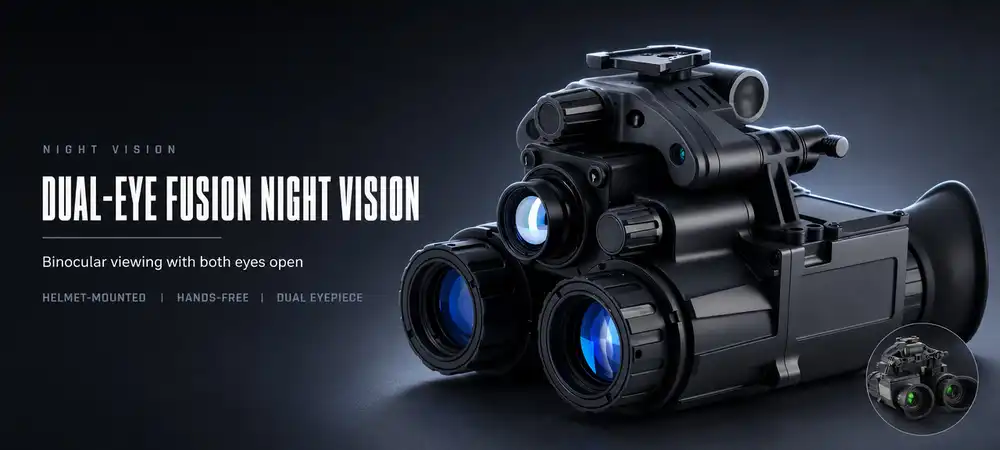
The MHNV MH-F-PVS31 is a good example of what a Fusion Night Vision Goggle made by professionals should look like. It works with two Gen 2+ or Gen 3 image intensifier tubes that move independently and a 640×512 uncooled VOx microbolometer thermal channel. The two-tube stereoscopic design is important because it gives you a natural sense of depth that a single-tube monocular can't physically provide. At the same time, the co-registered thermal overlay shows you warm objects that the IIT channel alone would miss. This multispectral design is what makes a real fused night vision system stand out.
Core Specifications That Drive Performance
You can manually focus the MH-F-PVS31's IIT channel from 250 mm to infinity and adjust the diopter range from -4 to +2 for each eye. The field of view is 40°. The FOM grades range from 1200 to 1800, and autogating is normal on all of them. The thermal channel has a resolution of 640×512 pixels, a NETD of less than 40 mK, a field of view of 24×18°, and must be shown on a screen that is at least 1024×768 pixels. Field-selectable viewing modes, such as low-light only, thermal only, and blended fusion, let operators change viewing modes to fit watching, searching, or identifying jobs without having to switch devices.
The built-in functions go beyond optics and include an electronic zoom, an electronic compass, pitch indication, WiFi streaming, intelligent target tracking, photo and video capture, and playback. All of these functions can be used from the goggle body without taking off the helmet. Commanders can use WiFi to send the live goggle feed to a smartphone or a command post, which is something that traditional IIT-only goggles can't do.
Comparing Fusion Goggles with Other Night Vision Technologies
A vintage PVS-14 monocular is a tried-and-true, low-cost tool, but it has a major flaw: viewing through a monocular doesn't give you any depth cues like using binoculars would, which makes operators tired and increases navigation errors after long periods of use. The AN/PVS-7 has two eyepieces, but it only sends a single IIT picture to both eyes, so it doesn't really separate the stereo images. In addition to adding thermal detection, a fusion night vision goggle with two tubes solves both issues simultaneously.
Comparing detection ranges can teach you a lot. The MH-F-PVS31 can detect and identify a humanoid target from 1,000 meters away and a vehicle from 2,500 meters away, according to verified performance data. Customers can easily compare those numbers to the L3Harris ENVG-B or other fusion platforms since they are written directly on the public spec sheet and don't use vague "up to" language.
There are thermal monoculars on the market that cost less than $1,000, but they usually only have 320×240 resolution, don't improve the picture, and don't let you see depth. They are used for different things. A purchasing team outfitting people for vehicle security, forward observation, or search-and-rescue operations will quickly discover that a thermal-only device at that price tier does not match the performance envelope of a real Fusion Night Vision Goggle.
Evaluating the Investment: Performance, Reliability, and Cost Considerations
The price of acquisition is only one factor that is used to judge a purchase. When operations go on all the time, battery runtime is very important. The MH-F-PVS31 has an external 2×18650 battery box that lets the power be managed and expanded without stopping the task. The anti-corrosion coating on the IP67-sealed housing lets it be used in environments from -40 °C to +50 °C, such as the coast, the desert, the Arctic, and the jungle. That makes it less likely that you'll need to replace or fix things.
These are the main things that affect how much it costs to own a dual-spectrum Fusion Night Vision Goggle:
- Tube grade selection: The FOM 1200 is good for standard patrol duties, but the FOM 1600 or 1800 should be upgraded for forward observation duties where the ability to detect things at a distance is crucial to operations.
- Maintenance simplicity: The thermal microbolometer is solid-state and doesn't need high-voltage service, which makes it easy to maintain. The germanium objective lens needs to be cleaned in a special way every so often to keep its IR transmission, but under regular use, none of the replaceable parts break down.
- Warranty and after-sales support: The MH-F-PVS31 comes with a 1-year maker warranty, serialized QC data sheets for each tube, and 24-hour pre- and post-sales help in CN, EU, and US time zones.
All of these things make the investment safer than people usually think when they are looking at a premium fused night vision system for the first time.
Procurement Guide: How to Buy Fusion Night Vision Goggles for Your Business
Sourcing, Customization, and Logistics
To get a real fusion night vision goggle, you need to buy it from a reputable company that has proof of compliance. MHNV® is certified to ISO 9001:2015 and makes goods that meet CE, RoHS, and FCC standards so they can be sold in the EU and the US. Each image intensifier tube comes with a serialized QC data sheet that lists SNR, FOM, resolution, halo, and EBI. This is the proof that separates a reliable supplier from a shady seller.
The MH-F-PVS31 mounts using a dovetail and shroud-compatible helmet interface that works with the PVS-31, Ops-Core, and Team Wendy shroud ecosystems. This means that teams that already use that mounting standard can just drop it into their existing fleet. The goggle body is 125 mm long, 105 mm wide, and 94 mm thick, and it weighs 660 g without the battery. The interpupillary distance can be changed from 58 mm to 78 mm, which fits head sizes from the 5th to the 95th percentile.
MHNV® helps OEMs and ODMs buy things. Pilot orders start at one unit for finished devices and ten units for image intensifier tubes. Lead times for mass production are 30 to 45 days. You can ask for volume discount matrices, and there are foreign transit stores in Los Angeles and Rotterdam that serve returning bulk customers with tight delivery times.
Why Fusion Night Vision Goggles Are a Preferred Choice in Professional Markets
Since 2013, MHNV® has been in the business of night vision and thermal imaging. They serve customers in more than 60 countries who use their products for hunting, security patrol, industrial inspection, and things that are related to defense. The company does all of its own research and development, including developing algorithms, designing FPGAs, writing embedded firmware, doing optical engineering, designing mechanical parts, and testing. It is one of the few Chinese companies that has its own auto-gating circuits and an image fusion algorithm.
That level of engineering detail is not a coincidence. It means that the MH-F-PVS31 Fusion Night Vision Goggle is a system in which the IIT, thermal channel, fusion algorithm, and display pipeline are all designed to work in harmony. People who are looking at night vision goggles from more than one seller will not find a lot of openness.
Conclusion
Neither thermal-only devices nor IR-only devices can match the capabilities of a fusion night vision goggle. The MHNV MH-F-PVS31 has a form factor that is suitable for helmets, and offers confirmed long-range detection, true stereoscopic depth awareness, a full digital function suite, and MIL-grade environmental resistance. The operational return on a fused night vision system is not marginal for B2B buyers, distributors, and integrators who need to equip people who work in environments that are hard to predict.
FAQ
1. How long does the battery last on a fusion night vision goggle?
The MH-F-PVS31 has an extra 2×18650 battery box that lets the power control be switched out in the field. Runtime changes depending on the mode chosen; using low-light mode only saves a lot of power compared to full fusion mode with WiFi turned on. Depending on the sensor load, the majority of expert Fusion Night Vision Goggle platforms last between 8 and 15 hours.
2. Can the thermal channel operate independently?
Yes. There are three field-selectable modes on the MH-F-PVS31: low-light only, thermal only, and mixed fusion. Without taking off their helmets, operators choose the setup that works best for their surroundings.
3. What maintenance does the thermal sensor require?
The VOx microbolometer is solid-state and physically strong. To keep the infrared transmission going, the germanium objective lens needs to be cleaned with special solutions on a regular basis. Regular optical cleaners won't work on germanium surfaces.
4. Is the MH-F-PVS31 compatible with existing helmet mounting systems?
The goggle has a mount that works with dovetails and shrouds and is compatible with the PVS-31, Ops-Core, and Team Wendy ecosystems. This means that it can be used directly with current fleet equipment without the need for extra upgrades.
5. What is the operating temperature range?
With an IP67 rating, the housing can work in temperatures ranging from -40 °C to +50 °C, so it can be used in the Arctic, the desert, the coast, and the jungle.
Request a Quotation for the MHNV® MH-F-PVS31 Fusion Night Vision Goggle
With full-stack OEM/ODM capabilities, ISO 9001:2015 certification, and a proven track record of supply across more than 60 countries, MHNV® is a recognized fusion night vision goggle manufacturer. The MH-F-PVS31 has a 640×512 thermal channel and Gen 2+/Gen 3 IR performance. It is a helmet-ready platform that can be ordered for pilot projects or in large quantities. You can email our team at sarah@mh-elec.com to get pricing information, specifications, and a personalized procurement proposal.
References
1. Holst, G. C. Electro-Optical Imaging System Performance. SPIE Press, 2008.
2. Rogalski, A. Infrared Detectors. CRC Press, 2010.
3. Lloyd, J. M. Thermal Imaging Systems. Plenum Press, 1975.
4. Night Vision and Electronic Sensors Directorate (NVESD) Technical Report: Image Intensifier Tube Performance Standards. U.S. Army DEVCOM, 2019.
5. Hecht, E. Optics, 5th ed. Pearson Education, 2017.
6. Jane's Electro-Optic Systems: Night Vision and Thermal Imaging Equipment Review. Jane's Information Group, 2022.
YOU MAY LIKE