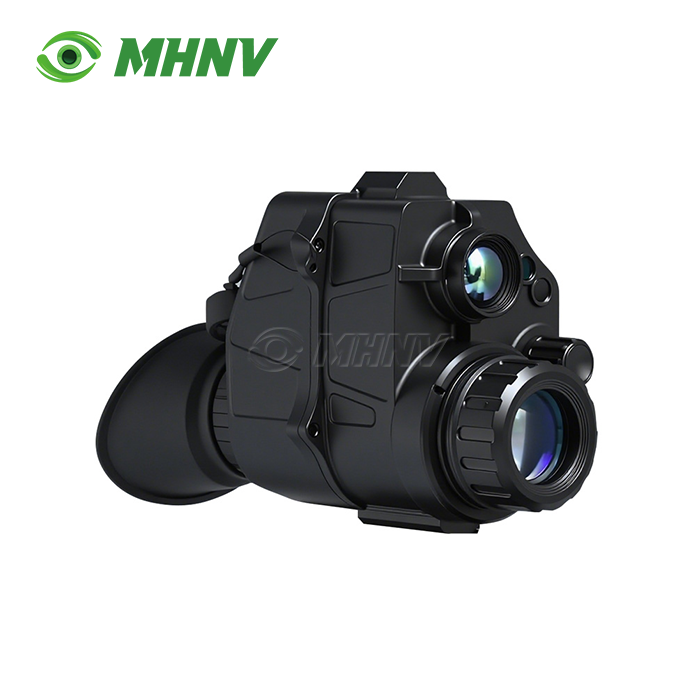
Fusion Night Vision Monocular
Fusion Night Vision Monocular – Dual-Channel IIT + Thermal PVS-14 System for Enhanced Target Detection
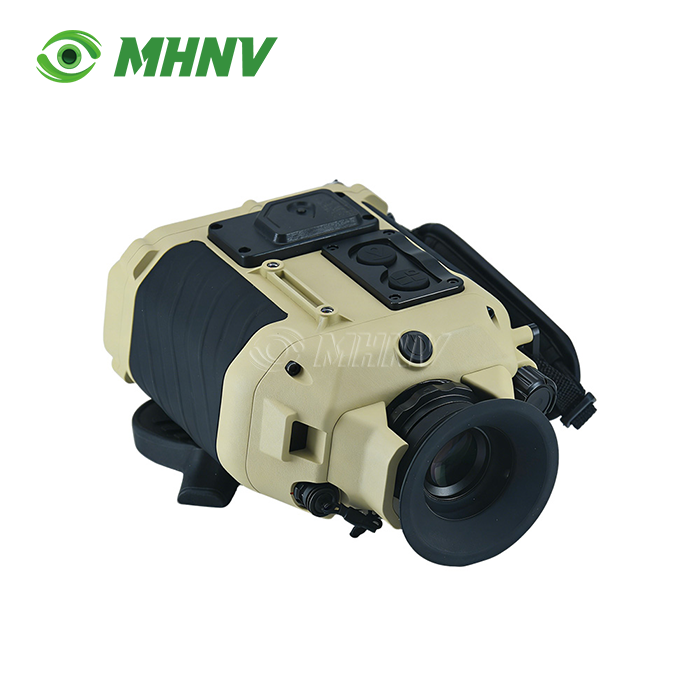
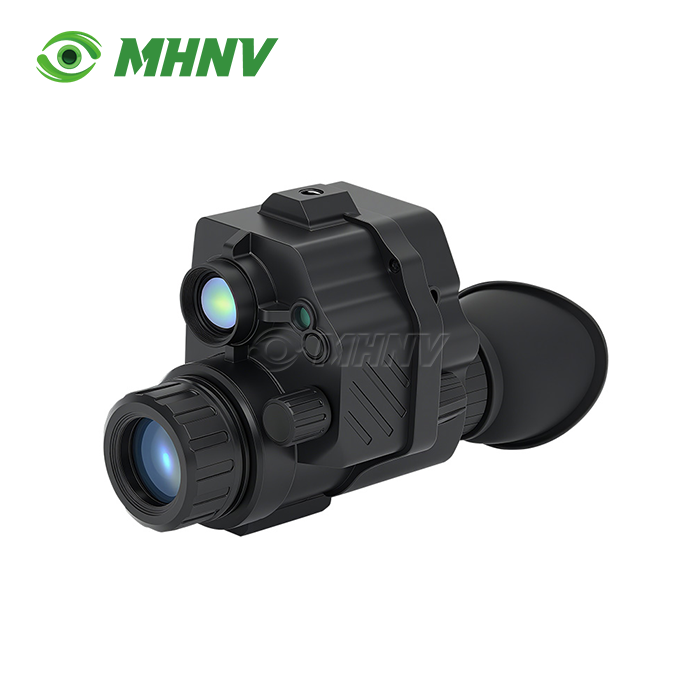
Fusion Night Vision Monocular technology merges Gen 2+/Gen 3 image intensification and 640×512 thermal imaging into one optical pathway, solving critical limitations of single-sensor systems. Xi'an MH Electronics' MHNV MH-F-PVS14 model integrates an 18 mm autogating image intensifier tube with FOM ratings from 1200 to 1800, resolution exceeding 60 lp/mm, and a 640×512 VOx microbolometer with NETD below 40 mK, all within a compact 124 × 56 × 88 mm housing under 350 g. The dual-channel architecture overlays live IIT and thermal images through pixel-level co-registration across a 40° IIT FOV and 24°×18° thermal FOV, delivering unbroken situational awareness.
How Fusion Night Vision Monocular Technology Eliminates Detection Gaps?
Traditional image intensifier tubes require ambient moonlight or starlight and cannot detect heat signatures concealed behind foliage. Standalone thermal sensors identify heat sources but lack fine geometric detail for navigation. A product combines both sensor streams into one synchronized view.
The MHNV MH-F-PVS14 processes signals from a Gen 2+ or Gen 3 IIT channel and a 640×512 thermal channel through real-time FPGA-based fusion algorithms. Users select IIT-only mode for high-resolution detail in moderate moonlight, thermal-only mode in complete darkness, or blended fusion to overlay heat signatures onto optical structure.
Picture-in-picture displays thermal insets for selective threat checks. Outline and highlight overlay modes trace thermal edges onto the IIT scene, preserving spatial orientation while tagging heat sources. Six thermal palettes—White Hot, Black Hot, Red Hot, Outline, Highlight, and Thermal—adapt contrast for sunrise, dusk, artificial lighting, and zero-light scenarios.
This multi-mode capability replaces the need to carry separate devices or toggle between handheld thermals and helmet-mounted NVGs.

Technical Specifications
| Parameter | Specification |
|---|---|
| Model | MHNV MH-F-PVS14 |
| Architecture | Fused IIT + thermal single-eye monocular |
| IIT Class | Gen 2+ or Gen 3 selectable |
| IIT FOM | 1200 (standard), 1400 / 1600 / 1800 upgrades |
| IIT Resolution | ≥60 lp/mm |
| IIT Autogating | Standard on every grade |
| IIT Objective Focal Length | 26 mm |
| IIT Focus Range | 250 mm to infinity |
| IIT Field of View | 40° |
| IR Illuminator | 940 nm covert |
| Thermal Detector | Uncooled VOx microbolometer |
| Thermal Resolution | 640 × 512 pixels |
| Thermal Pixel Pitch | 12 µm |
| Thermal NETD | <40 mK |
| Thermal Refresh Rate | 50 Hz |
| Thermal Objective | 18 mm F1.0 germanium |
| Thermal Field of View | 24° × 18° |
| Thermal Palettes | White Hot, Black Hot, Red Hot, Outline, Highlight, Thermal |
| Fusion Magnification | 1.0× ±5% |
| Diopter Adjustment | −5 to +4 |
| Image Modes | IIT only, Thermal only, PIP, Outline, Highlight, Full Fusion |
| Digital Zoom | Supported |
| Weight | ≤350 g (excluding battery) |
| Dimensions | 124 × 56 × 88 mm |
| IP Rating | IP67 |
| Operating Temperature | −40 °C to +50 °C |
| Power Supply | External 2×18650 lithium pack |
| Mounting | Handheld, head-mount, helmet-mount (PVS-14 compatible) |

Six Operational Modes for Every Field Scenario
Field conditions change quickly. The MHNV system lets operators switch between display modes without disassembly. IIT-only mode maximizes battery life during patrolling under adequate starlight. Thermal-only mode delivers uninterrupted vision when smoke, dust, or muzzle flash saturates the image intensifier channel.
Picture-in-picture presents a thermal inset window over the full IIT view for fast thermal scans while maintaining primary optical navigation. Outline overlay traces thermal edges in glowing lines over the intensified image. Highlight overlay colors hot spots above a user-set temperature threshold. Full blended fusion merges both channels at adjustable opacity for maximum detail density.
Each mode responds to specific tactical needs. Outline mode preserves low-profile viewing during covert operations. Highlight mode accelerates search-and-rescue sweeps by tagging body heat against cold terrain. Full fusion maximizes target discrimination when scanning mixed environments with warm machinery and cool structures.
PVS-14 Housing Ensures Drop-In Compatibility
The 124 mm length and standard dovetail interface match dimensions of conventional PVS-14 monoculars. Existing helmet mounts, J-arms, skull-crushers, and dual-bridge accessories fit the MHNV MH-F-PVS14 without modification.
Teams already equipped with PVS-14 mounting ecosystems integrate the Fusion Night Vision Monocular into current workflows without retraining or purchasing proprietary brackets. Diopter adjustment from −5 to +4 accommodates operator vision requirements.
Weight under 350 g maintains helmet balance during extended wear. The external 2×18650 battery pack relocates mass to the rear helmet mount or vest, reducing front-end fatigue during multi-hour operations.
IP67 Sealing and Extreme-Temperature Performance
Full IP67 sealing protects internal electronics and optics against dust ingress and submersion to 1 meter for 30 minutes. Coastal patrols in salt spray, monsoon rain, and river crossings do not compromise sensor alignment or display clarity.
Operating range from −40 °C to +50 °C supports arctic border operations and desert assignments. Internal temperature stabilization prevents thermal drift that degrades image registration in mid-tier fusion systems exposed to rapid temperature swings.
Shock and vibration testing verify survivability under armament recoil and vehicle transport over rough terrain, meeting the demands of high-intensity deployment environments.
Grade-Selectable IIT Backbone From FOM 1200 to 1800
MHNV offers the same fusion housing across four IIT performance tiers. FOM 1200 Gen 2+ tubes provide entry-level pricing for training units and reserve fleets. FOM 1400 and 1600 options balance cost and performance for general patrol. FOM 1800 Gen 3 tubes deliver maximum signal-to-noise ratio for premium reconnaissance missions.
This modular approach lets procurement teams ladder one SKU family across budget levels, standardizing training, accessories, and field service on a single platform. Organizations upgrade performance by swapping IIT modules without replacing the complete device or retraining operators on new controls.
OEM and ODM Customization Through Integrated Manufacturing
Xi'an MH Electronics operates complete in-house capabilities for optical design, FPGA processing, firmware development, mechanical engineering, and precision assembly. OEM partners customize IIT grade, thermal palette presets, user interface language, logo placement, and housing materials—aluminum, magnesium, or polymer—within one engineering cycle.
Production lead times range from 15 to 25 days for ODM samples and 30 to 45 days for volume orders. Class-10,000 cleanrooms ensure contamination-free IIT calibration. Each unit ships with serialized QC data documenting SNR, FOM, resolution, halo, and EBI test results.

FAQ
Q: How does a product compare to a standalone image intensifier tube system?
A: It's a product that overlays live thermal imaging on top of the intensified low-light scene to show heat signatures from people, vehicles and hidden objects that are putting out infrared radiation but not enough visible or near-infrared photons for conventional image intensifier tubes to pick up. This is especially true through smoke, fog or dense vegetation that scatters light but is transparent to long-wave infrared wavelengths. This dual spectrum capacity removes the blind spots of detection of single-sensor systems providing complete situational awareness under diverse environmental circumstances without the need of operators to carry or switch between separate devices.
Q: Can the thermal overlay intensity be adjusted separate from the IIT brightness?
A: Yes, professional grade product systems have separate control of channel gain. When the identification of heat signatures is important for search missions, operators boost the brightness of the thermal overlay and subsequently decrease the opacity of the thermal image to preserve fine optical detail when moving across difficult terrain or searching for non-thermal characteristics such as text, wiring, or structural damage.
Q: Can the device operate in complete darkness with no ambient light?
A: Yes, the thermal channel is always working in complete darkness – caverns, basements and moonless gloomy nites – because it senses emitted infrared radiation, not reflected photons. The output of the IIT channel is small without ambient light, but the thermal sensor still has the entire detecting ability and hence enables uninterrupted vision in zero-light conditions, and the operator may maintain situational awareness across illumination shifts.
Q: How is the registration of the IIT and thermal sensors maintained under physical stress?
A: With the use of precision mechanical housings and digital calibration techniques, the sensor axs are fixed in pixel-level co-registration for high-quality product designs. The MHNV MH-F-PVS14 is calibrated at several temperature points and stress tested under simulated armament recoil to demonstrate that thermal outlines are spatially synchronised with IIT geometry throughout the rated operational envelope of −40 °C to +50 °C.
Q: Will this be compatible with normal PVS-14 helmet mounting systems?
A: Yes, the MHNV MH-F-PVS14 has a dovetail interface that is compatible with industry standard PVS-14 form factors. This means it is compatible with Wilcox, Norotos and similar J-arm, skull-crusher and dual-bridge mounts. It's designed for drop-in integration with legacy helmet ecosystems, and requires no proprietary brackets or operator retraining on mounting processes.
Contact MHNV for Custom Fusion Solutions
Contact sarah@mh-elec.com to discuss your Fusion Night Vision Monocular requirements and receive detailed specifications.
YOU MAY LIKE