Thermal Fusion Night Vision Devices
Thermal Fusion Night Vision Devices – Dual-Spectrum PVS-14 Platform with 640×512 Thermal Core and Autogating Gen 2+/Gen 3 Integration
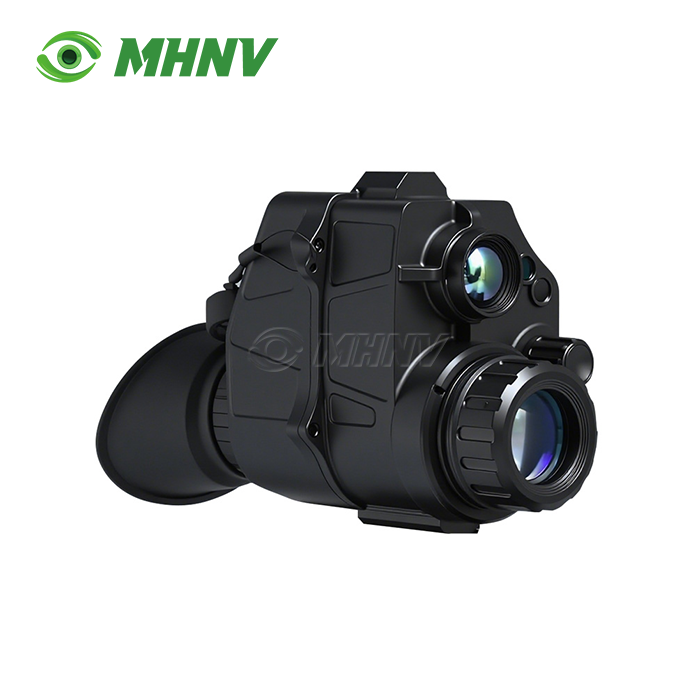
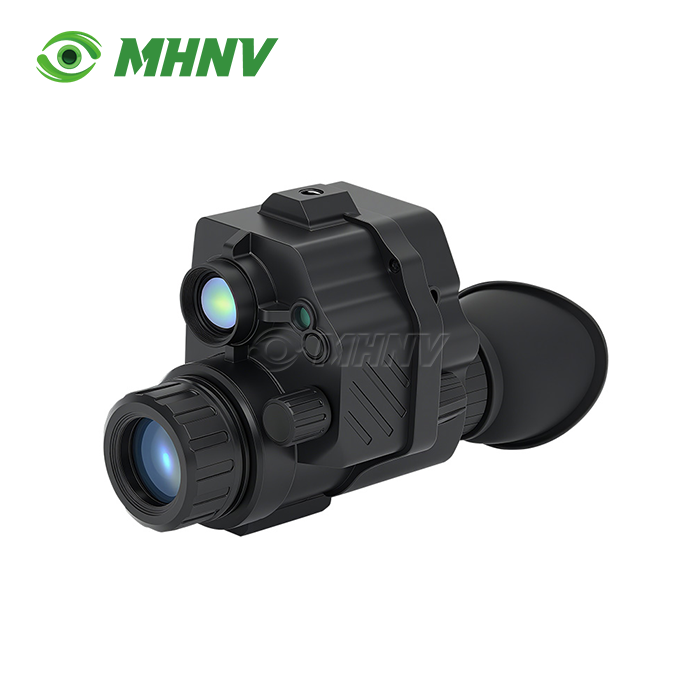
Xi'an MH Electronics And Technology Co., Ltd. introduces the MHNV MH-F-PVS14, a professional-grade dual-sensor monocular delivering co-registered image intensifier and thermal overlay in the industry-standard PVS-14 housing. This system combines an 18 mm autogating Gen 2+/Gen 3 IIT tube (FOM 1200–1800 selectable) with a 640×512 VOx microbolometer operating at 12 µm pitch and NETD <40 mK. The result is pixel-aligned fusion that exposes heat signatures through camouflage, smoke and zero-light scenarios while preserving the spatial detail and texture recognition essential for navigation and identification.
Engineered for law enforcement, search-and-rescue, hunting, and professional observation, Thermal Fusion Night Vision Devices fill the operational gap that single-mode systems cannot address. Offered with six field-switchable display modes and six thermal palettes, this platform adapts in seconds to changing mission demands without requiring hardware swaps or helmet reconfiguration.
Dual-Channel Architecture: IIT and Thermal in One Eye
The MHNV MH-F-PVS14 integrates two independent optical channels into a unified monocular form factor.
The IIT channel features a 26 mm F1.2 objective, 40° field of view, and ≥60 lp/mm resolution extending focus from 250 mm to infinity. Autogating circuitry protects the tube against transient light spikes while maintaining gain across all ambient levels.
The thermal channel uses an uncooled 640×512 VOx sensor at 12 µm pitch paired with an 18 mm F1.0 germanium objective. With a 24°×18° field of view and refresh rate of 50 Hz, the thermal core delivers NETD under 40 mK for reliable detection of sub-degree temperature differentials. Onboard FPGA processing registers both image streams at the display plane, ensuring pixel-to-pixel alignment within ±5 % across the 1.0× magnification window.
Six Display Modes and Six Thermal Palettes for Every Scenario
Operators switch between IIT-only, thermal-only, picture-in-picture, outline overlay, highlight overlay, and full fusion modes through the device menu.
Outline mode applies edge detection to thermal data, rendering heat-signature borders onto the IIT base layer—ideal for scanning dense foliage or structural interiors. Highlight mode emphasizes the hottest regions without obscuring background detail. Full fusion blends both channels at adjustable opacity for maximum information density.
Six thermal palettes—white hot, black hot, red hot, outline, highlight, and thermal—allow instant adaptation to environmental contrast conditions. Combined, these options transform a single housing into a versatile tool set, eliminating the need to carry separate devices for different mission phases.

Technical Specifications
| Parameter | Value |
|---|---|
| Model | MHNV MH-F-PVS14 |
| Architecture | Fused IIT + thermal monocular |
| IIT Class | Gen 2+ / Gen 3 selectable |
| IIT FOM | 1200 standard; 1400 / 1600 / 1800 optional |
| IIT Resolution | ≥60 lp/mm |
| IIT Autogating | Standard on all grades |
| IIT Objective Focal Length | 26 mm |
| IIT Focus Range | 250 mm to ∞ |
| IIT Field of View | 40° |
| IR Illuminator | 940 nm covert |
| Thermal Detector | Uncooled VOx microbolometer |
| Thermal Resolution | 640 × 512 |
| Thermal Pixel Pitch | 12 µm |
| Thermal NETD | <40 mK |
| Thermal Refresh Rate | 50 Hz |
| Thermal Objective | 18 mm F1.0 germanium |
| Thermal Field of View | 24° × 18° |
| Thermal Palettes | White hot, black hot, red hot, outline, highlight, thermal |
| Fusion Magnification | 1.0× ±5 % |
| Diopter Adjustment | −5 to +4 |
| Image Modes | IIT only, thermal only, PIP, outline, highlight, full fusion |
| Digital Zoom | Supported |
| Weight (excl. battery) | ≤350 g |
| Dimensions | 124 × 56 × 88 mm |
| IP Rating | IP67 |
| Operating Temperature | −40 °C to +50 °C |
| Power Supply | External 2×18650 lithium pack |
| Mounting | Handheld, head-mount, helmet-mount (PVS-14 compatible) |
PVS-14 Ecosystem Compatibility and Modular Mounting
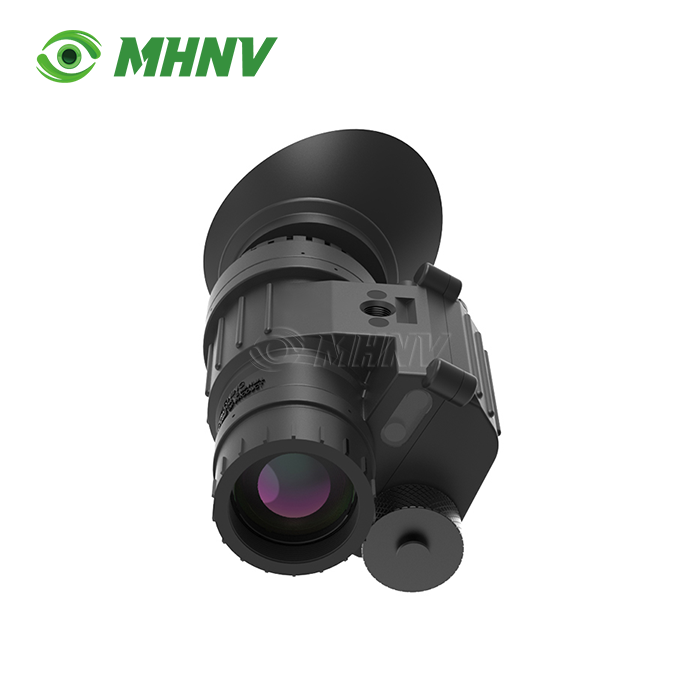
The MH-F-PVS14 is the same size as the historical PVS-14 monocular at 124 x 56 x 88 mm and under 350 g (without battery) and uses the same dovetail/J-arm interface. This compatibility enables for a drop-in installation on current helmet mounts, skull-crushers, dual-bridge systems and nite vision flip assemblies.
Organisations who have already used PVS-14 accessories save the expense and training burden of switching to a proprietary mounting ecosystem. Inventory, spare parts, battery and field-service procedures are consistent, which simplifies logistics for fleet operators and OEM integrators.
Environmental Durability: IP67 and Extended Temperature Range
Housing is sealed to IP67 standards to prevent dust ingress and immersion to 1 metre for 30 minutes to preserve internal electronics. All seams are gasketed and the objective lens is coated with a hydrophobic coating to shed moisture.
Operating temperature ranges from −40 °C to +50 °C, validated by thermal-shock and humidity cycling tests performed according to MIL-STD-810 procedures. All battery performance, FPGA stability and IIT high voltage regulation are within specification over this envelope providing consistent operation in polar patrol, desert reconnaissance, coastal search and rescue and high altitude conditions.

Grade-Selectable IIT Performance from FOM 1200 to 1800
The same fusion enclosure accommodates image intensifier tubes across the FOM 1200, 1400, 1600 and 1800 performance ladder. Buyers select the IIT grade that meets budget, regulatory limits and operational needs without modifying the thermal core, firmware or mechanical assembly.
This modularity enables distributors and OEMs to provide entry, mid-tier and premium SKUs within one product range. Training materials, service paperwork and accessory catalogues have not changed, minimising total cost of ownership and easing the procurement process for agencies operating multi-tier fleets.
Manufacturing and Quality Assurance at MHNV®
Since 2013, Xi'an MH Electronics And Technology Co., Ltd. has operated a vertically integrated facility covering optical design, IIT integration, FPGA development, thermal sensor calibration, and final assembly. The engineering team spans algorithm development, embedded firmware, PCB layout, mechanical design, and testing disciplines.
Every Thermal Fusion Night Vision Devices unit undergoes signal-to-noise ratio verification, MTF analysis, parallax correction, non-uniformity correction (NUC) for the thermal detector, and environmental stress screening. Production occurs in Class-10,000 cleanrooms, and outgoing quality control includes shock, vibration, and immersion testing to ensure field reliability.
ISO 9001:2015 certification, CE compliance, and RoHS adherence govern the manufacturing process. Each device ships with a serialized QC data sheet documenting IIT FOM, thermal NETD, and alignment tolerances.

Global OEM and ODM Customization Services
MHNV® offers full customisations in IIT grade, optical arrangement, firmware interface, housing material, logo positioning and packaging design. Volume pricing is offered for fleet procurement with minimum order quantities for finished devices starting at one piece.
Lead times are between 3-7 days for ready stock configurations and 30-45 days for ODM developments. Customer unique tooling and intellectual property is protected through non-disclosure agreements and non-compete protection.

FAQ
Q: How do the products handle haloing from bright lights?
A: More advanced gadgets incorporate auto-gated image intensifier tubes and digital filters to minimise halo artefacts generated by transient light sources such as car headlights or muzzle flashes. The autogating circuit rapidly ups and downs the tube voltage in response to localised spikes in brightness to prevent blooming and saturation. The thermal overlay is not impacted by visible-spectrum light therefore heat signatures will still be visible if the IIT channel is temporarily washed out providing situational awareness during transitions to dynamic lighting conditions.
Q: Can these devices be utilised in absolute darkness (0 lux)?
A: Yes, thermal sensors are not affected by ambient illumination. They sense long wave infrared radiation generated by objects based on their temperature. The image intensifier component needs trace photons coming from starlight, moonlight or active IR lighting to function, the thermal channel gives a heat-based depiction of the surroundings in complete darkness. The fusion overlay guarantees visual contact with lifeforms, recently used engines, and thermal gradients, even in the complete absence of natural light sources.
Q: Is there a lag of the fused image with rapid head movements?
A: For high-end fusion systems, FPGA-based processing pipelines are used to achieve latency of less than 10 milliseconds from sensor acquisition to display output. The sub-frame delay avoids motion induced nausea and maintains spatial orientation for rapid target acquisition, vehicle operation and high speed patrol. Real-time synchronisation of the IIT and heat data streams, along with hardware accelerated frame buffering, results in a steady and responsive composite image over the entire 50 Hz refresh cycle, meeting the perceptual thresholds for continuous helmet-mounted use.
Q: What is the maintenance cycle for the thermal sensor compared to the image intensifier tube?
A: Image intensifier tubes have a limited lifetime of use, usually rated between 10,000 and 15,000 hours, after which the photocathode sensitivity and resolution decline. In contrast, uncooled microbolometer arrays are solid-state devices that do not have a consumable photocathode and hence have a much longer service life. Thermal detectors, however, require periodic non-uniformity correction (NUC) to compensate for pixel-to-pixel gain changes induced by temperature drift and ageing. Today, we have NUC automated with firmware that starts calibration routines at power-up or at pre-set intervals to keep image clarity without manual interaction or field service.
Q: How does the outline mode work technically?
A: Outline mode uses real-time edge-detection algorithms on the thermal data stream to locate the spatial gradients that make up the boundaries of objects. The FPGA detects high-contrast thermal edges using gradient filters (such as Sobel or Canny operators) and superimposes the contour lines with variable intensity on the IIT base picture. The method provides an outline of heat emitting objects such as humans or animals, against a detailed nite vision background, which allows quick shape recognition and classification, without obscuring the environment background, which is especially useful in cluttered or heavily vegetated areas.
Contact MHNV® for Quotation and Technical Support
For pricing, lead times, OEM customization, or technical consultation on Thermal Fusion Night Vision Devices, contact our export team at sarah@mh-elec.com. We support global logistics and multilingual customer service.
YOU MAY LIKE
.webp "Laser Target Locator Module (LTLM)")