Fusion Night Vision Goggle vs Thermal: Which Is Best for Buyers?
Deciding between Fusion Night Vision Goggle One of the more typical choices purchasers confront when outfitting teams for low-light or night operations is a thermal-only gadget and goggle. There are true positives to each technique, but they tackle distinct challenges – image intensification is good for realistic depth perception, and thermal imaging can see heat signatures independent of ambient-light conditions. Budget, mission type, and projected environmental circumstances drive what method makes more sense for a specific fleet, and getting it wrong might mean paying for capacity a team never ever utilises. We'll discuss how a Fusion Nite Vision Goggle incorporates both technologies, how it performs vs thermal-only systems, and who stands to gain the most from switching to fusion in this post.
What Is a Fusion Night Vision Goggle and How Does It Differ From Thermal-Only Devices?
Before comparing performance, it helps to understand exactly what sets a Fusion Night Vision Goggle apart architecturally from a device that relies on thermal imaging alone.
Dual-Channel Architecture: IIT Plus Thermal
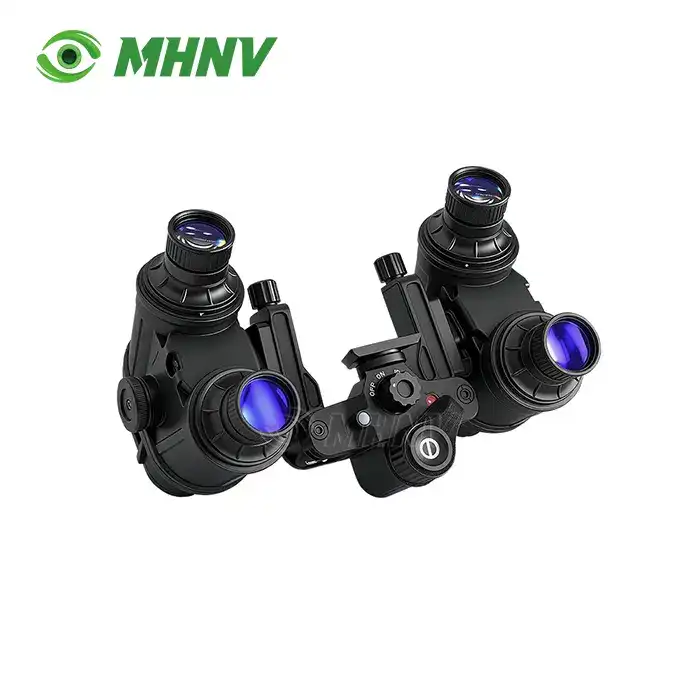
A genuine Fusion Nite Vision Goggle like the MHNV MH-F-PVS31 merges two autogating Gen 2+/Gen 3 image intensifier tubes with a 640 by 512 uncooled thermal channel into one head-worn device. This dual-channel architecture means the gadget is not forced to choose between light amplification and heat sensing but instead offers both concurrently, co-registered into one image. Thermal-only systems, however, rely only on temperature contrast and may have difficulty displaying fine detail on objects that are close to the same temperature as their surroundings—a disadvantage that a Fusion Nite Vision Goggle fully solves by overlaying the two data streams.
Stereoscopic Depth Perception vs Single-Channel Thermal
A very evident benefit of a Fusion Nite Vision Goggle is true stereoscopic depth sensing, using dual IIT tubes rather than a single sensor. This depth signal provided by binoculars is technically impossible to replicate in monocular thermal-only or single-channel thermal goggles and is of great importance for activities such as close-quarter movement, scaling ladders, or negotiating rough terrain at night. Thermal-only devices are still useful for heat detection, but a Fusion Nite Vision Goggle provides the user with a spatial awareness that thermal imaging tends to flatten out into a less-intuitive, two-dimensional image.
Viewing Modes: Low Light, Thermal, and Blended Fusion
Flexibility is another characteristic. The Fusion Nite Vision Goggle is intended to be able to pick presentation styles: low light only, infrared thermal only, and blended fusion overlay, so operators may select the presentation style most suited to the work at hand. A mixed overlay of the heat signatures with a natural-light background is typically more beneficial for search or stalk operations than each channel by itself. That flexibility is why consumers comparing a Fusion Night Vision Goggle to a fixed, thermal-only device generally find the fusion unit more adaptable across shifting mission needs.
| Feature | Fusion Night Vision Goggle | Thermal-Only Device |
|---|---|---|
| Depth perception | Stereoscopic (dual IIT tubes) | Limited, often monocular |
| Viewing modes | Low light, thermal, blended fusion | Thermal only |
| Detail in similar-temperature scenes | Enhanced via IIT overlay | Can be difficult to resolve |
How Does a Fusion Night Vision Goggle Perform Compared to Thermal-Only Systems?
Specifications only tell part of the story — actual detection performance is what buyers ultimately care about most.
Detection and Identification Range on Human and Vehicle Targets
Published performance data provide the customer with something solid to compare a Fusion Nite Vision Goggle to its alternatives. Identification is achieved at 400 m and detection at 1000 m for a 1.7 m humanoid target, whereas on a 5 m vehicle target, identification reaches 1000 m and detection 2500 m. These metrics significant because they are measurable, not some nebulous “up to” number, and they provide purchasers a precise point of comparison when considering a Fusion Nite Vision Goggle vs other fusion or thermal-only systems on the market.
Image Quality and Situational Awareness in Mixed Environments
In mixed illumination and complex surroundings — partial moonlight, vegetation, urban shadows — a Fusion Nite Vision Goggle tends to retain superior overall situational awareness than a thermal-only version. The low-light channel maintains the original scene texture and depth, but the thermal overlay highlights hot targets that could otherwise blend in with the backdrop. Thermal-only devices may still win in total darkness with no ambient light, but under most real-world operating conditions with at least some stars or moonlight, a Fusion Nite Vision Goggle provides a more comprehensive image of the surroundings.
Onboard Functions: Tracking, WiFi Streaming, and Recording
Modern fusion systems are much more than just optics. A good Fusion Nite Vision Goggle usually has electronic zoom, electronic compass, pitch indicator, WiFi streaming, smart target tracking, and picture and video recording with playback – all programmable from the goggle body without removing the helmet. This allows a commander to reflect the goggles' vision onto a smartphone or command post, while an integrated tracker may lock onto a moving target as the operator moves around. Few thermal-only goggles provide this same range of integrated functions in one head-worn gadget.
| Metric | Humanoid Target (1.7 m) | Vehicle Target (5 m) |
|---|---|---|
| Detection range | 1000 m | 2500 m |
| Identification range | 400 m | 1000 m |
Which Buyers Should Choose a Fusion Night Vision Goggle Over Thermal-Only?
With the technical comparison covered, the practical question becomes which use cases actually justify choosing fusion over a simpler thermal-only device.
Mounted Patrol, Driving, and Close-Quarter Movement
For mounted patrol, vehicle driving, and close-quarter movement, a Fusion Night Vision Goggle is generally the stronger choice because stereoscopic depth perception directly supports safe navigation at speed or in tight spaces. Thermal-only systems can leave gaps in spatial judgment that matter when driving on rough terrain or moving through confined structures at night. Teams whose missions blend movement and target detection in the same operation tend to get the most practical value from a fusion device rather than carrying separate thermal and night vision units.
Search and Rescue and Surveillance Applications
Search and rescue teams benefit enormously from a Fusion Night Vision Goggle's ability to spot a heat signature through foliage or debris while still maintaining natural depth perception for safe movement across difficult terrain. Surveillance applications similarly benefit from the blended viewing mode, which helps operators distinguish a genuine target from background clutter more reliably than thermal imaging alone. For these mission types, the added capability of a Fusion Night Vision Goggle often outweighs the higher cost compared to a single-technology thermal device, particularly when the same team may switch between navigation-heavy tasks and target-detection tasks within a single operation.
Durability, Ergonomics, and Helmet Compatibility
Finally, practical field durability matters as much as optical performance. A well-built Fusion Night Vision Goggle typically features an IP67-sealed, anti-corrosion housing rated from -40°C to +50°C, along with interpupillary distance adjustment covering a wide range of head widths and dovetail helmet-mount compatibility with common shroud ecosystems. Buyers replacing existing PVS-31-style goggles across a fleet should specifically confirm mount compatibility, since a Fusion Night Vision Goggle designed for direct drop-in replacement saves significant cost compared to retrofitting an entire helmet system, and it also shortens the training curve for operators already familiar with the existing mounting hardware.
Conclusion
A Fusion Night Vision Goggle outperforms thermal-only devices for most operational scenarios by combining stereoscopic depth with thermal detection in one unit. MHNV® engineers these fusion systems in-house, offering verified performance data and full OEM/ODM support for teams evaluating fusion versus thermal-only equipment.
FAQ
Q1: What's the main advantage of a Fusion Night Vision Goggle over thermal-only?
A: It adds stereoscopic depth perception and natural scene detail alongside thermal heat detection.
Q2: What's the detection range for a human target?
A: Verified figures show 1000 m detection and 400 m identification on a 1.7 m person.
Q3: Can a Fusion Night Vision Goggle switch between viewing modes?
A: Yes, operators can select low-light only, thermal only, or blended fusion in the field.
Q4: Is this goggle compatible with existing PVS-31 helmet mounts?
A: Yes, dovetail and shroud-compatible mounting supports a direct fleet drop-in replacement.
Q5: What environmental conditions can the goggles withstand?
A: IP67-rated housing supports operation from -40°C to +50°C across varied climates.
Upgrade to a Fusion Night Vision Goggle Today
Ready to equip your team with a Fusion Night Vision Goggle that outperforms thermal-only alternatives? MHNV® offers verified detection data, full engineering support, and OEM/ODM customization for fleets worldwide. Contact our team at sarah@mh-elec.com to request a technical datasheet or discuss your deployment requirements today.
References
1. Vollmerhausen, R. H., & Driggers, R. G. — Analysis of Sampled Imaging Systems, SPIE Press.
2. U.S. Department of Defense — MIL-STD-810 Environmental Engineering Considerations.
3. National Defense Industrial Association (NDIA) — Proceedings on Soldier Sensor Systems.
4. Csorba, I. P. — Image Tubes, Howard W. Sams & Co.
5. Driggers, R. G., Cox, P., & Edwards, T. — Introduction to Infrared and Electro-Optical Systems, Artech House.
6. SPIE — Proceedings on Infrared Technology and Fusion Imaging Applications.
YOU MAY LIKE