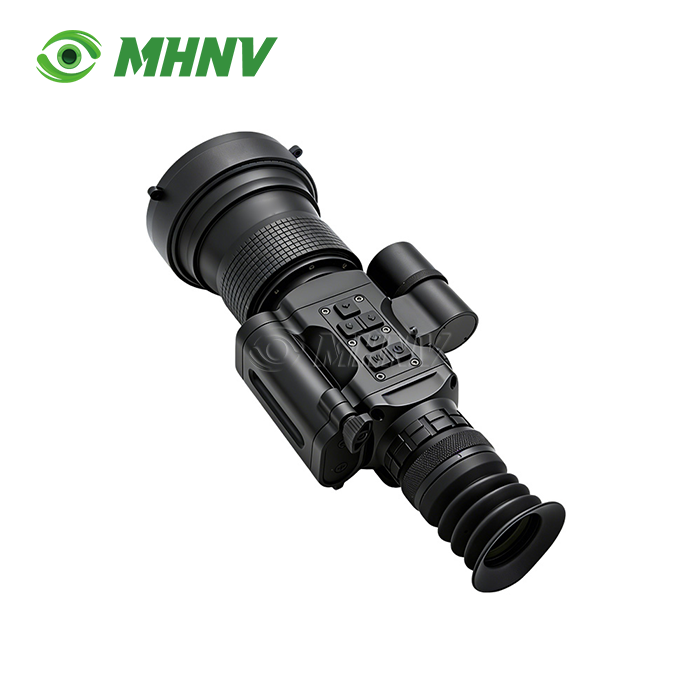
Thermal Monocular Scope With Rangefinder
Professional Thermal Monocular Scope With Rangefinder | Enterprise-Grade Hunting & Observation Solution | Integrated LRF & Wi-Fi Streaming
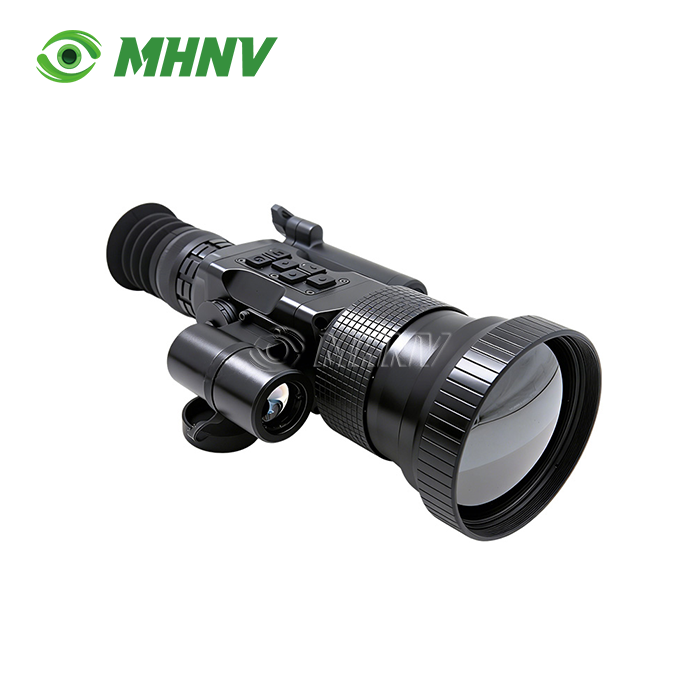
Thermal detection technology combined with precision laser ranging has transformed professional hunting and wildlife observation workflows. The MHNV® MH-T Series delivers an enterprise-grade Thermal Monocular Scope With Rangefinder engineered for hunting outfitters, ranch operators and professional observation teams requiring fast target acquisition across variable terrain. Built around 12-micron uncooled VOx microbolometers in 384×288 or 640×512 resolution tiers, this platform integrates a factory-installed 1.3 km eye-safe laser rangefinder and Wi-Fi streaming into a single 1.2 kg body. Three interchangeable germanium objectives—35 mm, 50 mm and 75 mm F1.0—cover close hog control through long-range predator detection without changing accessories or training protocols. With 1200G impact resistance, IP67 sealing and minus 40°C to plus 55°C operation, the system maintains performance across arctic, desert and coastal environments.

Why Integrated Rangefinding Changes Field Performance?
Operators using traditional thermal scopes had to shoulder down, utilise a handheld rangefinder, shoulder back up and re-acquire the target. This 15 to 25 second cycle minimises the chances of a first round hit on moving game.
The MHNV® product removes that workflow. Behind the eyepiece is a factory incorporated 1.3 km eye-safe 1535 nm LRF module. Range readout in the reticle with the push of a trigger button. The range-to-fire-solution time is three to five seconds.
For hunting guides taking customers after coyotes or pigs at longer range, this speed advantage directly translates to better success rates. Faster involvement implies less livestock loss for ranch operators that have to deal with predators on broad tracts.
Multi-Mission Platform Architecture Reduces Total Ownership Cost
Most thermal scope lines require several product SKUs for close, medium and long range missions. Each SKU has its own training needs, spare parts stocks and accessory catalogues.
The MH-T series is a single platform standard. The 35 mm objective provides a large field of view for close hog control. With a 50mm objective, it offers a good compromise between field of view and range for deer stalking. The 75 mm objective gives identification at 500 meters for predator detection.
All three goals have the same housing, mount interface, electronics and accessories. Operators learn to operate a system. Parts inventory cut 25-40 percent. The maintenance protocols are same for the entire fleet.
Technical Specifications
| Parameter | Value |
|---|---|
| Model | MHNV MH-T Series |
| Working Spectral Band | 8–14 μm |
| Detector Type | Uncooled VOx microbolometer, 12 μm pixel pitch |
| Detector Resolution | 384×288 (entry) / 640×512 (premium) |
| MRTD at 1 f/# | ≤50 mK |
| Display | 1024×768 OLED |
| Objective Focal Length | 35 / 50 / 75 mm F1.0 germanium |
| Field of View | 5.9° × 4.7° (reference) |
| Focusing Distance | 10 m to ∞ |
| Eyepiece Magnification | 14× optical baseline |
| Electronic Zoom | 1×, 2×, 4× |
| Image Polarity Modes | White hot, black hot, red hot, false color, stroke outline |
| Laser Rangefinder | Optional integrated, 1.3 km eye-safe |
| Wi-Fi | Yes (live streaming, photo/video capture) |
| Battery | 2×18650 lithium |
| Continuous Runtime | ≥8 hours |
| Operating Temperature | -40°C to +55°C |
| Impact Resistance | 1200G |
| Weight | ≤1.2 kg |
| Dimensions | 255 mm × 116 mm × 102 mm |
| IP Rating | IP67 |

Real-Time Image Streaming For Collaborative Operations
Modern hunting operations often involve guides coaching clients, ranch managers documenting predator control for insurance claims, or training teams reviewing shot placement.
The built-in Wi-Fi module mirrors the live scope view to smartphones and tablets in real time. On-board photo and video recording captures every engagement for evidence, YouTube content creation, guided-hunt customer proof and after-action review.
Remote observers can monitor the scope feed from a command post or vehicle. This capability supports safety protocols, quality assurance and client satisfaction in commercial hunting operations.
Built To Survive Magnum Recoil And Extreme Environments
Consumer-grade thermal scopes typically publish 800 to 1000G impact ratings that fail under repeated .30-06 or 7 mm Rem Mag recoil. Hunters either accept frequent scope failure or downgrade rifle caliber.
The MHNV Thermal Monocular Scope With Rangefinder is impact-tested to 1200G across all three objective variants. This rating covers common hunting calibers from .223 Remington through .308 Winchester, .30-06 Springfield and heavier magnum rounds.
IP67 sealing protects against dust and immersion to one meter for 30 minutes. Operating temperature from minus 40°C to plus 55°C ensures function in arctic winter, southern monsoon, high desert and coastal salt-spray environments.
Hunters and ranch operators deploy the same scope across every mission profile without buying environment-specific variants.
Five Polarity Modes And Electronic Zoom For Every Light Condition
Heat signature contrast varies across terrain types, weather conditions and time of day. White hot mode works well in open desert. Black hot mode reduces eye fatigue during long observation sessions. Red hot and false color modes enhance target identification in cluttered forest environments.
The MH-T Series offers five polarity modes—white hot, black hot, red hot, false color and stroke outline—plus 1×, 2× and 4× electronic zoom. Operators switch modes in seconds to match the workflow to the environment.
The 1024×768 OLED display renders the 640×512 detector pixel-for-pixel with room for reticle overlay and menu without down-scaling artifacts. Image clarity remains high across all zoom levels.
FAQ
Q: What is the advantage of the integrated laser rangefinder over a portable rangefinder?
A: The factory integrates the 1.3 km eye-safe laser rangefinder module that offers one-touch range readout inside the reticle without taking your eye off the scope. This removes the 15 to 25 second shoulder down, handheld-LRF, re-shoulder cycle that standard setups demand. Range-to-fire-solution time is reduced to three to five seconds, which directly means a higher first-round hit chance on moving game at extended range. For hunting guides handling customers or ranch operators handling predators throughout large properties, this speed advantage vastly enhances engagement success rates.
Q: What is the difference between detection, recognition and identification ranges in thermal imaging?
A: Detection is seeing a blob of heat on the display; recognition is understanding the blob is an animal, not a rock or stump; identification is confirming the species or specific target. The inbuilt laser rangefinder bridges these gaps providing accurate distance data to enable the operators scale the heat signature and make confident identification decisions. At 400 meters , a coyote would look like a tiny blob on a 384x288 sensor . But if you know precisely how far away it is , you can compute the expected size and be sure of your target before pulling the trigger .
Q: Why does a 12 μm pixel pitch outperform larger pixel pitch detectors?
A: The narrower 12 μm pixel pitch allows for more detector elements to be packed into the same focal plane array size, which translates into better magnification and longer detection ranges using a smaller, lighter objective lens. This improves the mobility of the product while preserving or boosting image resolution. The weight and size benefit of 12 μm technology is a crucial factor in field performance and operator fatigue for operators that carry equipment over rugged terrain for extended durations.
Q: How often does the gadget need to have NUC (Non-Uniformity Correction) calibrated?
A: Most current thermal scopes (including the MH-T Series) have automatic NUC built into them that automatically refreshes the internal shutter every few minutes to clear ghost pictures and re-calibrate for ambient temperature fluctuations. This guarantees uniform sharp thermal imaging without manual interference. When the temperature is changing rapidly (for example, opening the door of an air-conditioned vehicle into hot outdoor air) you may hear a quick click as the shutters reset themselves. This is automatic and takes less than one second.
Q: How does fog or excessive humidity impact the rangefinder and thermal sensor?
A: The high humidity and light fog create an atmospheric attenuation that impacts the heat sensor and the laser rangefinder, although in opposite ways. The thermal sensor can see through light mist as it detects long-wave infrared radiation, however the LRF laser beam can scatter in heavy moisture, lowering effective range distance. The MH-T Series employs signal processing to reject backscatter returns and retain range accuracy under difficult situations. In heavy fog, limit the projected LRF range by 20-30 percent and use thermal detection for best performance in target acquisition.

Contact MHNV® For Custom Solutions
Contact our engineering team at sarah@mh-elec.com for Thermal Monocular Scope With Rangefinder technical specifications, OEM customization options and volume pricing.
YOU MAY LIKE
.webp "Laser Target Locator Module (LTLM)")