Why Aviation Night Vision Goggles Improve Flight Safety
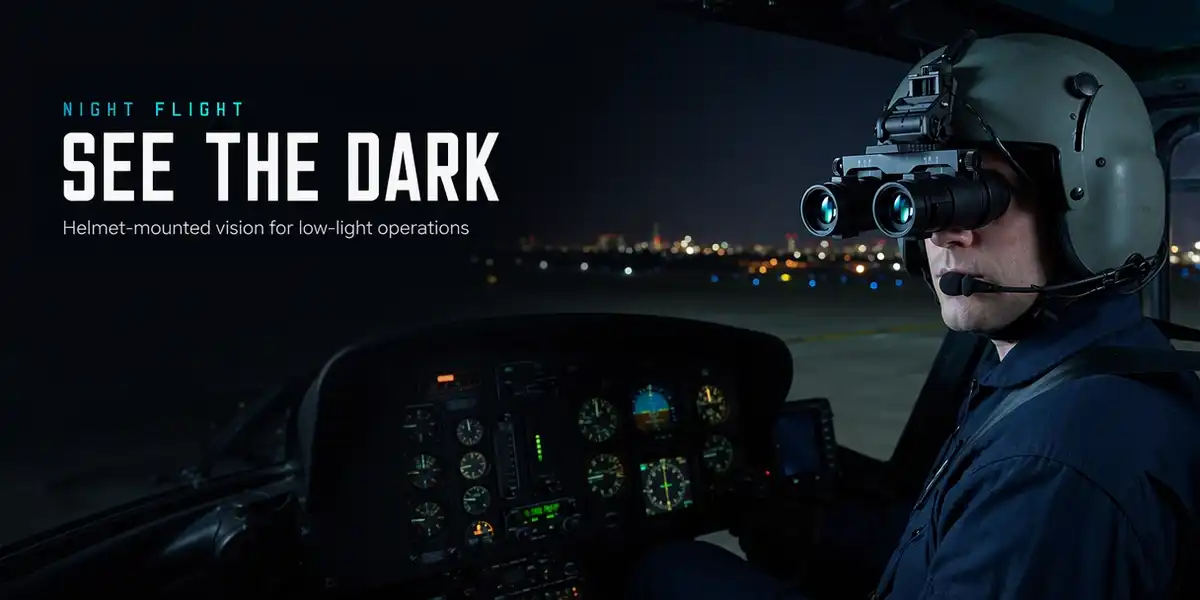
Aviation night vision goggles are electro-optical systems that amplify ambient starlight, moonlight, and near-infrared energy to give pilots a clear visual picture during low-light and no-light flight conditions. By converting invisible light into a usable image, these devices eliminate the dangerous "black hole" effect during night landings, allow terrain and obstacle recognition at safe distances, and reduce the cognitive load that causes pilot fatigue. When properly specified and maintained, aviation NVGs are one of the most impactful safety investments a flight operation can make.
Understanding How Aviation Night Vision Goggles Enhance Flight Safety
Flying at night has risks that flying during the day does not. A disproportionate number of fatal flying crashes are caused by controlled flight into terrain (CFIT), and most CFITs happen at night or when visibility is low. By restoring positional awareness when the human eye cannot, Aviation night vision goggles directly address this.
How Image Intensification Works in the Cockpit
An image intensifier tube (IIT) takes in photons from the scene, changes them into electrons at the photocathode, doubles those electrons through a microchannel plate, and finally changes them back into light that can be seen at the phosphor screen. The end result is a real-time image that is very bright from a scene that looks very dark to the naked eye. Importantly, aviation-grade goggles have filters that work with aircraft displays so that bright instrument panels don't wash out the picture. This way, the pilot can see clearly whether they are looking at the ground outside or the instruments inside.
Fatigue Reduction and Situational Awareness
Long-term night flights without visual aids put the brain through a lot of extra work, which makes it tired faster. Binocular NVG systems bring back stereoscopic depth awareness, which is close enough to normal daily vision to greatly lessen the need to make up for lost abilities. Studies in the flight human factors literature show that pilots who use NVGs make fewer mistakes when avoiding obstacles than pilots who do not use NVGs during night operations.
Aviation Night Vision Goggles Technology and Types
Generation 1 tubes had low light gain and a lot of distortion, but technology has come a long way since then. These days, most choices about what to buy are based on Gen 2+ and Gen 3 systems. These use Gallium Arsenide photocathodes and autogating circuitry to keep the sharpness even when light conditions change quickly.
Generation Comparison and Configuration Options
Gen 2+ tubes give a Figure of Merit (FOM) in the 1400–1600 range and work well for training and added operating tasks. Gen 3 tubes can reach FOM 1800–2000+, have SNR values above 25, and resolutions above 64 lp/mm. This makes them the best choice for main operating teams that fly in low-ambient conditions. When it comes to flying, binocular designs work better than monocular designs because they return the depth cues needed for safe handling at low altitude and formation flight.
Instead of light reflection, thermal imaging aviation night vision Goggles pick up heat that is being given off. Thermal devices are great at finding warm targets against cold backgrounds, but they can't see fine details in the countryside or read instruments in the cockpit. For those jobs, image-intensified NVGs are still the best option. A lot of modern procurement plans use both tools together to get better coverage.
Decision Factors for Procuring Aviation Night Vision Goggles
When buying test NVGs, procurement teams need to look at their visual performance, weight, power endurance, mechanical adjustability, and regulatory compliance as a whole, not just as individual specs.
The MHNV PVS9 aviation night vision binocular shows how these requirements come together in a single product. These are the main technical benefits that set it apart from other ground-forces designs:
- F/1.0 objective lens for maximum light throughput — An F/1.0 aperture lets in about 44% more light per unit time than the F/1.2 objectives that are popular in ground-forces goggles. This difference is what separates acceptable image quality from operationally safe image quality at higher altitudes where starlight is the only source of orientation.
- Tight optical axis parallelism meeting aviation standards — Less than 60 arc-minutes of horizontal divergence and less than 20 arc-minutes of vertical divergence. This meets military aviation standards. When parallelism errors go beyond these limits, they cause vergence stress, which makes pilots dizzy during formation flight and low-altitude passes. This is a safety risk that can't be stopped by loosening the ground-forces requirements.
- Three-axis mechanical adjustment — 16 mm fore-aft, 16 mm vertical, and 8° pitch. This allows it to work with visor rails and helmet-mounted display systems on both rotary-wing and fixed-wing platforms without needing platform-specific accessories, which makes buying things for the whole fleet easier.
- FOM upgrade path from 1400 to 2000 — At FOM 1400, the same housing can hold Gen 2+ tubes, and at FOM 2000, it can hold premium Gen 3 tubes. It's now possible to do mixed procurement, where main operating squadrons get FOM 1800 or 2000 tubes and training units get cheaper FOM 1400 tubes from the same product base.
- 469-gram aviation-optimized weight — Even though it has aviation-grade sights, the PVS9 is lighter than most dual-tube ground-forces designs. This means that it lowers the total weight on the pilot's helmet during long flights, directly protecting their ability to stay alert and make decisions.
Together, these benefits solve the most important practical problems in night flying. It has a resolution of more than 60 lp/mm, an SNR of more than 20, a field of view of 40°, a magnification of 1x, can run continuously for 40 hours on standard AA batteries, and comes with either green or white light tubes. White phosphor (P45) tubes provide better contrast and reduce eye strain, which is a significant ergonomic benefit for missions that last a long time.
MHNV® manufactures the PVS9 under an ISO 9001:2015 certified quality management system, with every IIT individually calibrated in a Class-10,000 cleanroom and shipped with a numbered QC data sheet that confirms the SNR, FOM, resolution, halo, and EBI values.
Maintenance, Usage, and Safety Guidelines for Aviation NVGs
Maintenance discipline is just as important for operational consistency as the original design. Before every flight, pilots should make sure that the objective caps are off, the diopter settings are correct for each person's prescription (within a range of ±4 diopters), and the battery voltage is checked. The PVS9 can run for 40 hours on AA batteries, which makes logistics easier. However, batteries should still be replaced on a regular schedule instead of waiting for low-battery indicators to show up during operations.
When you clean your lenses after a flight with approved lens tissue, you protect the optical layers that are needed for minus-blue performance and halo reduction. image intensifier tubes are supposed to last between 10,000 and 15,000 hours, but they will only last that long if they are kept out of direct sunlight, which ruins the photocathode forever. Protective goal caps should be seen as mission-critical gear, not extras that can be used if desired. When B2B clients use these Aviation Night Vision Gogglesacross squadron fleets, they should set up written maintenance plans and keep track of each tube's hours by serial number.
Future Trends and Innovations in Aviation Night Vision Goggles
Along with augmented reality overlays, heads-up display symbols, and AI-assisted picture processing, the next version of pilot night vision technology adds AR to the optical path. These changes make it possible for navigational waypoints, altitude alerts, and danger indicators to show up right in front of the pilot's eyes without interrupting the discipline of an instrument check.
As miniaturization progresses, housing sizes and tube weights are going down. This is a big plus when combined with platforms that are already optimized, like the PVS9. When companies buy things, they often choose flexible tube upgrades like the FOM 1410-to-2000 upgrade path for the PVS9. This lets them use these changes without having to replace the whole platform, which increases the investment's useful life and lowers the total cost of ownership. These improvements are being quickly adopted by the civilian HEMS, SAR, and wildland firefighting markets, creating new demand segments in addition to the established military and law enforcement channels.
Conclusion
By bringing back the sense of direction that darkness takes away, Aviation Night Vision Goggles make night flying less dangerous and easier to handle. Finding the right platform means finding one whose optical performance, weight, adjustability, and ability to meet specific mission profiles are all a good fit. The MHNV PVS9 takes all of these factors into account with engineering that is designed for aviation: F/1.0 optics, tight parallelism, three-axis adjustment, a scalable FOM range, and a weight that takes into account the total weight that pilots carry in their helmets. For buying teams building reliable trucks that can operate at night, these requirements are a safe investment that can be made.
FAQ
1. What is the difference between green and white phosphor in aviation NVGs?
Most pilots find that the black-and-white picture produced by white phosphor (P45) is better than the standard green phosphor (P43) display in terms of contrast and eye fatigue. The MHNV PVS9 gives you both choices so you can meet the needs of your organization or the rules.
2. Can aviation NVGs operate in total darkness?
Image-intensified goggles need a photon source in the background. In a normal open-sky situation, sunlight or moonlight is enough. In places with no light at all, like sealed buildings, an infrared illuminator is needed to provide the photon input that the tube enhances.
3. What battery life should procurement teams plan for?
The MHNV PVS9 can run continuously for 40 hours on normal AA batteries at 3V. This runtime is long enough for multi-day field operations and makes planning easier than with private rechargeable formats.
4. Are these goggles suitable for civilian aviation operators?
Yes, binocular aviation NVGs are used by HEMS, SAR, wildland firefighting, and maritime patrol operators for the same reasons that military pilots do: to see the terrain and avoid obstacles.
5. How do aviation NVGs differ from thermal goggles?
Image-intensified NVGs pick up ambient light that bounces off surfaces and provide high-resolution landscape information. Thermal imagers pick up heat that is being given off and are very good at finding warm targets. Aviation companies with difficult missions often buy both technologies so that they can work together to cover more ground.
Partner With MHNV® for Certified Aviation Night Vision Goggles
Since 2013, MHNV® has sold OEM and ODM night vision products to builders and distributors in more than 60 countries. With ISO 9001:2015 certification and MIL-STD-810-rated components, our Aviation Night Vision Goggles manufacturer offers full-stack customization for IIT grade, phosphor type, firmware, and housing. You can email our buying team at sarah@mh-elec.com to ask about the MHNV PVS9's specs, bulk price, or to get a sample evaluation.
References
1. Nakagawara, V. B., & Wood, K. J. (2008). Night Vision Goggles and Their Use in Civil Aviation. Federal Aviation Administration Civil Aerospace Medical Institute.
2. Previc, F. H., & Ercoline, W. R. (Eds.). (2004). Spatial Disorientation in Aviation. American Institute of Aeronautics and Astronautics.
3. U.S. Army Aviation Center. (2009). Aeromedical Training for Flight Personnel (TC 3-04.93). Department of the Army.
4. Steinberg, E. P., et al. (2016). "Human Factors in Night Vision Goggle Operations." Aviation, Space, and Environmental Medicine, 87(4), 412–419.
5. Flight Safety Foundation. (2021). Controlled Flight Into Terrain: Historical Analysis and Mitigation Strategies. Flight Safety Foundation.
6. Wood, R. B., & Rash, C. E. (Eds.). (2000). Helmet-Mounted Displays: Design Issues for Rotary-Wing Aircraft. SPIE Press.
YOU MAY LIKE