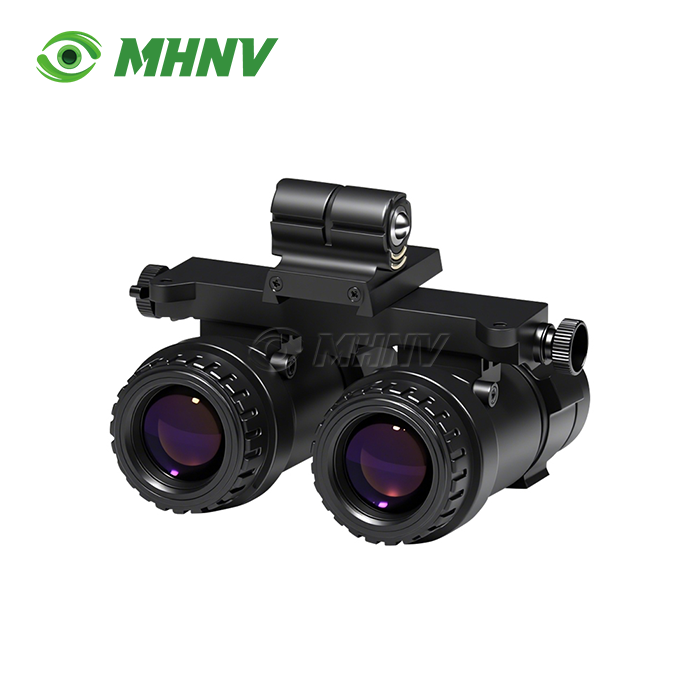
Aviation Night Vision Goggles For Pilots
Aviation Night Vision Goggles For Pilots | Dual-Tube Gen 2+/Gen 3 System with F/1.0 Optics for Night Flight Operations
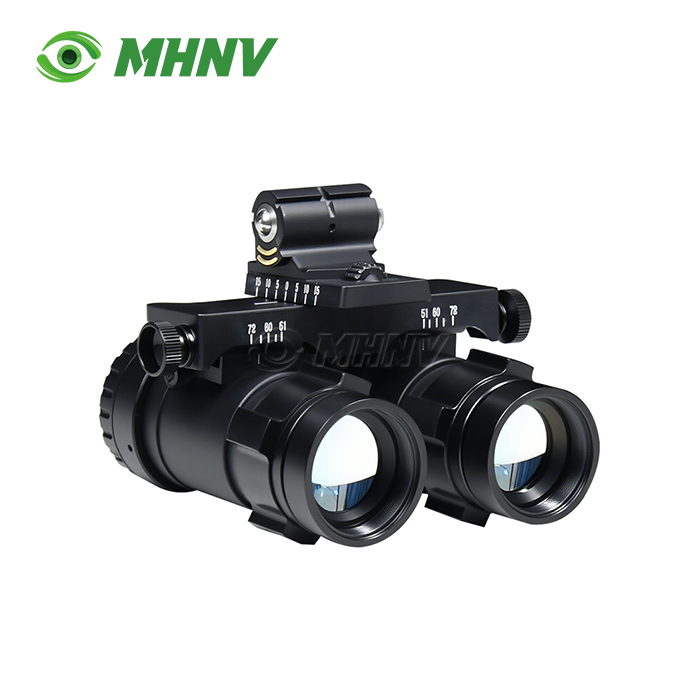
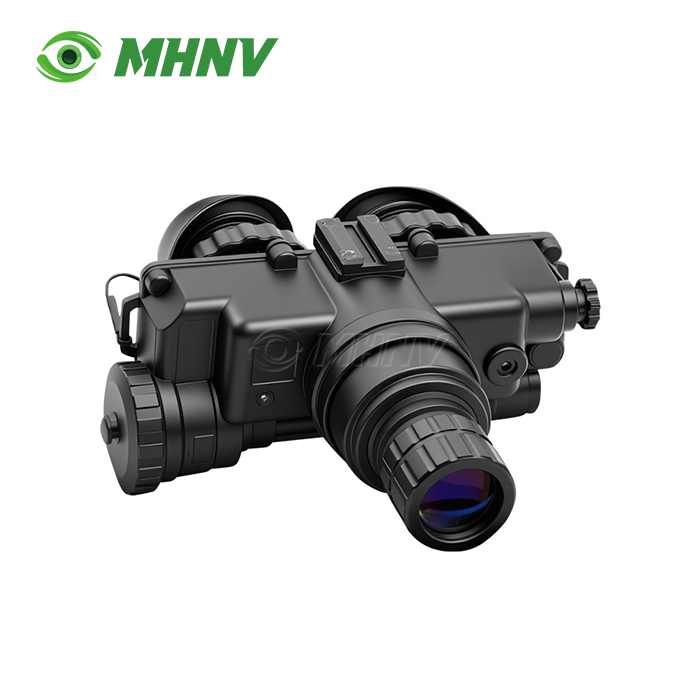
Xi'an MH Electronics And Technology Co., Ltd. presents the MHNV PVS9 Aviation Night Vision Goggles For Pilots, a binocular electro-optical system engineered for rotary-wing and fixed-wing cockpit integration. This dual-tube platform delivers FOM 1400–2000 performance with F/1.0 objective aperture for maximum light throughput. The system features resolution exceeding 60 lp/mm, SNR above 20, and cathode sensitivity over 600 µA/lm.
Built for helmet-mounted operations, the unit incorporates three-axis mechanical adjustment (16 mm front-rear, 16 mm vertical, 8° pitch) and maintains optical axis parallelism within aviation standards (horizontal divergence <60 arc-minute, vertical <20 arc-minute). The lightweight 469-gram housing operates 40 hours continuously on dual or quad AA battery configurations.
Wide-Aperture Optical Architecture for Aviation Light Sensitivity
The PVS9 employs F/1.0 objective lenses—44% faster light-gathering than F/1.2 ground-systems designs. This specification is critical for aerial observation where ambient starlight serves as the primary illumination source at altitude.
The 40° field of view supports peripheral awareness during formation flight and terrain scanning. The 1× magnification preserves natural depth perception for landing zone evaluation and obstacle avoidance.
A 250 mm to infinity focus range accommodates cockpit instrument scanning through long-range terrain reconnaissance. The ±4 diopter adjustment compensates for individual pilot vision without corrective eyewear interference.
Aviation-Compliant Optical Axis Parallelism
Divergence tolerances meet aviation goggle specifications: horizontal deviation under 60 arc-minutes and vertical under 20 arc-minutes. These limits prevent binocular rivalry—a visual conflict that causes pilot disorientation during extended missions.
The 52–72 mm interpupillary distance adjustment accommodates 95% of pilot populations. The 25 mm eye relief allows integration with visor systems and prescription eyewear.
Fourteen-millimeter exit pupils match the human eye's scotopic aperture, maximizing effective resolution transfer from image intensifier tube to pilot perception.
Technical Specifications
| Parameter | Specification |
|---|---|
| Model | MHNV PVS9 |
| Resolution | ≥60 lp/mm |
| Signal-to-Noise Ratio | ≥20 |
| Figure of Merit | 1400 (1600/1800/2000 optional) |
| Cathode Sensitivity | ≥600 µA/lm |
| Magnification | 1× |
| Field of View | 40° |
| Aperture (F-Number) | F/1.0 |
| System Resolution | 1×10⁻³ lux @ 1.59 mrad |
| Optical Axis Parallelism | Horizontal: <60′ / Vertical: <20′ |
| Focus Range | 250 mm to ∞ |
| Diopter Adjustment | ±4 D |
| Eye Relief | 25 mm |
| Exit Pupil Diameter | 14 mm |
| Interpupillary Distance | 52–72 mm |
| Mechanical Adjustment | 16 mm (front/rear), 16 mm (up/down), 8° (pitch) |
| Dimensions | 108×131×93 mm |
| Weight | 469 g |
| Power Supply | 3V (2×AA or 4×AA) |
| Operating Time | 40 hours continuous |
| Phosphor Options | Green P43 / White P45 |
Modular FOM Architecture for Mission-Tailored Procurement
The platform supports field-selectable tube upgrades from Gen 2+ FOM 1400 through premium Gen 3 FOM 2000 configurations. This modularity enables fleet managers to allocate high-performance tubes to primary operational squadrons while deploying cost-effective variants for training units.
All configurations share identical mechanical housing and power architecture, simplifying logistics and maintenance training. Tube replacement requires no optical realignment—preserving calibration across the service life.
Both green P43 and white P45 phosphor variants are available. White phosphor provides enhanced contrast for urban environments and reduced eye fatigue during multi-hour missions.
Three-Axis Helmet Integration System
The precision-machined adjustment mechanism provides 16 mm of front-rear translation, 16 mm vertical travel, and 8° pitch rotation. This range accommodates diverse helmet platforms—from lightweight rotary-wing designs to fixed-wing ejection seat configurations.
The system interfaces with standard aviation helmet rails without platform-specific adapters. You can reposition the goggle assembly for optimal center-of-gravity balance, reducing neck strain during extended operations.
Quick-release mechanisms enable rapid donning and doffing in emergency scenarios. The mount maintains positional memory, eliminating readjustment between flights.
Power Efficiency for Extended Operations
Dual AA battery configuration delivers 40 hours of continuous operation—sufficient for multi-day deployments without resupply. The alternative quad AA mode provides redundancy for critical missions.
Auto-gating circuitry protects tubes from overexposure when transitioning between low-light and illuminated environments. This feature extends tube lifespan while maintaining image quality during landing pattern approach lights or cockpit illumination exposure.
Low-voltage cutoff prevents tube damage from battery depletion. An LED indicator provides advance warning before power loss occurs.
Manufacturing Quality and Support Infrastructure
MHNV® controls the complete production chain—from optical design through final assembly—within ISO 9001:2015-certified facilities. Each unit undergoes collimation testing, environmental stress screening, and blemish mapping before shipment.

Class-10,000 cleanrooms enable image intensifier tube integration without contamination risk. Automated testing systems verify SNR, FOM, and resolution against aerospace tolerances.
Every Aviation Night Vision Goggles For Pilots system includes serialized quality documentation tracing optical components, calibration data, and environmental test results. This chain-of-custody record supports airworthiness certification and maintenance tracking.

FAQ
Q: What is operationally better about the F/1.0 aperture over F/1.2 ground systems?
A: This aperture gathers 44% more photons per unit time than F/1.2 designs, allowing you to capture usable imagery under conditions of starlight-only illumination at altitude where atmospheric scattering reduces the available ambient illumination, allowing you to maintain visual orientation in nite flight profiles that would yield marginal image quality with slower optics, directly aiding safer operations in low illumination environments where ground-based goggles would degrade situational awareness.
Q: Why is parallelism of optical axs important for the safety of pilots flying in formation?
A: Binocular rivalry is the neurological effect of receiving misaligned images from each eye, which causes spatial disorientation, loss of depth perception, and increased fatigue on a multi-hour mission. This is especially dangerous in formation flight where precise station keeping is required to maintain safe distances, which misaligned optics will systematically degrade.
Q: Can I upgrade the image intensifier tubes without replacing the entire goggle system?
A: Yes, the modular architecture allows FOM 1400 through FOM 2000 tubes to be used in the same housing. You can purchase affordable Gen 2+ tubes to start and upgrade to premium Gen 3 performance when budgets allow or mission needs change. The mechanical and electrical interfaces are the same between all the tube variants, so no recalibration or retraining is required.
Q: Why is three-axis mechanical adjustment important for aviation applications?
A: Helmet-mounted systems must be compatible with a wide range of head shapes, helmet designs and cockpit configurations. The 16 mm front-rear and vertical travel plus 8° pitch adjustment allows the optical axis to be precisely aligned with your natural sight line, regardless of the helmet you wear, maintaining the correct eye relief distance and exit pupil alignment that single axis systems cannot without sacrificing image quality or causing eye strain.
Q: What maintenance intervals are required for the system to be airworthy?
A: Aviation grade Nite Vision systems usually require periodic inspections every 180 days to check the nitrogen purge, collimation testing on calibrated optical benches and seal integrity. MHNV® provides technical documentation to support your requirements for your maintenance program and our engineering team is available for remote consultation to troubleshoot during routine service intervals to reduce aircraft downtime.
Contact Us for Aviation Night Vision Solutions
Contact our technical team at sarah@mh-elec.com for Aviation Night Vision Goggles For Pilots performance demonstrations, tube selection guidance, and fleet procurement solutions tailored to your operational requirements.
YOU MAY LIKE