Gen 3 Image Intensifier Benefits for Night Vision
When procurement teams evaluate night vision solutions for defense, security, or industrial use, the Gen 3 image intensifier consistently stands apart. Built around a Gallium Arsenide (GaAs) photocathode and a microchannel plate with an ion barrier film, these tubes deliver photon amplification gains of 30,000–50,000×, enabling clear imagery under starlight conditions. With resolution specs reaching 64–72 lp/mm, SNR above 28, and rated operational life exceeding 10,000 hours, third-generation intensifier tubes represent the most capable passive night imaging technology available to B2B buyers today.
Understanding Gen 3 Image Intensifier Technology
How the GaAs Photocathode Changes Everything
The Gallium Arsenide photocathode is what any Gen 3 Image Intensifier does as its main part. GaAs reacts to light from 450 to 950 nm, which is wider than the multialkali photocathodes found in Gen 1 and Gen 2 tubes. This range of sensitivity picks up background photons that earlier generations just didn't get. When photons hit the photocathode, they free electrons. These electrons move through the microchannel plate, multiply many times over, and then hit a phosphor screen (P43 for green output or P45 for white output), turning back into a picture that the human eye can read.
MCP Ion Barrier Film: The Lifespan Differentiator
Ion feedback was a problem with Gen 2 tubes. Positively charged ions went backward through the MCP and broke down the photocathode over time. Gen 3 tubes cover the MCP surface with an extremely thin film that blocks ions. This film stops ions from hitting the tube while keeping electrons moving. This makes the tube last longer than its rated 10,000 hours of use. The EBI (Equivalent Background Illumination) stays at ≤0.25 μlx, which means that images will have a lot of contrast even when there is almost no light. EBI should be seen as a main requirement by procurement experts, not a side point.
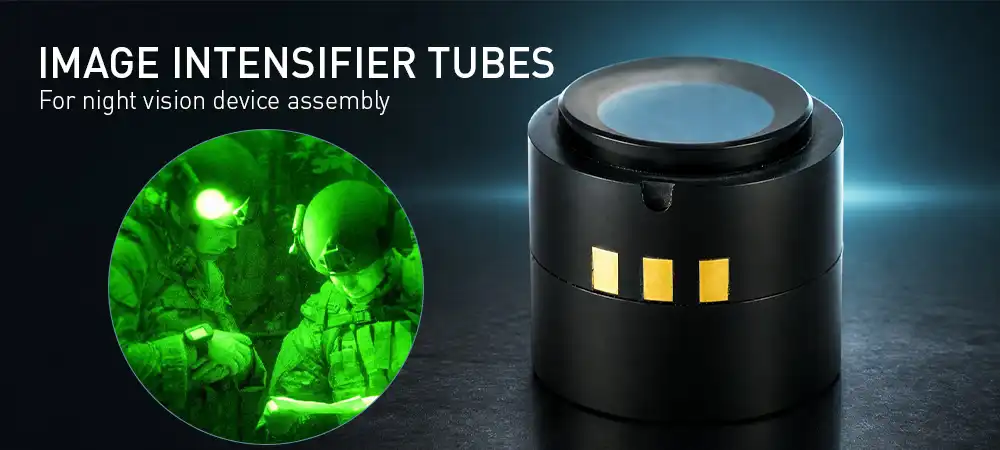
Key Advantages of Gen 3 Image Intensifiers over Previous Generations
There is a big difference between third-generation tubes and the ones that came before them. These Gen 3 image intensifier tubes are the best choice for tough procurement situations because they have these main performance benefits:
- Ultimate photon sensitivity: The GaAs photocathode has light sensitivity above 1,800 μA/lm, and quality tubes can reach 3,000 μA/lm. In this way, operators can travel in cloudy starlight without using any active lighting, keeping their hidden position.
- Autogating protection: Floodlights or car headlights can quickly destroy Image Intensifier Tubes that aren't covered. Autogating circuits act at the microsecond level, changing the photocathode voltage on the fly to stop picture distortion and protect the device from short-term overexposure.
- Superior resolution and SNR: Third-generation tubes have a resolution of 64–72 lp/mm and an SNR of at least 28 (usually more than 30). This means that they can show clear details at distances where Gen 2 images become noisy. The rise in luminance of ≥10,000 cd/m²/lx makes identification even more certain.
- Rugged environmental tolerance: It can work in temperatures between -45°C and +55°C, and it can also be stored at temperatures between -55°C and +70°C. The tube is < 75 g, works with 2.2–3.4V, and draws < 25 mA at 3V. These are all reasonable specs for putting it into small, battery-powered platforms.
All of these benefits lower the total cost of ownership. A tube that lasts 10,000 hours or more, doesn't get damaged by ions, and can handle high and low temperatures needs less repair and care than older tubes. For programs that buy in bulk, this difference in lifespan means big savings over the lifecycle.
Applications and Use Cases of Gen 3 Image Intensifiers in Modern Industries
Third-generation photocathode technology is useful in more areas than most buying teams think at first. All of these uses have one thing in common: they all need reliable, low-noise images in places with little natural light.
Tactical military and law enforcement applications depend on Gen 3 Image Intensifiers integrated into devices like the PVS-14 monocular and the PVS-31 binocular. Operators conduct covert navigation, target acquisition, and close-quarters recognition at ranges where enemies with worse sights can't effectively react.
Aerial surveillance and SAR missions integrate these tubes into cockpit imaging systems. Celestial radiance is the only thing that helps pilots find their way through mountainous areas or maritime search corridors. The GaAs photocathode can pick up this radiance where silicon-based digital sensors can't.
Security monitoring and perimeter surveillance installations use white phosphor (P45) output for extended observation shifts. Multiple human factors studies have shown that white phosphor imagery is good for you because it keeps your eyes from getting tired after long periods of use.
Scientific research and wildlife monitoring benefit from the high-gain, low-noise profile for observing animals at night and doing high-speed ballistic analysis, which can't be done with active infrared lighting because it would upset the subject or change the measurement environment.
How to Choose the Best Gen 3 Image Intensifier for Your Procurement Needs
Key Specification Checklist
The first step in choosing the right Gen 3 Image Intensifier tube is to make sure that the factors listed on the paper match the needs of the operation. Photocathode sensitivity above 1,800 μA/lm is sufficient for most military needs; procurement programs that need to keep an eye on things beyond 300 meters should favor Image Intensifier Tubes with a rating of around 3,000 μA/lm. At working range, a resolution of 64–72 lp/mm is the standard for identifying people as targets. SNR above 28 gives you the low-noise floor you need to make decisions with confidence.
Phosphor Screen Selection
The choice of output phosphor affects both performance and the health of the operator. Most law enforcement and defense programs use P43, which stands for green phosphor or gadolinium oxysulfide. P45 (white phosphor, Yttrium Aluminum Garnet) makes a grayscale picture that is linked in scientific writing to better contrast perception and less eye fatigue after long-term use. Any serious supplier of intensifier tubes should have both phosphor options in stock.
Gen 3 vs. Digital and Thermal Alternatives
Digital night vision costs less per unit, but it can't match the GaAs photocathode tube's photon sensitivity or reaction speed. Since thermal imaging looks for heat signatures instead of reflected light, it works best as a supplement rather than a direct replacement for Gen 3 tubes, which are best at identifying. For the best spatial awareness, high-value buying projects often use a fusion platform that combines both technologies.
Procurement Guide: Buying Gen 3 Image Intensifiers with Confidence
Getting Gen 3 Image Intensifier tubes from a known company with clear quality control records is good for both the budget and the credibility of the business. Each tube should come with a QC data sheet that is serialized and lists the SNR, FOM, resolution, halo radius, and EBI that were measured in a cleanroom that is properly set up. Documentation showing agreement with ISO 9001:2015, CE, RoHS, and FCC rules should be normal features, not extras that can be chosen.
Prices for bulk orders usually go up and down in levels. Pilot quantities are used to set the quality standard before commitments to buy in bulk. Buyers should discuss guarantee terms that last at least a year and make sure that there are clear ways to get replacements or repairs. Lead times are different. Standard tubes that are in stock ship within 3–7 business days, but mass production runs take 15–30 business days, based on the setup.
OEM and ODM buyers should make sure that the seller lets them change the way the cover is configured. The types of output windows—inverting flat, non-inverting spherical (SR40), and non-inverting flat—determine which host device housings can be used for integration. If your supplier can't offer these options, it will slow down the growth of your product.
Conclusion
In the defense, security, and skilled commercial markets, Gen 3 Image Intensifier tubes set the bar for passive night imaging that can be measured. The GaAs photocathode, ion barrier film, autogating circuit, and high-resolution phosphor output work together to make a base that is better in every way than previous generations. When looking at night vision solutions, procurement teams should give more weight to verified suppliers who offer full-parameter QC documentation, phosphor configuration options, and proof of export compliance. The choice to use Gen 3 technology is not based on guesswork; it is based on performance data collected in more than 60 countries over the course of 10 years.
FAQ
1. What is the operational lifespan of a Gen 3 image intensifier tube?
The Gen 3 Image Intensifier tube is supposed to work for more than 10,000 hours if the ion barrier film is still in place and it is used at the right voltage and temperature. The MIL-SPEC Mean Time Between Failures (MTBF) tests, not marketing guesses, are what this standard comes from.
2. What does EBI measure and why does it matter?
Equivalent Background Illumination checks how much light is still coming out of the photocathode when it doesn't receive any light. A smaller EBI, like ≤0.25 μlx, means the tube makes less self-generated noise, which makes the picture contrast better in complete darkness.
3. Is white phosphor (P45) better than green phosphor (P43)?
Neither is clearly better than the other. It is known that P43 green phosphor is the best defense because it matches the eye's highest level of photopic sensitivity. A human factors study has shown that P45 white phosphor creates grayscale images that are easier for many operators to understand during long surveillance sessions. This is because their eyes don't get tired as quickly.
4. What input voltage does a standard Gen 3 tube require?
The normal working voltage is between 2.2V and 3.4V, and the input current at 3V is about 25mA. Because of these specs, the tubes can be used with small, battery-powered night vision devices.
5. Can these tubes be customized for OEM integration?
Yes. OEM programs can change the shape of the faceplate, the type of phosphor, and the configuration of the output window. This is as long as the agreed-upon minimum order amounts and wait times are met.
Partner with MHNV® — Your Trusted Gen 3 Image Intensifier Supplier
Gen 3 Image Intensifier tubes are made and sent to more than 60 countries by MHNV®. Each tube is tested in a Class-10,000 laboratory and comes with a fully numbered QC data sheet. The P43 and P45 phosphor types are both in stock, and standard models can be sent out within 3–7 business days. As a certified manufacturer that has been in business since 2013, MHNV® allows OEM/ODM customization of the output window type, phosphor choice, and housing specification. Contact the team at sarah@mh-elec.com to request a personalized quote or product demonstration.
References
1. Holst, G. C. Electro-Optical Imaging System Performance. SPIE Press, 2008.
2. Dereniak, E. L., & Boreman, G. D. Infrared Detectors and Systems. Wiley, 1996.
3. U.S. Army Night Vision and Electronic Sensors Directorate. Night Vision Technology Overview. NVESD Technical Report, 2015.
4. Bhattacharya, P. Semiconductor Optoelectronic Devices. Prentice Hall, 1997.
5. Stupp, E. H., & Brennesholtz, M. S. Projection Displays. Wiley, 1999.
6. NATO Standardization Office. STANAG 4351: Image Intensifier Tubes — Performance Characteristics and Test Methods. NATO, 2012.
YOU MAY LIKE