What Are Aviation Night Vision Goggles? A Buyer's Guide
Aviation night vision goggles are electro-optical systems engineered to amplify ambient light — starlight, moonlight, or near-infrared radiation — so pilots can perceive terrain, obstacles, and other aircraft during low-light or no-light operations. Unlike general-purpose night optics, aviation night vision goggles must integrate with cockpit lighting filters, helmet-mounted display rails, and aircraft avionics without introducing spatial disorientation. They are mission-critical tools used across helicopter emergency medical services, military rotary-wing operations, search-and-rescue missions, and fixed-wing night patrol, where unaided vision creates unacceptable safety risk.
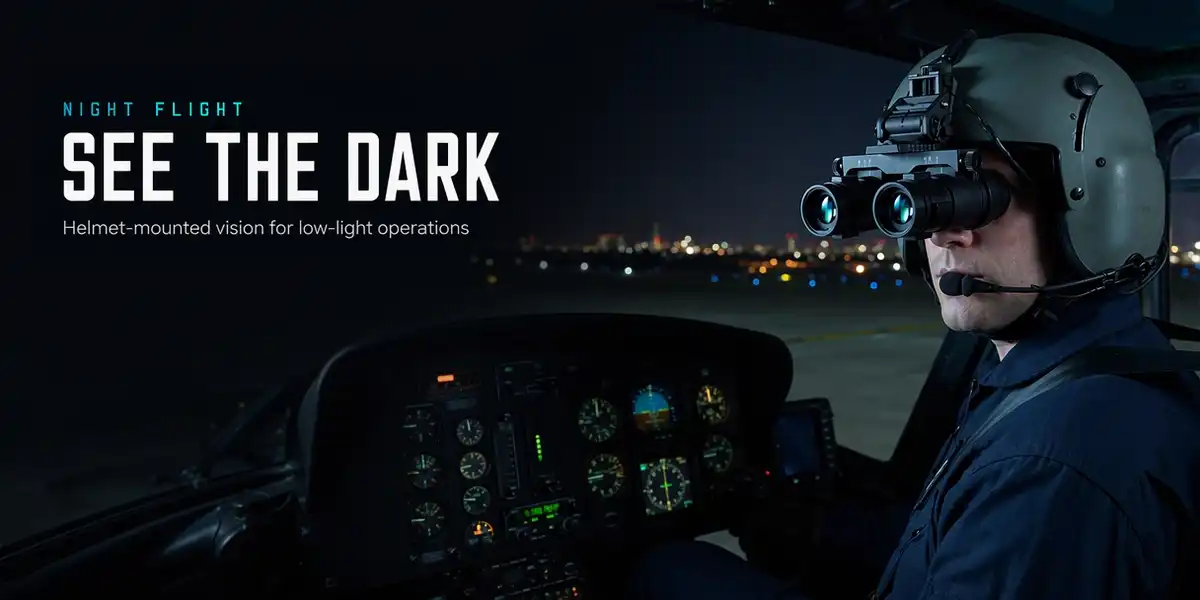
Understanding Aviation Night Vision Goggles
How Image Intensification Works in Flight
image intensifier tubes (IIT) take in photons through the objective lens and turn them into electrons. They then boost these electrons across a microchannel plate and turn them back into visible light on a phosphor screen. The pilot sees a boosted picture that is shown in real time, without the delay that comes with digital sensors. In flight, latency above 50 milliseconds causes the risk of spatial disorientation that has been linked to a number of Controlled Flight Into Terrain (CFIT) crashes, as shown in reports from the FAA and NTSB.
Evolution From Analog to Advanced Digital Systems
In the 1970s, the first AN/PVS-5 goggles were made with Gen 1 tubes that didn't have a lot of sharpness. In the 1980s, Gen 2 added microchannel plate technology, which greatly improved the signal-to-noise ratio. To this day, Gen 3 GaAs photocathode tubes with FOM numbers above 1800 are the standard for main operational squadrons. At the moment, the cutting edge is made up of digital virtual reality and thermal image overlays.
It's clear that aviation night vision Goggles technology has strategic value: it lowers the risk of CFIT, keeps operations going late at night, and lets crews see power lines, terrain contours, and unmarked obstacles that humans can't see.
Types and Technologies of Aviation Night Vision Goggles
The most important factor in buying Aviation Night Vision Goggles is the generation rate. Gen 1 devices can't be used in airplanes because they don't have enough sharpness. Gen 2+ devices with FOM 1200–1400 can be used for training and other tasks. Gen 3 devices with FOM 1800–2000 have the sharpness and sensitivity needed for battle or search and rescue operations.
The choice of phosphor screen also affects how the user feels. A lot of military systems still use green lighting (P43). White phosphor (P45) makes a black-and-white picture with better contrast and less eye fatigue during long flights. This choice has slowly grown in the US and European airline markets.
thermal imaging systems work even in smoke, fog, and complete darkness because they look for heat emissions instead of light reflections. But thermal imagers don't have the ability to see depth or fine details that image intensification does at close range. Because of this, the two technologies are often used together in advanced fusion platforms instead of separately.
Recent improvements include autogating circuits that keep images from washing out near bright light sources, minus-blue objective coatings that dim the glow of cockpit instruments, and lightweight magnesium-alloy housings that make helmets lighter. All of these features have made their way from military purchases to commercial aviation NVG requirements.
How to Choose the Best Aviation Night Vision Goggles
To choose the best pilot aviation night vision goggles, you need to make sure that the optical performance fits the task description, the platform, and the regulatory environment. Here are the main success indicators that buying managers should look at:
- Resolution and SNR: For flight purposes, you need a resolution of at least 60 lines per millimeter and an SNR of at least 20. Higher SNR keeps image quality when there is a lot of cloud cover or a new moon, when photon flux drops sharply.
- FOM rating: Resolution and SNR are both used in the FOM rating, which is a single buying standard. FOM 1400 is good for training jobs, while FOM 1800–2000 is better for main operational tasks.
- Optical axis parallelism: For aviation-grade goggles, the horizontal divergence must be less than 60 arc-minutes and the vertical divergence must be less than 20 arc-minutes. Going beyond these limits causes binocular rivalry and vertigo in the pilot, which is a flight safety issue that ground-forces goggles with less strict tolerances for parallelism can't properly address.
- Weight and ergonomics: Adding one gram to the helmet makes the neck load higher during long operations. Devices that weigh less than 500 grams help pilots stay awake and alert during multi-hour missions.
- Helmet and avionics compatibility: Three-axis mechanical movement (fore-aft, up-down, and pitch) lets it work with a variety of helmet visor rail systems and helmet-mounted display setups without the need for platform-specific add-ons.
The expert shortlist is made up of these factors. In addition to specs, buyers should look at the supplier's FOM upgrade path, the availability of tubes in the long term, and whether the supplier can support mixed procurement strategies across squadrons with different mission profiles.
Procurement Considerations for Aviation Night Vision Goggles
Sourcing and Supplier Qualification
Technical risk is lower when you work with a qualified maker that has MIL-STD-810 environmental approval, serialized QC data sheets, and an ISO 9001:2015 quality management system. Each image intensifier tube should come with a calibration record that lists the SNR, FOM, resolution, halo diameter, and equivalent background illumination (EBI). These records should include data points that allow inspection teams to check the performance of the tubes on their own when they arrive.
Pricing, Volume, and Logistics
When buying aviation night vision gogglesin bulk for aviation, you can get discounts based on the amount you buy and access to transit warehouse stock, which cuts down on delivery times. Having framework deals with DHL, FedEx, and UPS as a supplier, along with combining sea freight for full container orders, can greatly lower the total landed cost of buying a big fleet. To avoid delays at the port, you need to take care of your customs paperwork ahead of time. This includes the commercial invoice, packing list, CE/RoHS certificates, and end-user statements.
The MHNV® PVS9 is MHNV®'s aviation-grade binocular platform, which was made for this kind of buying situation. Here are some of the best things about this device:
- F/1.0 objective aperture: This aviation-specific design captures 44% more light per unit time than standard F/1.2 ground-forces optics. It gives you the extra sensitivity you need at high altitudes where starlight is the only source of orientation information.
- FOM upgrade path from 1400 to 2000: The same housing can hold Gen 2+ tubes at FOM 1400 and premium Gen 3 tubes at FOM 2000. This allows for mixed buying, where main squadrons get FOM 1800/2000 tubes and training units get cheaper FOM 1400 configurations from the same base.
- Three-axis mechanical adjustment: The helmet can be adjusted in three dimensions: 16 mm fore-aft, 16 mm up-down, and 8° pitch. This allows it to be used on both rotary-wing and fixed-wing platforms without having to switch out accessories.
- 469-gram compact form factor: The PVS9's 469-gram compact size makes it lighter than similar dual-tube aviation goggles, even though they have aviation-grade optics. This makes the helmet lighter during long night patrols and formation flights.
- 40-hour continuous operation: The PVS9 can run continuously for 40 hours on either two or four AA batteries at 3V. It can also work in low light for longer periods of time without having to change batteries in the middle of a task.
These benefits directly solve the practical and organizational problems that airline procurement teams face when they try to give different fleets a single, expandable platform.
Additional specifications also include a 40° field of view, an IPD range of 52–72 mm, a ±4 diopter eyepiece, 25 mm eye relief, a 14 mm exit pupil, a focus range of 250 mm to infinity, and measurements of 108 mm x 131 mm x 93 mm. You can choose between green phosphor and white phosphor tubes.
Safe Use and Maintenance of Aviation Night Vision Goggles
As part of the pre-flight check, the optical alignment, battery condition, objective lens cap removal proof, and diopter setting review for each crew member must all be checked. If you expose an image intensifier tube to bright light without the protective cap, the photocathode can be permanently damaged. This is a failure mode that can be completely avoided.
Cleaning Aviation Night Vision Goggles requires only lint-free optical paper and approved lens solution. Abrasive materials can scratch the anti-reflection layers that are essential to minus-blue performance. Microchannel plates don't break down when they are stored in a padded, humidity-controlled case. As recommended by the maker, calibration should be done at regular times, usually once a year or after a big impact event.
Structured training programs, especially NVG transition classes that use simulators, lower the risk of spatial disorientation events that happen during the first few months of use. Gen 3 image intensifier tubes are rated for 10,000 to 15,000 hours of use if they are handled correctly. This means that the amount of money spent on training is directly related to how long the asset lasts.
Conclusion
Aviation night vision goggles fill in the gaps in your vision that make flying at night or in low light inherently dangerous. To choose the right device, you need to make sure that the output rate, FOM, optical axis tolerance, weight, and adjustment range all fit with the real-world conditions. The MHNV® PVS9 combines these needs into a single platform that can be set up in different ways and can be used by training groups up to main combat units. MHNV® gives B2B aircraft buyers the supply-chain stability they need with ISO 9001:2015 certification, MIL-STD-810 environmental approval, and serialized tube QC data.
FAQ
1. What operational range do aviation NVGs typically cover?
Image-intensified Aviation Night Vision Goggles can clearly see terrain features and unlit obstacles from the ground up to several thousand feet in the air, even when it's dark outside. When paired with an IR light, the MHNV® PVS9 can provide machine-resolution sensitivity at 10⁻³ lux at 1.59 mrad, allowing work to be done in almost complete darkness.
2. Can the same NVG platform work across commercial and military aircraft?
Yes, as long as the gadget has enough mechanical movement. The PVS9's three-axis adjustment system can be used with both rotary-wing and fixed-wing helmet rail systems because it can move 16 mm forward and backward and 8° pitch. The IPD ranges from 52 to 72 mm.
3. How do digital and analog aviation night vision devices compare in durability?
Under MIL-STD-810 settings, analog image-intensification systems have been shown to work for 10,000 to 15,000 hours. Digital sensor systems might have features like video output, but they are more likely to lose sensitivity when light changes quickly without autogating circuits.
4. What is the difference between green phosphor and white phosphor tubes?
When compared to traditional green phosphor (P43), white phosphor (P45) provides a black-and-white picture with better contrast and less eye fatigue. This makes it the best choice for long, multi-hour flights.
5. What certifications should a qualified aviation NVG supplier hold?
The minimum standards that can be trusted are ISO 9001:2015 for quality management, MIL-STD-810 for environmental qualification, and serialized per-tube QC documentation that includes SNR, FOM, resolution, halo, and EBI.
Partner With MHNV® — Your Trusted Aviation Night Vision Goggles Supplier
With the supply-chain dependability that B2B buyers around the world demand, MHNV® provides aviation night vision goggles made to military optical standards. The MHNV® PVS9 has a 469-gram form factor, F/1.0 aviation optics, and FOM ratings that can be set anywhere from 1400 to 2000. It is also certified by ISO 9001:2015 and can run continuously for 40 hours. Email our team at sarah@mh-elec.com to get bulk prices, help choosing the right tube grade, or a display of our products.
References
1. U.S. Army Research Laboratory. Image Intensifier Technology and Performance Standards for Night Vision Devices. Army Research Laboratory, 2018.
2. Federal Aviation Administration. Night Vision Goggle Operations: Advisory Circular AC 90-116. FAA, 2016.
3. NATO Standardization Office. STANAG 4671: Unmanned Aerial Vehicle Systems Airworthiness Requirements. NATO, 2009.
4. Dereniak, Eustace L., and Glenn Boreman. Infrared Detectors and Systems. Wiley-Interscience, 1996.
5. National Transportation Safety Board. Special Investigation Report on Night Visual Meteorological Conditions Accidents. NTSB, 2012.
6. Vollmerhausen, Richard H., and Ronald G. Driggers. Analysis of Sampled Imaging Systems. SPIE Press, 2000.
YOU MAY LIKE