Counter Sniper System Manufacturers: Compare Quality and Support
Choosing the right counter sniper system manufacturer is one of the most consequential procurement decisions a defense buyer or security integrator can make. A reliable counter sniper system must deliver precise threat detection, rugged field performance, and long-term manufacturer support — all within a defined budget and compliance framework. Whether you're sourcing for military deployment, law enforcement operations, or critical infrastructure protection, understanding what separates a capable manufacturer from a mediocre one determines operational outcomes. This guide walks through the technology, leading suppliers, evaluation criteria, and emerging trends to help global B2B buyers make informed, confident procurement decisions.
Understanding Counter Sniper Systems: Technology and Components
How Detection Technology Works at the Core
A current Counter Sniper System uses sound, light, and radar, among other types of sensors, to find, track, and identify dangerous threats in real time. Sound sensors pick up the signatures of muzzle blast and ballistic crack. Optical surveillance systems, like those that use the cat's-eye effect, can pick out the retroreflective fingerprints of scopes, binoculars, or cameras that are hidden up to 1,500 meters away. Radar devices make it possible to keep tracking over open areas. These layers work together to make a multi-spectral detection architecture that no single sensor can copy.
Modular Architecture and Operational Workflow
Professional-level sniper detection systems are usually made up of separate modules. These modules work together to send real-time alerts to operators, process and filter sensor data, and record danger data. For this workflow—detect, process, and alert—to be practically useful, it needs to run within seconds. When purchasing Counter Sniper System solutions, people in charge should look at benchmarks for delay, the quality of sensor fusion, and whether the system can be integrated with current command and control systems. Long-term flexibility and lower upkeep costs are also helped by modularity.
Comparing Leading Counter Sniper System Manufacturers
Global Manufacturers and Their Core Strengths
There are both well-known defense companies and specialized manufacturers in the global sniper detection market. Boomerang acoustic detection systems made by Raytheon Technologies are well known and have been used in many military operations. Law enforcement agencies in both cities and the military use Shotspotter's shooter detection systems. At the level of system integration, Lockheed Martin and Boeing provide powerful sensor fusion tools. With these makers, you can choose one that fits your needs best. Raytheon focuses on sound technology that has been used on battlefields and has a long history of U.S. government contracts. Shotspotter focuses on strong data platforms for network-connected urban deployment. Boeing and Lockheed Martin are more involved in platform integration, which means they make parts for bigger command systems instead of Counter Sniper Systems that can be used on their own. Before choosing a few providers, B2B buyers and OEM integrators should compare these skills to how they will be used in their own deployments.
Quality Benchmarks and Support Structures
In this market area, quality is judged by how well it detects, how often it sets off false alarms, how long it lasts under MIL-STD-810 conditions, and its approval history. There are big differences between vendors when it comes to customer support structures that cover installation, operator training, warranty coverage, and technical help after the sale. If a buyer wants OEM customization or white-label solutions, they should look for makers whose R&D depth can be checked and whose export compliance programs can be seen.

Evaluating Counter Sniper System Solutions: Features and Benefits
MHNV® Optical Sniper Detection Device: Specification Breakdown
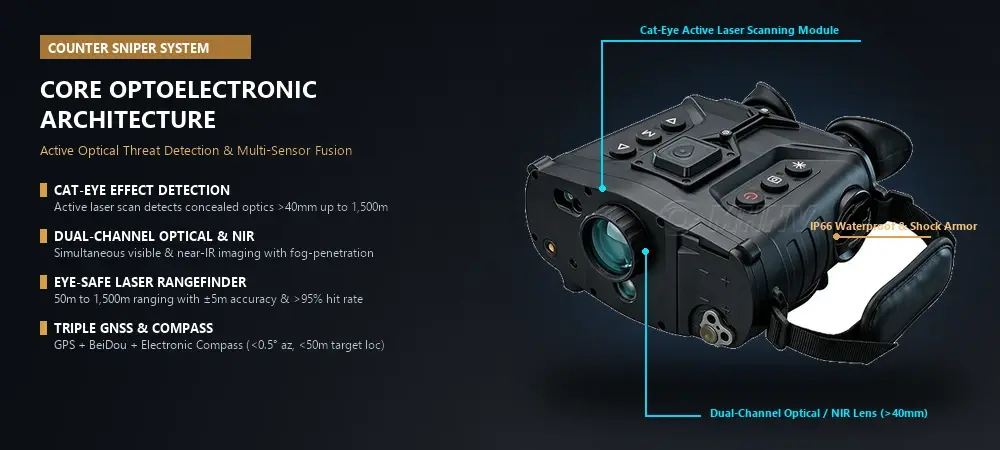
MHNV® has a technically dense product that meets most operational needs in a small, field-ready package, making it stand out among companies that make advanced optical-based sniper detection technology. These are the main things this gadget can do:
- Cat-Eye Effect Detection up to 1,500m — Active laser scanning finds retroreflective signatures from optical lenses bigger than 40mm in diameter at 100m to 1,500m, which lets you find hidden surveillance devices early, before a threat happens.
- Dual-Channel Imaging — Visible light and near-infrared imaging work together to support all-weather target search and recognition, keeping observations going even when there isn't much light or bad weather.
- Laser Rangefinder with ±5m Accuracy — An eye-safe laser measures objects from 50m to 1,500m away with ±5m accuracy and a hit rate of at least 95%. This gives accurate distance information for figuring out target coordinates without the need for a separate ranging device.
- Triple Positioning: GPS, BeiDou, and Electronic Compass — Multi-constellation GNSS plus electronic compass integration gives real-time self-positioning and target coordinate output with accuracy of less than 0.5° in angle and within 50 meters for target positioning.
- 1× to 8× Continuous Electronic Zoom — The wide-range magnification goes from 1× for wide-area scanning to 8× for close-up identification without having to change the lenses mechanically. This makes the job of the user easier when there are changing threats.
- Full-Color and Defogging Modes in Under 1 Second — Instant mode switching adapts to quickly changing visibility without stopping active target tracking, which is very important when the field is foggy, at dawn, or at dusk.
- WiFi Real-Time Video Transmission — The built-in WiFi sends live video to external devices at the same time that it records onboard, so you can watch from afar without needing extra gear or cables for transmission.
- 4-Hour Video and 10,000-Photo Onboard Storage — Large internal storage with USB export lets you keep longer records without an external camera or having to frequently dump data in the field.
- IP66 Protection in a 3.0kg Portable Body — The portable body weighs 3.0 kg and has IP66 protection. It is waterproof and dustproof, and its 225x180x90mm size means it can be used by hand or on a tripod in a variety of settings, from deserts to beaches.
With all of these features, the portable Counter Sniper System can handle the whole process from recognition to paperwork that military units, police tactical teams, and security experts need. One device gives operators both early warning recognition and accurate coordinate output, so they don't have to carry around a bunch of different tools.
How to Choose the Right Counter Sniper System Manufacturer
Matching Vendor Capabilities to Procurement Requirements
Application segmentation should be the first step in making decisions about this type of procurement. End users in the military put a high value on detection range, environmental robustness, and combining multiple sensors. Most of the time, law enforcement organizations stress portability, ease of training, and network interaction. Customization options, IP protection, and supply reliability are important to OEM integrators and security system developers. Once the buyer knows what the application profile is, they should use the following criteria to judge manufacturers:
- Accuracy of detection and rate of false alarms under public test settings
- Ratings for the environment (IP rating, working temperature range, shock protection)
- OEM and ODM customization options for firmware, optics, housing, and branding
- Following the rules for export licenses and keeping records of past trade compliance
- Structure for after-sales help, including warranty length, expert response time, and supply of spare parts
Each requirement is met by MHNV®, which has an ISO 9001:2015-certified production environment, follows CE/RoHS/FCC rules for both EU and US markets, and has a full-stack engineering team that can customize software, optical parameters, and mechanical case for OEM buyers.
Trends and Future Outlook in Counter Sniper System Technology
It's happening very quickly in the market for Counter Sniper System identification. AI-powered analytics now allow automatic danger classification, which makes it easier for operators to think clearly in high-stress situations. As dangers from both above and below come together on modern battlefields, sensor fusion between sniper detection and drone detection units is becoming an important thing to think about when buying new equipment.
Also becoming more popular are modular and mobile system designs. Platforms that can be placed on a vehicle, a tripod, or moved by hand without any hardware changes are becoming more and more popular. If manufacturers put money into modular architecture now, they will have an edge when it comes time to buy things again. This trend toward more flexible deployment is right in line with MHNV®'s small, multi-mode optical detection device, which weighs less than 3 kg and can be used either hand-held or on a tripod.
Conclusion
When choosing a manufacturer for a Counter Sniper System, you need to carefully weigh the company's technology, support infrastructure, and how easy it is to buy their products. Depending on where they are used, acoustic and optical monitoring methods have different strengths. MHNV® offers a highly advanced and field-tested optical sniper detection system that combines cat-eye detection, laser ranging, multi-constellation positioning, and real-time wireless communication in a body that weighs less than 3 kg. If B2B buyers and OEM integrators are looking for a reliable Chinese maker with clear compliance records and a lot of customization options, MHNV® is a strong choice that should be highly considered.
FAQ
What factors influence the accuracy of optical sniper detection systems?
The precision of detection relies on the frequency of the laser scanning, the diameter of the target lens, the weather, and the quality of the sensor calibration. The MHNV® device can find optical lenses bigger than 40mm from up to 1,500m away, with an accuracy of ±5m and a hit rate of ≥95% in normal weather.
Can this type of device integrate with existing surveillance infrastructure?
Yes, the built-in WiFi lets you watch live video on other devices, and the USB port lets you directly send data to other devices. Command software that can read NMEA-format positioning data can use coordinates from GPS and BeiDou.
What training and support does MHNV® provide after purchase?
For large B2B orders, MHNV® offers video tutorials, remote setup help, and training at the customer site. The maker offers a one-year guarantee on the whole device, and there is a pre-sales team available 24 hours a day, 7 days a week, in CN, EU, and US time zones.
What is the minimum order quantity for OEM procurement?
Pilot sales start at one unit for finished devices and ten units for picture intensifier tubes. If you want a discount for ordering more than ten units, you can ask for one.
Request a Tailored Quote from MHNV® — Your Trusted Counter Sniper System Supplier
MHNV® has been making night vision and optical recognition products for more than 12 years and can do full-stack OEM/ODM work with software, optics, and mechanical design. Our Counter Sniper System solutions are built for global B2B buyers who need reliability without sacrificing anything else. They are CE, RoHS, and FCC compliant. You can ask for a product demonstration, technical datasheet, or custom quote by going to mhnvnightvision.com or emailing sarah@mh-elec.com.
References
1. Jane's Defence Weekly — Acoustic and Optical Gunshot Detection Systems: Capability Assessment, 2023.
2. Defense Technical Information Center (DTIC) — Sniper Detection Technology Survey for Force Protection Applications, 2021.
3. International Defence Review (IDR), Jane's by S&P Global — Counter-Sniper Systems in Urban and Battlefield Environments, 2022.
4. RAND Corporation — Protecting Deployed Forces: Emerging Technologies for Threat Detection, 2020.
5. Military Technology Magazine (MILTECH) — Sensor Fusion Advances in Force Protection Equipment, 2023.
6. Small Arms Survey, Graduate Institute Geneva — Precision Threat Detection: Trends in Anti-Sniper Technology Deployment, 2022.
YOU MAY LIKE