Gen 2 Image Intensifier Benefits for Security and Defense
When procurement teams evaluate night vision solutions for security and defense contracts, the Gen 2 image intensifier consistently emerges as a technically sound, cost-balanced choice. It delivers real operational value — passive surveillance without an IR signature, sharp imagery in near-total darkness, and a robust form factor that survives field punishment. This article breaks down why Gen 2 intensifier technology remains a procurement staple across military units, law enforcement agencies, and border security operators worldwide, and what distinguishes a Grade A tube from a mediocre one.
Understanding Gen 2 Image Intensifier Technology
How the MCP Changed Everything
Adding the Microchannel Plate (MCP) was the big step forward in Gen 2 Image Intensifier technology. This glass disk, which has millions of tiny electron-multiplying channels, fixed the problems with Gen 1 devices' low edge resolution and distorted shapes. The end result is a small, passive package that boosts brightness by up to 30,000 times. Operators can't be seen by infrared sensors, which is a key military edge in crowded areas.
The Na2KSb(Cs) Photocathode Advantage
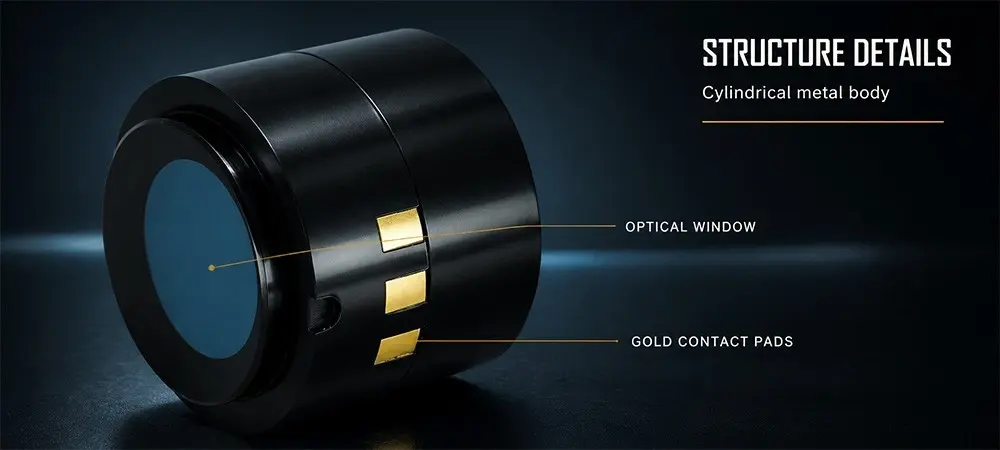
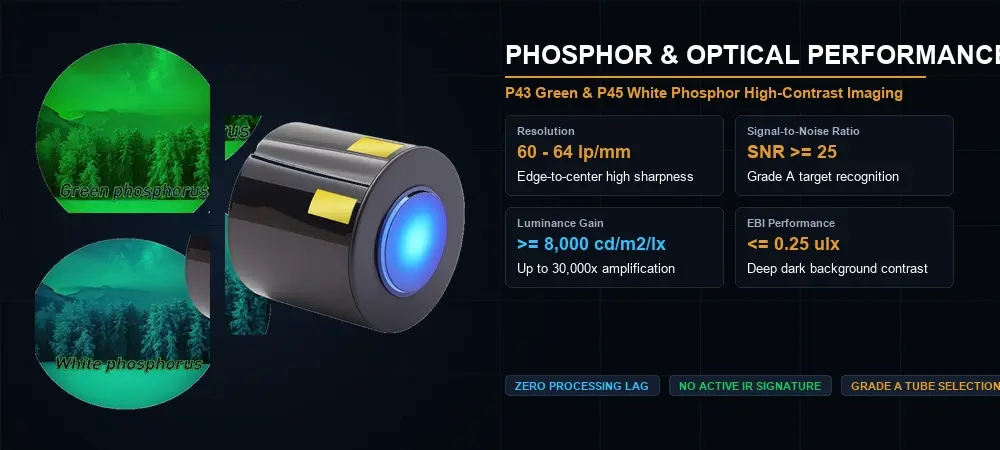
It has a useful width of at least 17.5 mm and luminous sensitivity choices of 550, 650, or 750 μA/lm (Grade A). It is built around a Na2KSb(Cs) multi-alkali photocathode. When you mix the AVG glass input window with P43/P45 phosphor powder, you get a resolution of 60–64 lp/mm and an SNR of 25. The luminance rise is more than 8,000 cd/m²/lx, and the EBI stays at ≤0.25 μlx. This makes the background really dark, which makes targets stand out clearly.
The tube works in temperatures ranging from -45°C to +55°C and can be stored safely between -55°C and +70°C. With a total weight of only 75 grams and an input voltage range of 2.2 to 3.4V, it fits easily into helmet-mounted goggles, weapon sights, and vehicle-mount systems, so neither the user nor the platform has to do any extra work.
Comparing Gen 2 Image Intensifiers with Other Technologies
To pick the best night vision technology, you need to be honest about how well it works, how much it costs, and how well it fits your needs. Compare Image Intensifier Tube technology to other platforms in this way:
- Gen 2 vs. Gen 1: The Gen 1 tubes have problems like fisheye distortion, low edge resolution, and the need for active IR illuminators. The Gen 2 Image Intensifier tubes don't have these problems. Gen 2 Image Intensifiers get rid of distortion through MCP electron multiplication, provide constant edge-to-center sharpness at 64 lp/mm, and work quietly in starlight, which is a huge benefit for secret operations.
- Gen 2 vs. Gen 3: Gen 3 tubes have a GaAs photocathode that converts photons more efficiently, which makes them better in almost complete darkness. Gen 3 products, on the other hand, cost a lot more per unit and are harder to ship. Gen 2 Image Intensifier performance often meets the need without the extra cost in situations where lighting conditions are predictable, and budgets are limited.
- Gen 2 vs. Digital Night Vision: Digital devices can record video and stream wirelessly, but they have delay and need active lighting when it's really dark outside. Gen 2 Image Intensifier tubes react instantly and have no processing lag, which is very important when even a half-second delay is not acceptable.
- Gen 2 vs. Thermal Imaging: Thermal cameras are very good at finding heat signatures even when there are things in the way, like smoke or fog. A Gen 2 Image Intensifier can make more realistic textures in faces and environments than these do. Many more advanced systems now mix both channels, and MHNV®'s own image-fusion algorithm does the same thing with low-light and LWIR thermal data in a single goggle line.
These differences help procurement managers choose technologies that are in line with operational policy and budget cycles, instead of chasing after specifications that go beyond what the mission needs.
Procurement Considerations for Gen 2 Image Intensifiers
To get image intensifier tubes for government or police work, you need more than just the best price. Total cost of ownership is affected by things like supplier qualification, technical traceability, and logistics reliability. Each MHNV® Gen 2 Image Intensifier tube comes with a numbered QC data sheet that lists the SNR, FOM, resolution, halo width, and EBI that were all tested one by one in an ISO 9001:2015-compliant Class-10,000 cleanroom.
Before agreeing to a bulk deal, buying officers should make sure that the following are true about the supplier:
- Compliance documentation: CE, RoHS, and MIL-STD-810 outdoor grades (shock, vibration, humidity, and altitude) show that the tube can handle conditions in the field and get through customs in the EU and US.
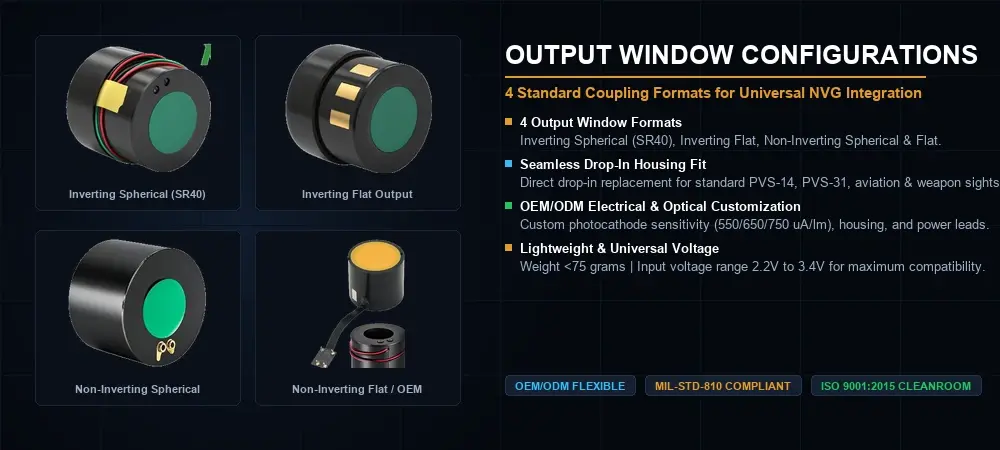
- OEM/ODM flexibility: When it comes to OEM/ODM options, MHNV® lets you change the photocathode sensitivity level, the output window style (inverting spherical SR40, inverting flat, non-inverting spherical SR40, or non-inverting flat), the phosphor type (P43 green or P45 white), the housing, the software, and the packaging.
- Logistics architecture: The framework deals with DHL, FedEx, UPS, and EMS, allowing for shipping anywhere in the world in 5 to 8 days. Transit centers in Rotterdam and Los Angeles (via 3PL) speed up the processing of repeat bulk orders. We take care of all the export paperwork in-house, including the Commercial Invoice, Packing List, CO/CE/RoHS, and more.
At MHNV®, talks for bulk purchases start at 10 pieces for IIT and go up from there. Volume discount grids can be found upon request. MOQ for finished night vision gear starts at one unit for testing purposes.
Application Scenarios and Case Studies in Security and Defense
Image Intensifier Tubes work in three different areas that are functionally separate from each other. Each area puts different demands on the tube.
For close-quarters actions in cities, tactical defense and police teams put Gen 2 Image Intensifier tubes in NVGs and weapon sights. The MCP blocks the bright light from streetlamps that is too much for Gen 1 devices, and the auto-gating supply module, which is built right into the MHNV® tube assembly, keeps the photocathode safe as users move from dark to light areas. During that transition, the resolution stays the same, which has a direct effect on how accurately shots are hit and how aware you are of your surroundings.
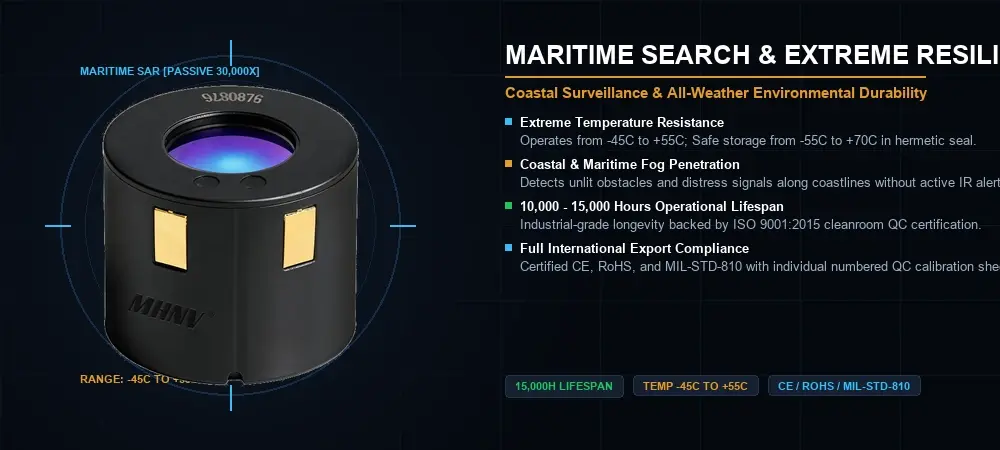
Passive Gen 2 Image Intensifier night vision is used by maritime search and rescue teams to find unlit objects in the dark along the coast without sending out an active infrared signal that would alert other ships. Because it can work in temperatures ranging from -45°C to +55°C, it stays effective in both cold North Atlantic waters and hot Gulf waters.
Gen 2 Image Intensifier tubes' high-gain, low-lag imaging is used by scientists and engineers, such as ballistics experts and fluorescence microscopists, to see low-photon-emission events that digital devices miss. The highest brightness (4–8 cd/m²) and luminance gain (≥8,000 cd/m²/lx) allow for low-level photon capture without overworking the detector.
With proper care, tubes can last up to 10,000 to 15,000 operational hours in these situations. When testing in daylight, users should cover the objective with a pinhole lens to keep the photocathode from burning in. Devices should also be stored within the −55°C to +70°C range to maintain vacuum integrity.
How to Choose the Right Gen 2 Image Intensifier for Your Security and Defense Needs
To choose the right tube grade, you must first look at the SNR. An SNR of 25 with 64 lp/mm resolution and EBI ≤0.25 μlx (MHNV® Grade A) is good for high-priority surveillance, border security, and target recognition tasks that need very clear images. The SNR 20/60 lp/mm setup is good for backup platforms or training, where saving money is more important than peak performance.
Also, suppliers must be able to handle the way the host device wants the output window to be set up. MHNV® has all four formats—inverting spherical, inverting flat, non-inverting spherical, and non-inverting flat—so they can be easily dropped into current goggle and weapon sight housings. Warranty terms, a free IIT benchmarking service, and technical support 24 hours a day before the sale all lower the risk of buying for both first-time and repeat buyers.
Conclusion
In the security and defense supply chain, Gen 2 Image Intensifier technology has a clear and long-lasting place. The MCP-driven passive amplification, Grade A photocathode sensitivity, sub-0.25 μlx EBI performance, and < 75 g lightweight design work together to give procurement teams a technically sound, export-compliant option that can be used for everything from single unit tests to full-container OEM production runs. Every tube from MHNV® comes with a serialized calibration record, a MIL-STD-810 environmental rating, and a global logistics network that was designed to meet the needs of defense procurement timelines.
FAQ
1. How long does a Gen 2 image intensifier tube last under field conditions?
When used within the recommended limits, professional-grade tubes last between 10,000 and 15,000 hours. The two most important upkeep tasks for extending the device's life are keeping it out of direct sunlight for long periods of time and keeping it within the recommended temperature range.
2. What is the difference between Gen 2 and Gen 2+?
Gen 2+ has a better photocathode formula and higher-grade MCP, which makes it work better in almost total darkness and with a higher SNR. MHNV®'s Gen 2+ tubes hit SNR 25 at 64 lp/mm, which is something that regular Gen 2 Image Intensifier tubes can't do.
3. Does the tube require an IR illuminator?
When the moon or stars are out, the Gen 2 Image Intensifier works without doing anything. An IR illuminator should only be used in places with no natural light, like dark basements, sealed rooms, or places with a lot of clouds.
4. How does auto-gating protect the tube?
When outdoor light levels rise, the built-in auto-gating supply module changes the photocathode voltage automatically. This keeps the picture quality stable during changes from dark to light, stops burn-in, and saves the user's adapted vision.
5. What output window configurations are available?
There are four types of MHNV® Gen 2+ tubes that come in the box: inverting spherical (SR40), inverting flat, non-inverting spherical (SR40), and non-inverting flat. These meet all the standard NVG and weapon sight coupling needs.
Partner with MHNV® — Your Trusted Gen 2 Image Intensifier Supplier
MHNV® sells Gen 2 Image Intensifier tubes that are made to MIL-STD-810 standards, are measured for each order, and come with full QC data sheets. Our team gets back to you within 24 hours, whether you need a test batch or a full OEM production run. Email Sarah at sarah@mh-elec.com to get a volume quote, tube sample, or custom specification sheet right away.
References
1. Holst, G. C. Electro-Optical Imaging System Performance. SPIE Press, 2008.
2. Driggers, R. G., Vollmerhausen, R. H., & Devitt, N. Infrared Detectors and Emitters: Materials and Devices. Springer, 2001.
3. NATO Standardization Office. STANAG 4461: Night Vision Goggle Performance Requirements. NATO, 2012.
4. U.S. Army Night Vision and Electronic Sensors Directorate. Night Vision Technology Program Overview. NVESD Technical Report, 2015.
5. Bhattacharya, P., & Fornari, R. Comprehensive Semiconductor Science and Technology. Elsevier, 2011.
6. Jane's Defence Equipment & Technology. Electro-Optical Systems Annual Review. IHS Jane's, 2019.
YOU MAY LIKE